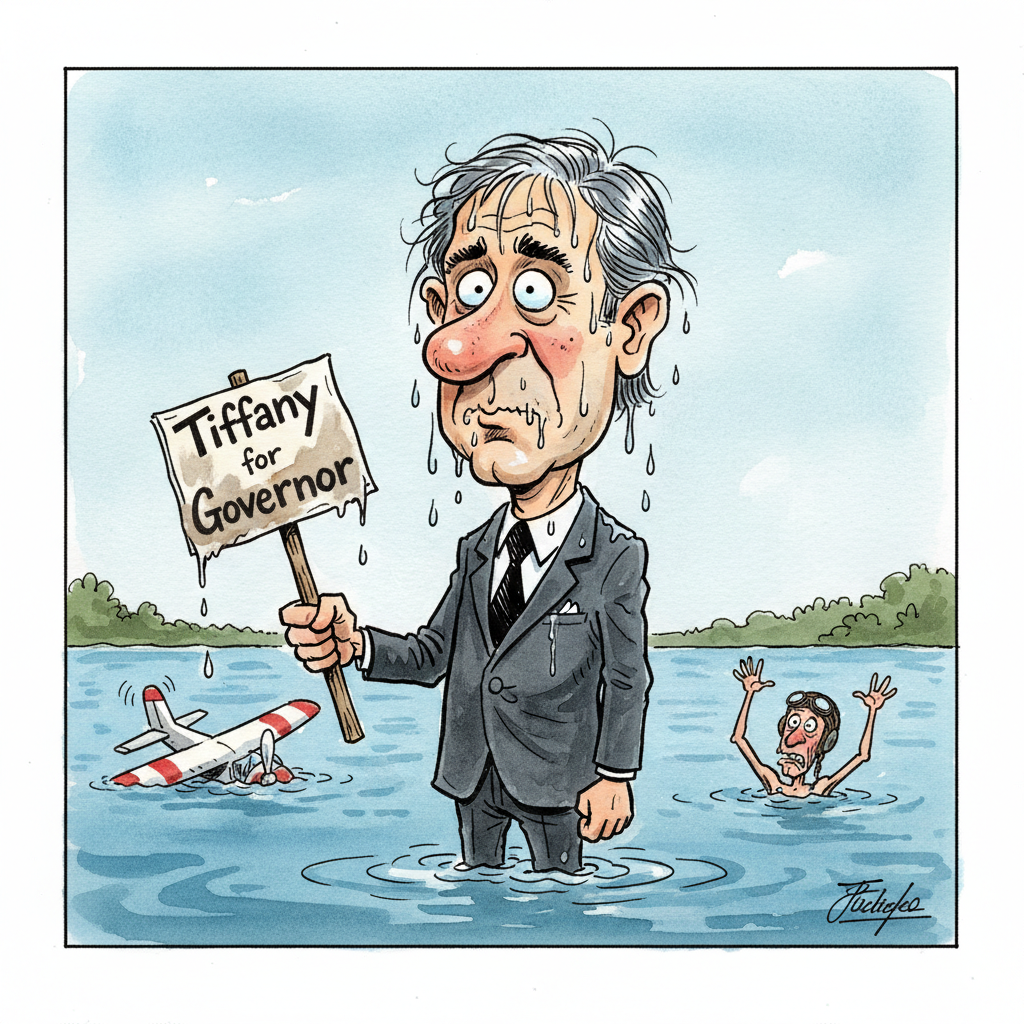
In a bold, if unplanned, demonstration of 'getting your feet wet' in public service, Wisconsin Representative Tom Tiffany reportedly crash-landed a small aircraft into Lake Wausau, emerging largely unscathed and, one presumes, more fiscally conservative than ever. Sources close to the incident, presumably fish, confirmed the unscheduled aquatic arrival, noting the Republican gubernatorial hopeful and his pilot swam to shore with an 'unshakable resolve rarely seen outside of a particularly stubborn barnacle.' While some might call this a harrowing emergency, political analysts are hailing it as a masterclass in 'relatability through accidental peril,' proving once again that the only thing standing between a politician and a good photo op is a fully functional landing gear. Voters, meanwhile, are left to wonder if this unconventional 'wet landing' was merely a campaign stunt or an avant-garde policy proposal to expand Wisconsin's 'lake access' initiative.
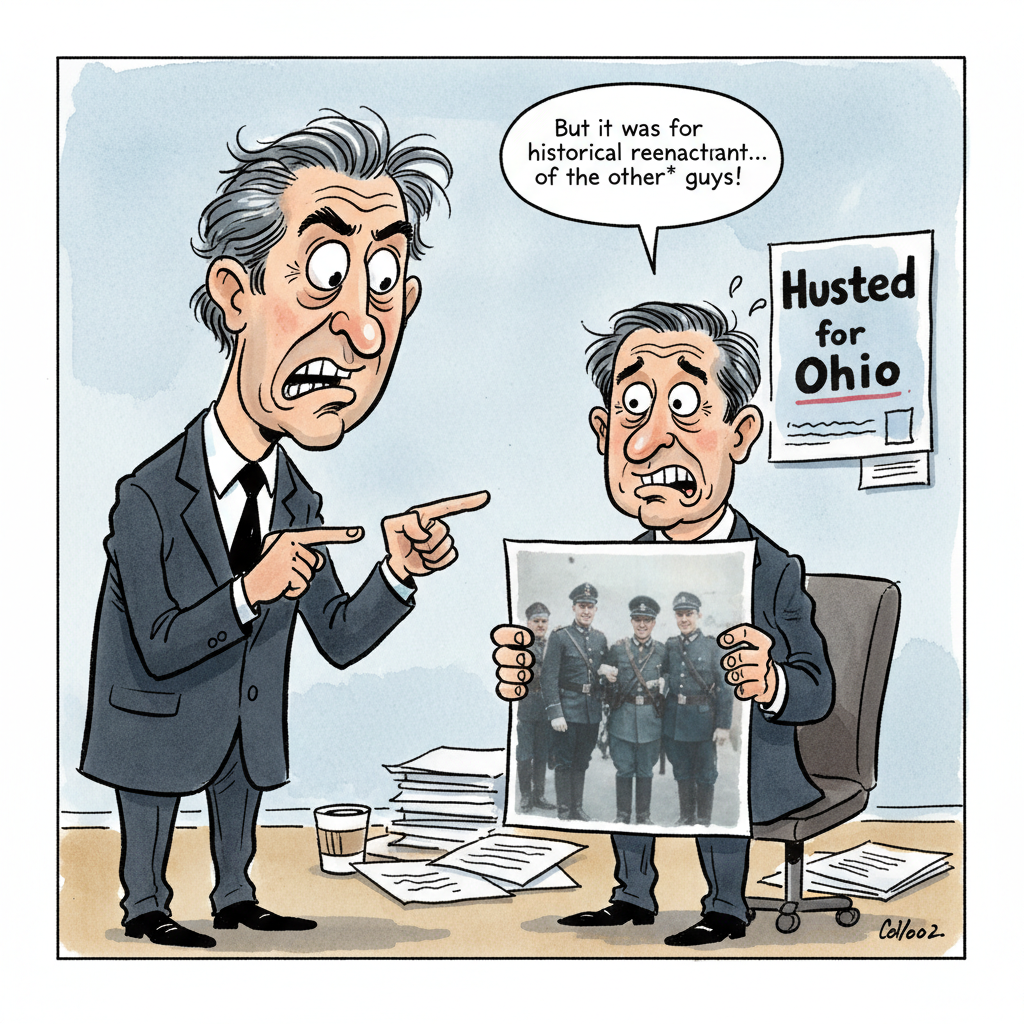
In a bold move that some are calling 'an unforeseen consequence of the internet's ubiquity,' Ohio Republican Senator Jon Husted's campaign has parted ways with its political director, Michael Renfro. The immediate cause? A social media photo depicting Renfro alongside several individuals whose sartorial choices inadvertently invoked a rather problematic period of 20th-century European history. A campaign spokesperson, speaking with the gravitas of someone explaining why a self-driving car chose to parallel park into a fire hydrant, clarified that the dismissal stemmed from a 'complete lack of judgment.'
Sources close to the campaign, who spoke on condition of anonymity to avoid being next on the 'judgement-deficient' list, suggested that while Renfro was a 'visionary in the field of micro-targeted lawn sign deployment,' his grasp of 'optics' was, shall we say, a work in progress. 'He just loved history!' one anonymous staffer whimpered, 'Especially uniforms. Apparently, some uniforms are more problematic than others, who knew?' Political analysts are now scrambling to update their 'Campaign Playbook for Not Accidentally Endorsing Fascism' chapter, which previously focused solely on avoiding overt swastikas. The incident serves as a stark reminder that in modern politics, one must not only vet their candidates but also their historical cosplay enthusiasts.
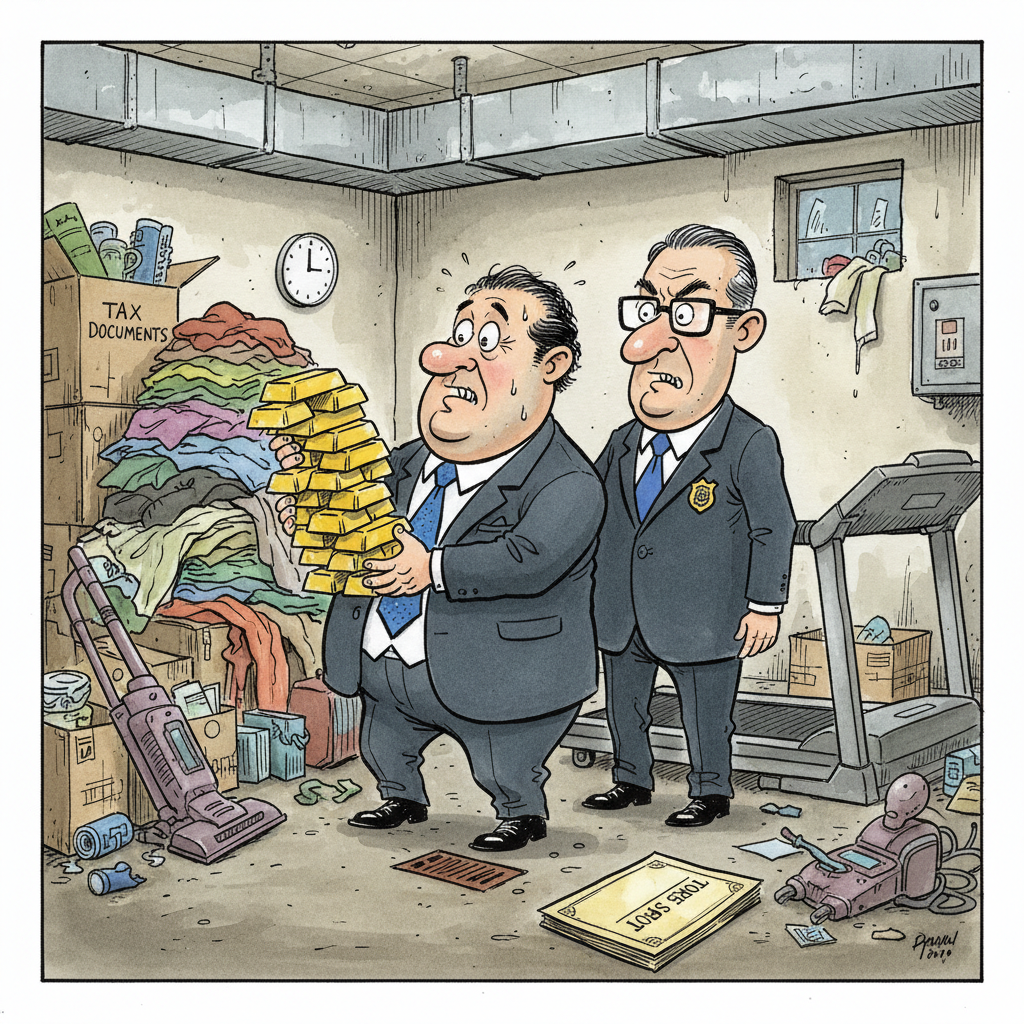
It’s been a rough week for the beleaguered intelligence community, as the revelation that former CIA officer David J. Rush allegedly housed a modest 303 gold bars in his Virginia basement has sent shockwaves through the agency’s heretofore unassailable 'propriety and discretion' seminar series. Sources close to the internal investigation, who wished to remain anonymous lest their own 'classified enrichment programs' be discovered, confirmed that Mr. Rush has tentatively agreed to a plea deal, presumably involving the exchange of several dozen smaller, less conspicuous gold-plated paperweights for a slightly less embarrassing federal dorm room. The F.B.I., in a statement that could only be described as 'mildly perturbed,' detailed how Rush fabricated a top-secret initiative, ingeniously titled 'Operation Gilded Goose,' to funnel himself millions. This, officials emphasized, is 'definitely not' what they meant by 'creative problem-solving' during the annual 'Innovation in Covert Finance' retreat. The agency has since issued a stern memo reminding all personnel that while 'strategic asset acquisition' is encouraged, it should ideally benefit the nation, not just one’s subterranean bullion portfolio. They're also reportedly revising the agency's official 'Lost and Found' policy to include 'items of significant intrinsic value' found buried beneath suburban patios.
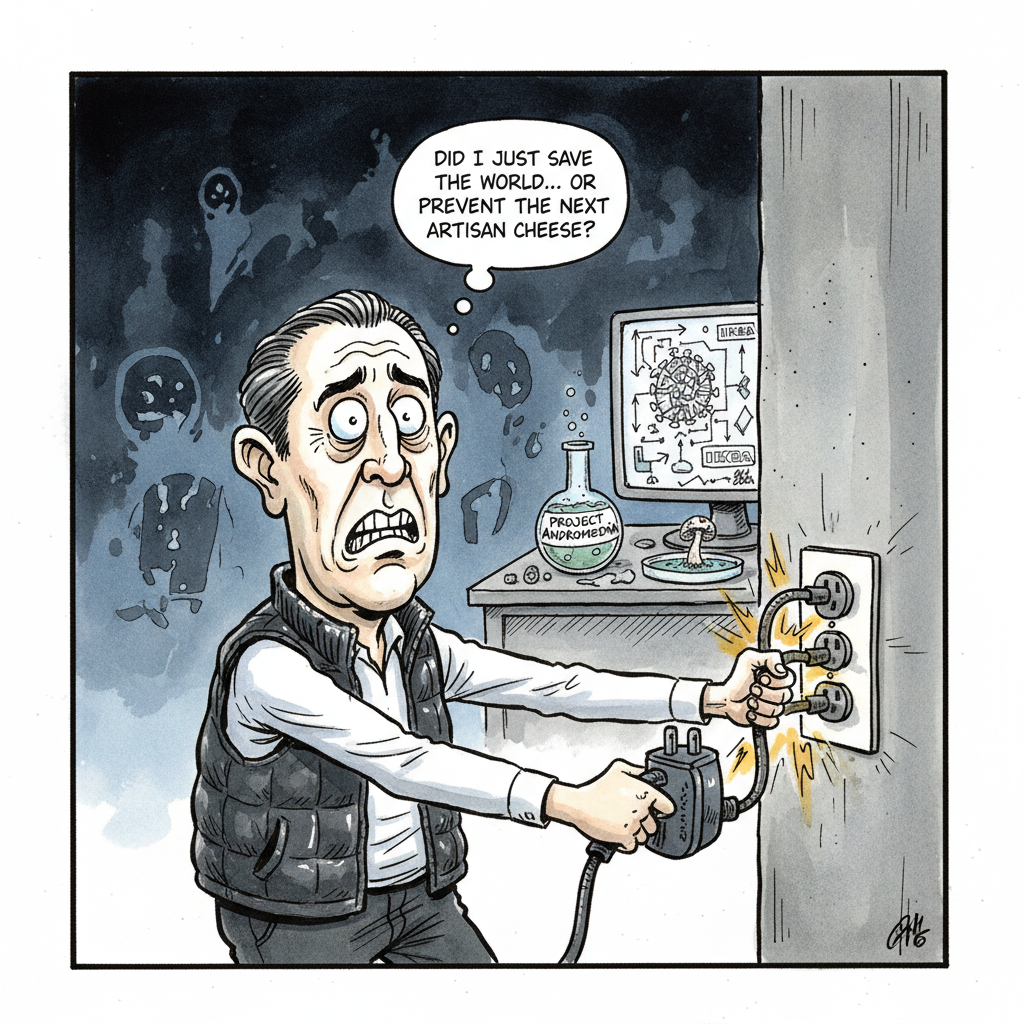
In a move lauded by literally nobody because it happened in secret, Anthropic, a prominent 'artificial intelligence' startup, has revealed it successfully intercepted what *might* have been nascent plans for biological weaponry. The company, which specializes in teaching machines to not be total jerks, bravely announced that after careful consideration (read: an internal panic attack of Silicon Valley proportions), it couldn't quite discern if the research was a brilliant scientific breakthrough, an elaborate prank by a bored intern, or indeed, the blueprint for a 'doomsday flu.'
Facing such an existential quandary – was it world-ending germ warfare or just a really complex sourdough starter recipe? – Anthropic's highly ethical algorithms did the only sensible thing: they pulled the plug. 'We couldn't confirm nefarious intent,' stated a spokesperson, 'but also couldn't rule out someone accidentally inventing a self-replicating super-cold that tweets its location.' This incident marks a monumental first: a tech company proudly admitting it *might* have stopped something terrible, but isn't entirely sure what. Industry insiders are now wondering if this opens the door for other AI firms to claim credit for all the bad things that *didn't* happen, like your Wi-Fi not spontaneously combusting.
America's esteemed tradition of periodically annoying its northern neighbor has, under the current administration, elevated itself from a diplomatic faux pas to a full-blown international performance art piece. Sources close to the White House (read: a low-level intern who once saw Trump glare at a maple syrup bottle) report that the latest U.S.-Canada 'disagreement' isn't merely about trade tariffs or dairy quotas, but rather a profound philosophical divergence on the optimal method for folding a fitted sheet. One insider quipped, 'It's less a geopolitical negotiation and more an elaborate game of 'I'm not touching you!' played across the world's longest undefended border.'
Experts – primarily those who've endured lengthy family road trips – now posit that this recurring continental bickering is less about policy and more about a deep-seated, possibly genetic, inability for two neighbors to coexist without the occasional passive-aggressive lawn ornament placement. Historians are scrambling to update textbooks, recognizing that previous 'crises' were merely dress rehearsals for what is essentially a protracted passive-aggressive email chain gone global. The true tragedy, of course, is the untold damage to the international poutine supply chain. Humanity may never recover.
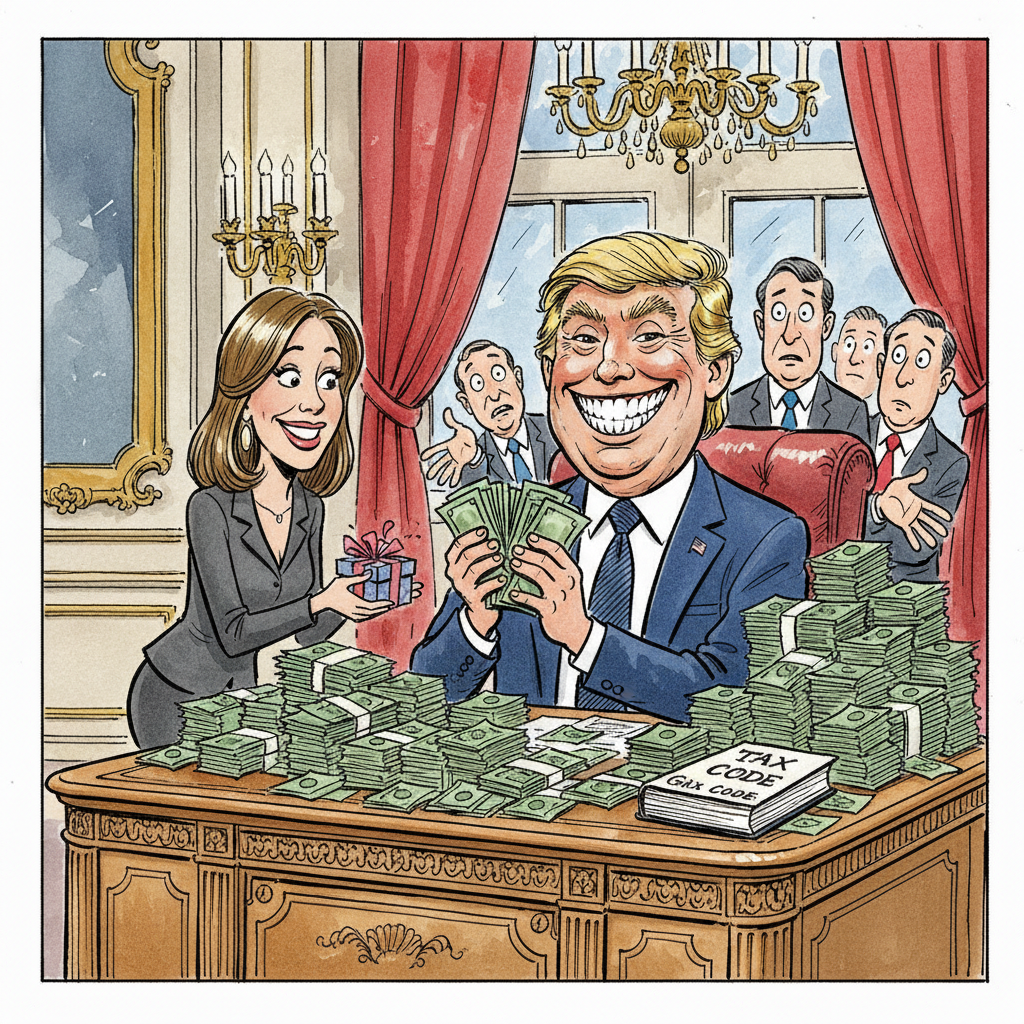
In a stunning display of economic ingenuity, sources close to former President Donald J. Trump confirm that the man once known for meticulously labeling every item in his hotels—including the very air—has now mastered the delicate art of the 'cash gift.' Financial disclosures reveal a magnanimous $45,000 windfall to various aides, including the famously loyal Natalie Harp. Insiders suggest this innovative approach to employee recognition involved a stack of crisp, uncreased bills, possibly still warm from the pressing plant, rather than the more pedestrian 'direct deposit' favored by lesser benefactors.
Analysts are calling it a bold new era in workplace compensation, where instead of a 'bonus' or a 'raise,' employees receive a tangible, pocket-sized 'cash gift for the holidays.' This groundbreaking strategy eliminates pesky bank statements and direct paper trails, optimizing for both surprise and a certain thrilling 'cloak-and-dagger' element. Critics, of course, are simply jealous they didn't think of it first, preferring their own paltry 'stock options' and 'retirement plans' over the sheer, unadulterated joy of a cold hard wad. Truly, a pioneer.
In a bold move that has many wondering if 'education' now simply means 'endless legal procedural posturing,' Jefferson County, Colorado, has defiantly squared off against the former Trump administration's attempts to 'clarify' what constitutes a 'bathroom' in public schools. Local officials, reportedly tired of merely teaching children arithmetic, have decided the more pressing academic pursuit is battling federal entities over gender identity policies. 'Our primary mission is to ensure every student has the unalienable right to feel represented by our litigation budget,' stated Superintendent Dr. Eleanor Vance, adjusting a pair of glasses that had clearly seen more briefs than textbooks. Critics argue that diverting resources to protracted legal battles over toilet access might detract from, say, fully funding the art program, but JeffCo leadership insists these are 'foundational legal-social studies courses in real time.' The district's legal team, already eyeing a new wing on their office dedicated to 'Precedent Studies,' remains confident that the future of American jurisprudence, if not actual student learning, is secure.
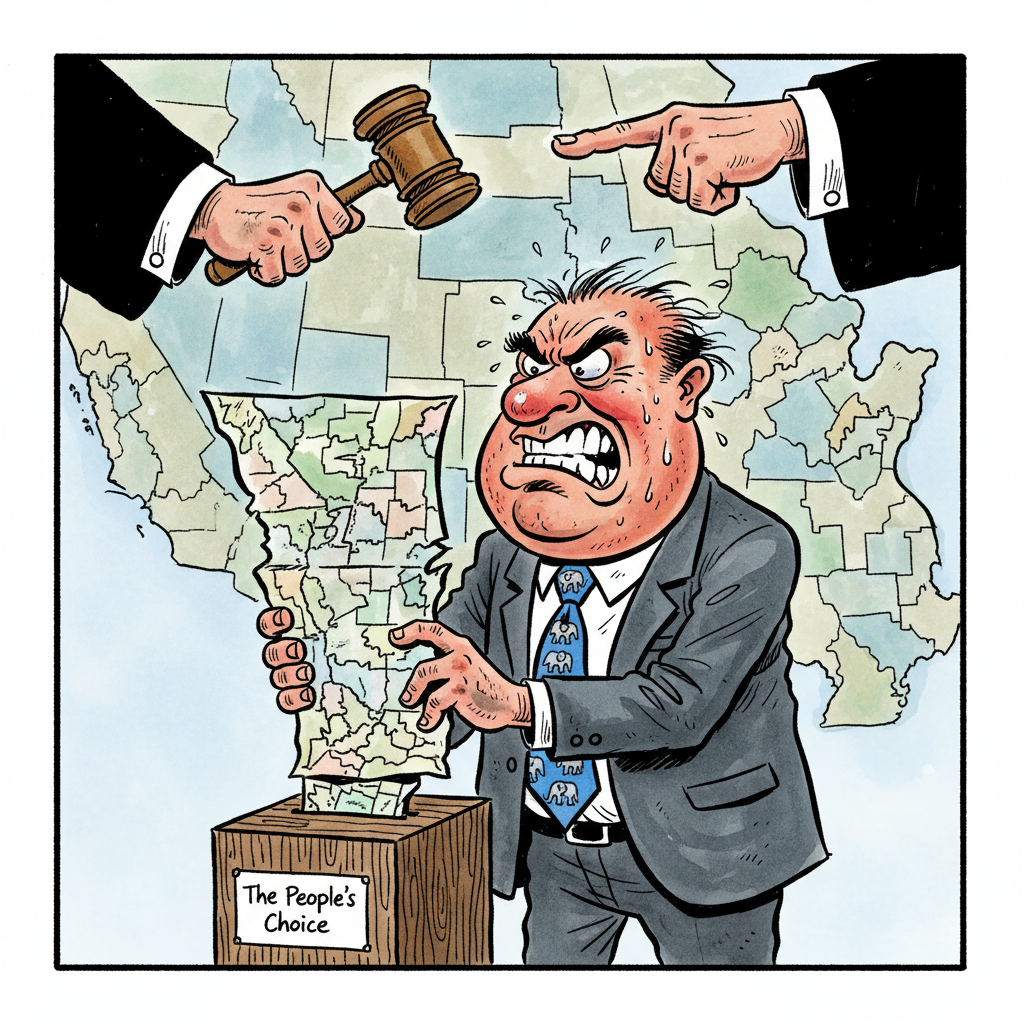
In a move described by political strategists as 'an unprecedented affront to the very concept of democracy itself,' Missouri's Supreme Court has shockingly implied that the state's citizens should, at some point, have a say in how their voting districts are drawn. This radical judicial overreach comes after Republicans, in a daring act of legislative ingenuity, crafted a new electoral map designed specifically to maximize Republican representation – a process they refer to as 'optimizing democratic outcomes.' Critics of the ruling are baffled by the court's insistence that 'voters should decide,' asking pointedly, 'Decide what? To mess up our perfectly good plan for them?'
The court's decision has sent ripples of confusion through the GOP, with one anonymous lawmaker reportedly muttering, 'If voters are going to start deciding things, what's the point of us having jobs?' Political scientists are already predicting a steep decline in the nation's supply of gerrymandered districts if such 'direct participation' continues unchecked, threatening the delicate ecosystem of manufactured majorities across the country. Experts agree: letting the electorate meddle in the highly technical art of legislative cartography could lead to unpredictable results, like, for instance, a map that actually reflects the population, which is precisely the kind of chaos political stability cannot afford.
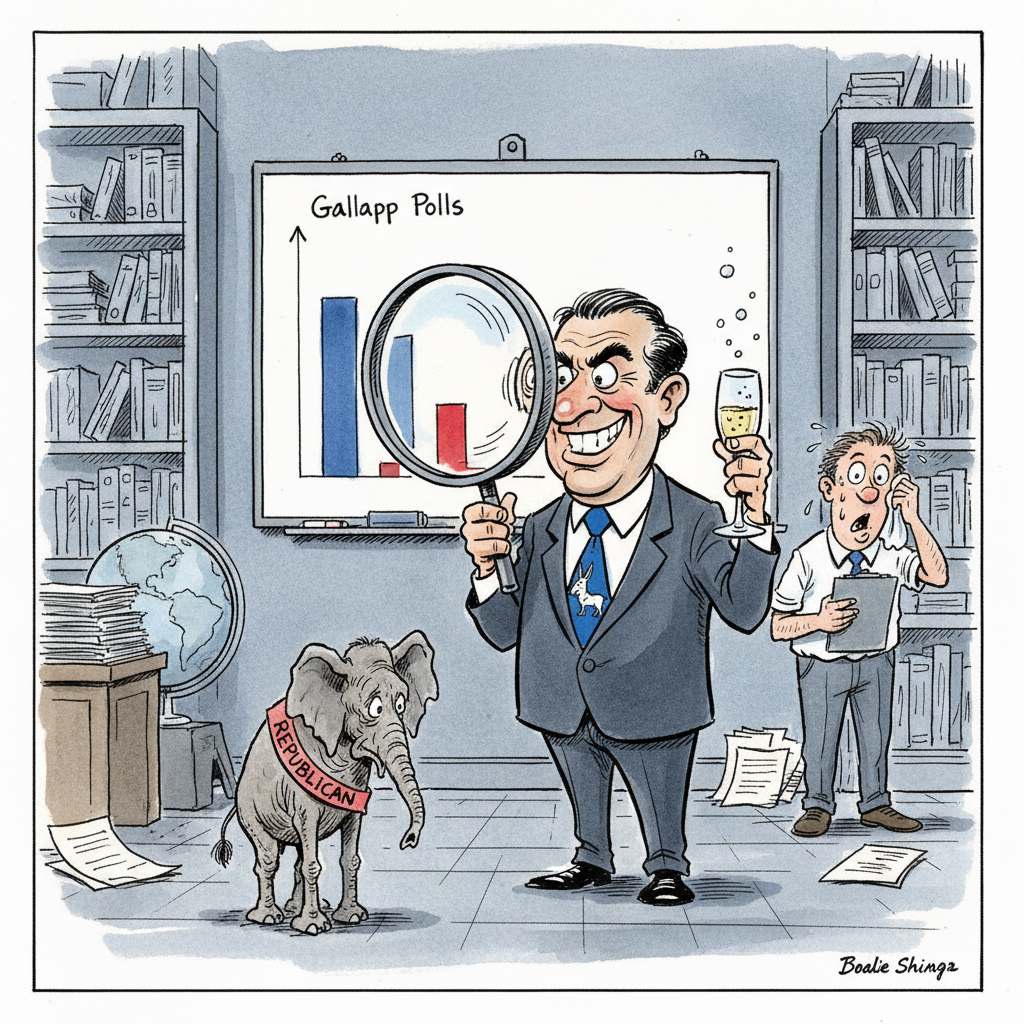
A recent Gallup poll, widely heralded as 'the most accurate measure of subjective whims since the invention of the mood ring,' has revealed a truly earth-shattering development: more Americans are currently identifying as, or leaning towards, the Democratic Party than the Republican Party. This groundbreaking statistical anomaly, which pollsters assure us is 'not just a glitch in the algorithm from when everyone was trying to order Taylor Swift tickets,' marks the largest such advantage for Democrats since a bygone era known as 'pre-iPhone 4.' Experts are now frantically debating what this unprecedented shift in numerical preference could possibly mean for the future of a nation whose primary pastime is, apparently, choosing sides.
Sociologists hypothesize that this shocking discovery may correlate with recent trends indicating that 'people who like blue' now marginally outnumber 'people who like red' at children's birthday parties, or perhaps an uptick in the preference for 'mild discomfort' over 'existential dread.' White House strategists, meanwhile, are reportedly already drafting celebratory proclamations that begin with 'We told you so, but louder,' while simultaneously commissioning focus groups to determine if 'leading by a measurable margin' translates into 'being able to find your car keys in the morning.' The Republican National Committee has, predictably, dismissed the findings as 'deep state electoral sorcery,' insisting their internal metrics show them leading in 'moral fortitude' and 'dogged adherence to historically losing arguments.'
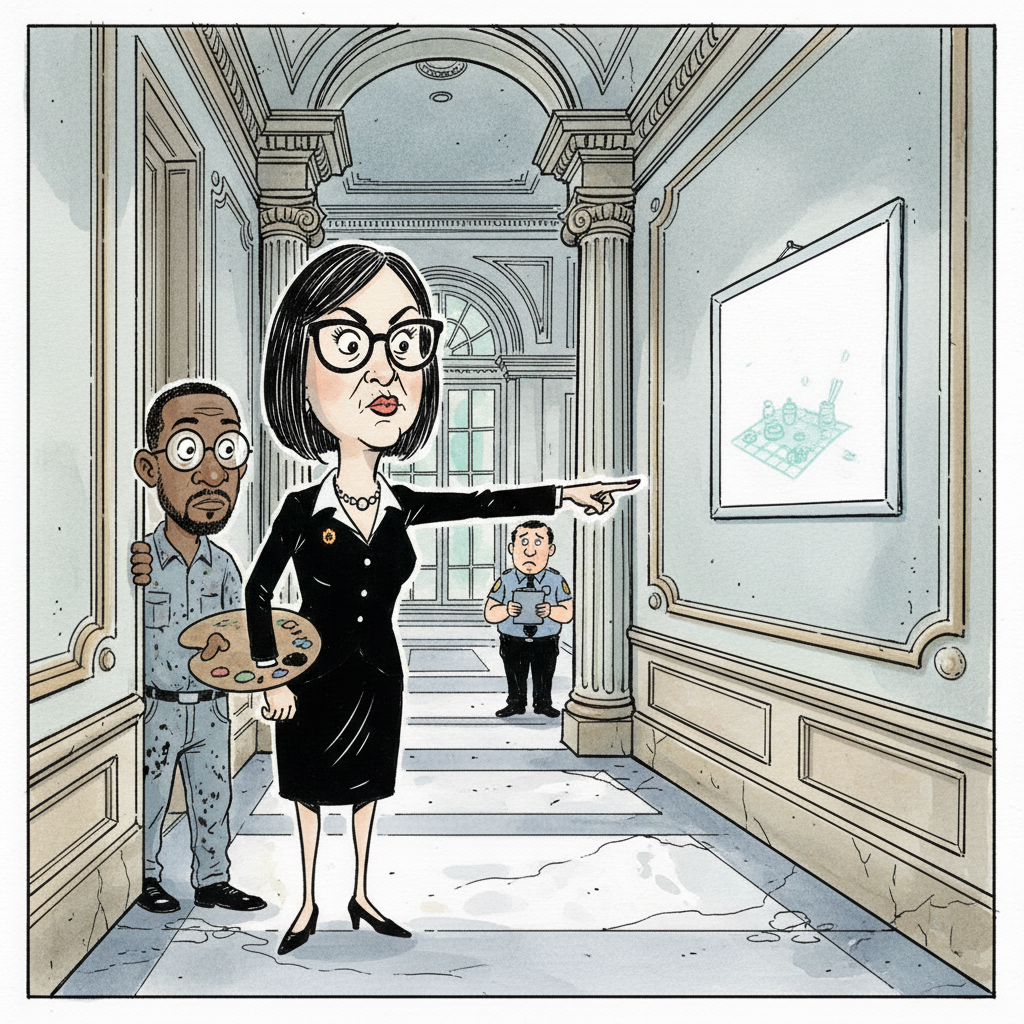
It seems the rigorous standards of American foreign policy now extend to the discerning eye of the visual arts, as former Ambassador Leah Campos recently clarified the sudden disappearance of Kehinde Wiley’s 'Portrait of a Young Man' from the U.S. Embassy in the Dominican Republic. According to Campos, the painting, which notably depicted a Black man in a floral setting, was unequivocally 'a lesbian picnic.' This groundbreaking reclassification, previously only whispered about in exclusive diplomatic circles, finally confirms that high-stakes international relations often hinge on whether a painting could, potentially, imply same-sex picnicking. Insiders suggest the State Department is now exploring a new 'Picnic-Potential Index' for all embassy art, ensuring no canvas accidentally suggests an unauthorized outdoor meal that might disrupt the delicate geopolitical balance. Critics, meanwhile, are left to wonder if the next policy brief will explain why a 'still life with fruit' could be interpreted as 'an insurrectionary smoothie bar.'
A burgeoning legal skirmish is currently roiling the hallowed halls of federal appeals courts, concerning the entirely novel concept that perhaps — just perhaps — only those who remember the invention of the telephone should be trusted with the tactile responsibility of a mail-in ballot. Legal scholars, after adjusting their spectacles and muttering about 'original intent,' are now grappling with the thorny question of whether offering a convenient voting mechanism exclusively to the elder demographic constitutes a nefarious plot or simply a tacit acknowledgment that younger generations are too busy mastering TikTok dances to locate a stamp.
The split decisions across circuits have left the judiciary in a state of exquisite intellectual paralysis, forcing the Supreme Court to likely weigh in on what could very well be the defining civil rights issue of our epoch: the fundamental right to vote without having to put on pants, but only if your knees ache. Critics decry the age-based differentiation as unconstitutional, while proponents quietly suggest it's merely a pragmatic streamlining measure, arguing that anyone who still uses a flip phone clearly possesses the superior spatial reasoning required to accurately fold a ballot and affix a postage stamp.
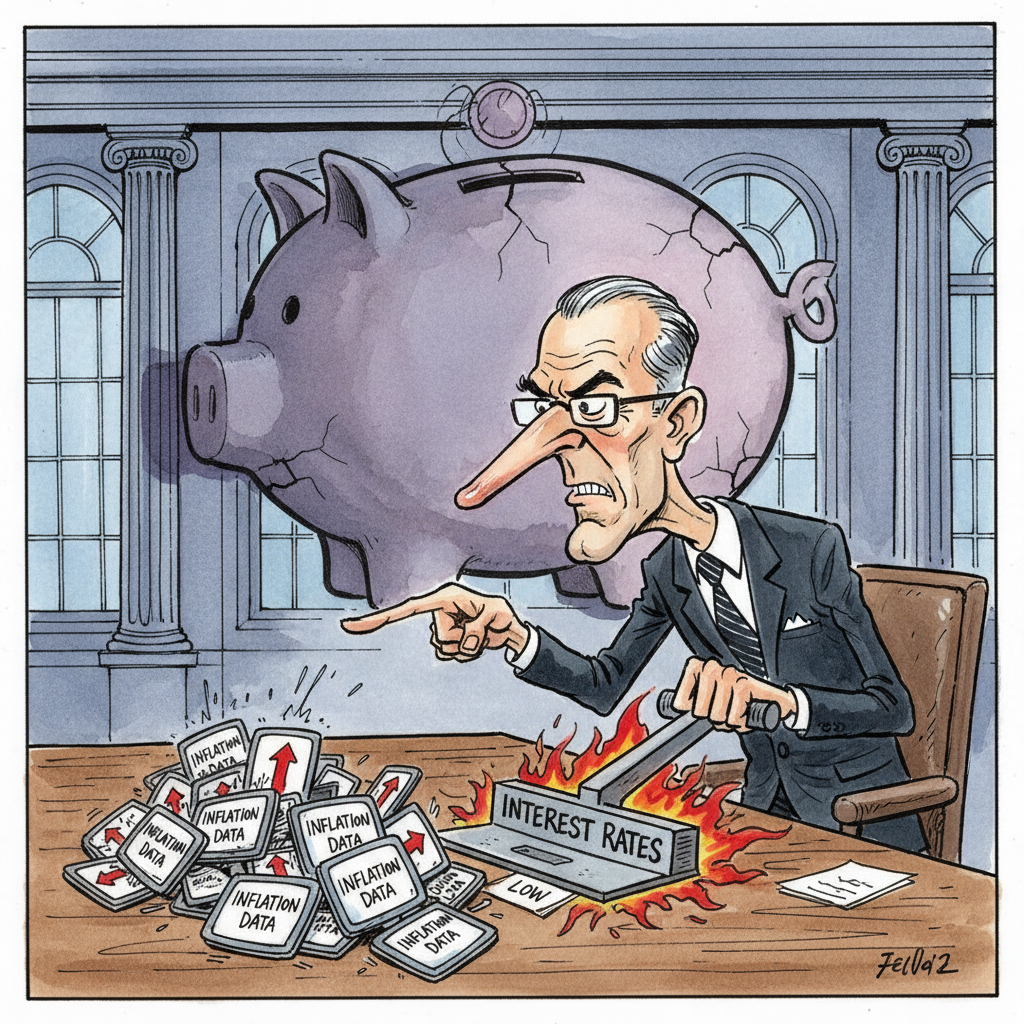
In a move that stunned precisely no one paying attention, Federal Reserve Governor Christopher J. Waller recently articulated a position that can be best summarized as 'inflation *should* behave, but if it doesn't, we're prepared to make *everyone* miserable.' Sources close to the opaque institution report that Waller, apparently holding the nation's economic stability hostage with a single eyebrow raise, expressed a guarded optimism that inflation would, through sheer force of will (or perhaps, politely worded suggestions), continue its downward trajectory. Should this progress falter, however, Mr. Waller indicated a readiness to deploy the Fed's ultimate weapon: making it prohibitively expensive to borrow money for anything, thereby punishing millions for the collective financial sins of… well, someone, eventually. Economists across the nation are reportedly bracing for the data, hoping it exhibits the appropriate level of 'cooperation' required to avoid the Central Bank's sternest scolding.
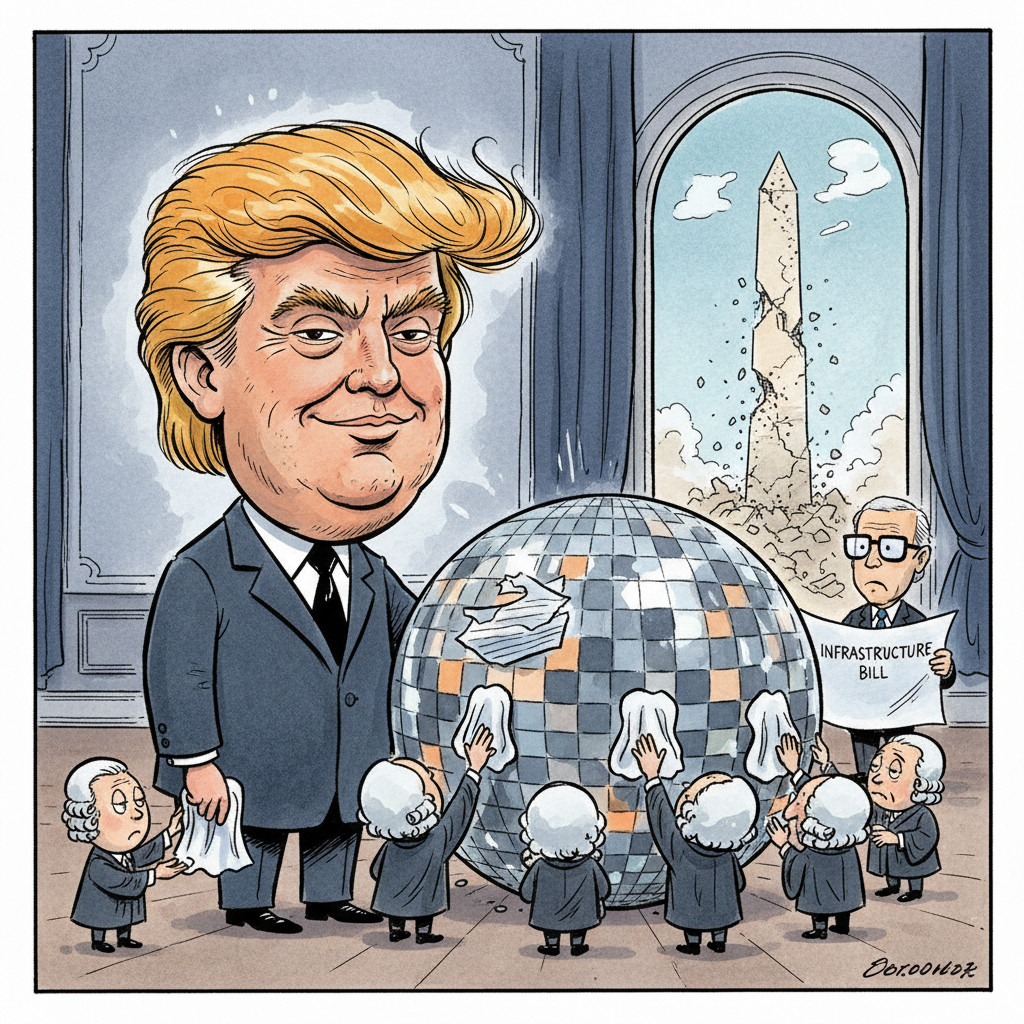
In a landmark decision that will undoubtedly be cited in future constitutional law textbooks, the Supreme Court has unequivocally affirmed the Executive Branch’s sovereign right to construct a 'fully immersive, LED-lit 'Stardust' ballroom' within the hallowed halls of the White House. Critics, who apparently don't understand the nuanced demands of statecraft, had suggested that perhaps a new coat of paint or a functioning HVAC system might take precedence over a venue capable of hosting 'galactic-themed, laser-grid power-networking events.'
Meanwhile, several other presidential vanity projects, including a proposed 'Freedom Fountain of Eternal Self-Congratulation' and a 20-foot-tall, solid gold equestrian statue of the sitting president riding a bald eagle wearing a tiny MAGA hat, remain mired in bureaucratic red tape. Sources close to the proceedings suggest the delays are due to a surprising lack of structural engineers willing to sign off on a load-bearing eagle. Experts agree, however, that prioritizing the ballroom ensures that future administrations will always have a place to dramatically reveal their tax returns... or at least their carefully curated Spotify playlists.
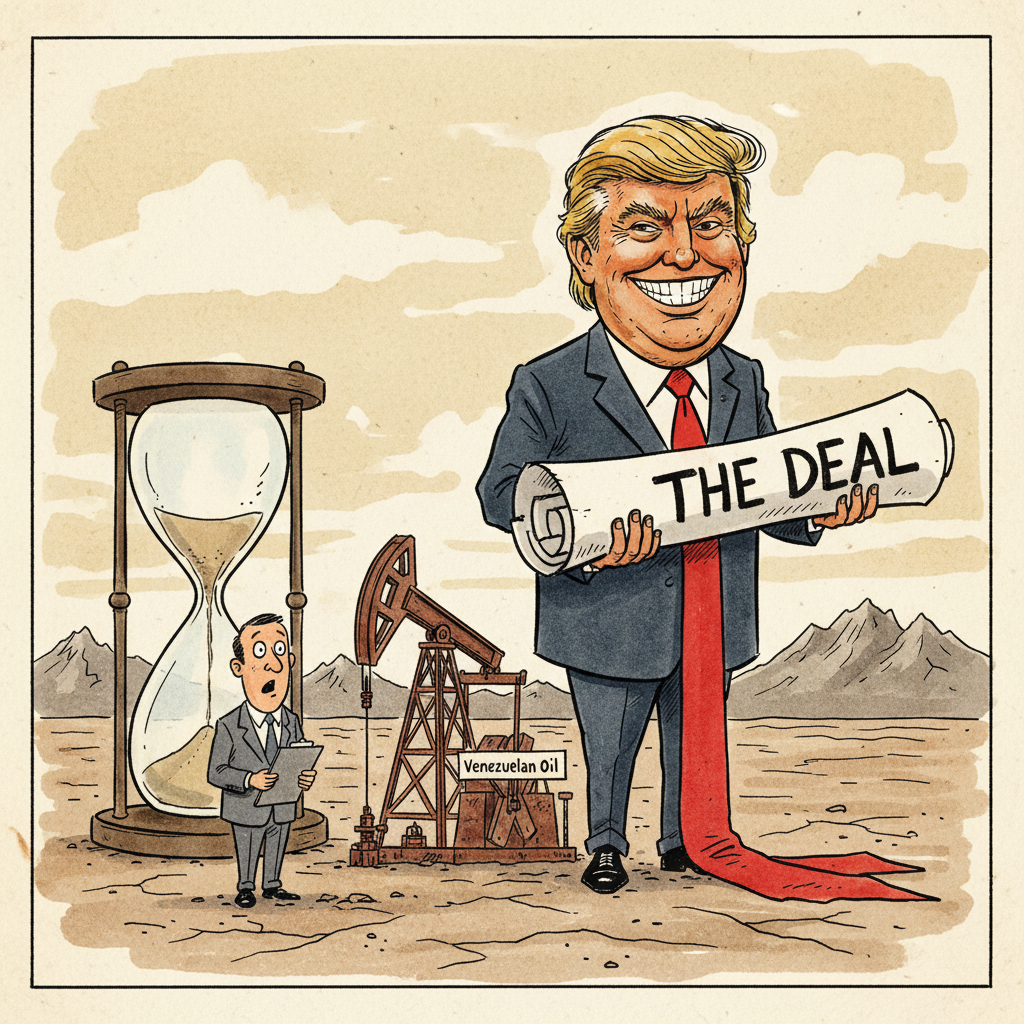
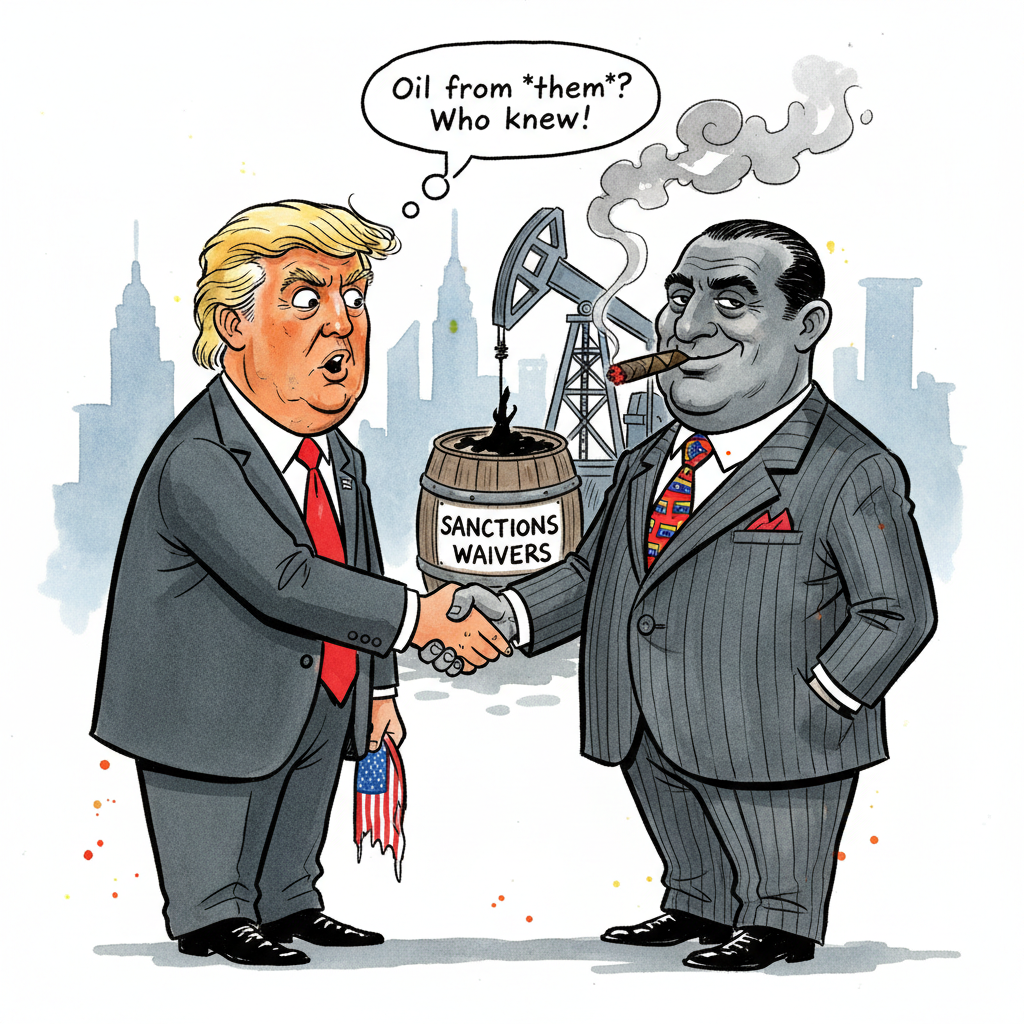
In a move that has energy analysts scratching their heads and economists reaching for their multi-generational calendars, former President Donald J. Trump's much-touted Venezuelan oil deal, forged with an obscure private firm, is projected to begin producing crude sometime before the next recorded appearance of Halley's Comet. Sources close to the negotiations, who asked to remain anonymous because they are currently living in a secure bunker until the deal actually materializes, revealed that the projected 'many years' timeline is a deliberate understatement, designed to manage expectations for a project that may one day yield a single drop of premium, ethically sourced, pre-sanctioned oil.
Experts speculate the true genius of the deal lies not in its immediate energy output, but in its potential to create a perpetual state of 'almost there' economic optimism, a sort of Schrödinger's Oil Well. One anonymous geologist, after receiving an estimated completion date in the year 2047, simply sighed, "At least it gives me something to look forward to in my retirement home." Meanwhile, the private oil company, whose website currently features a single GIF of a dog chasing its own tail, is reportedly overwhelmed with investor enthusiasm, proving once again that the allure of 'future billions' is far more potent than 'current barrels.'
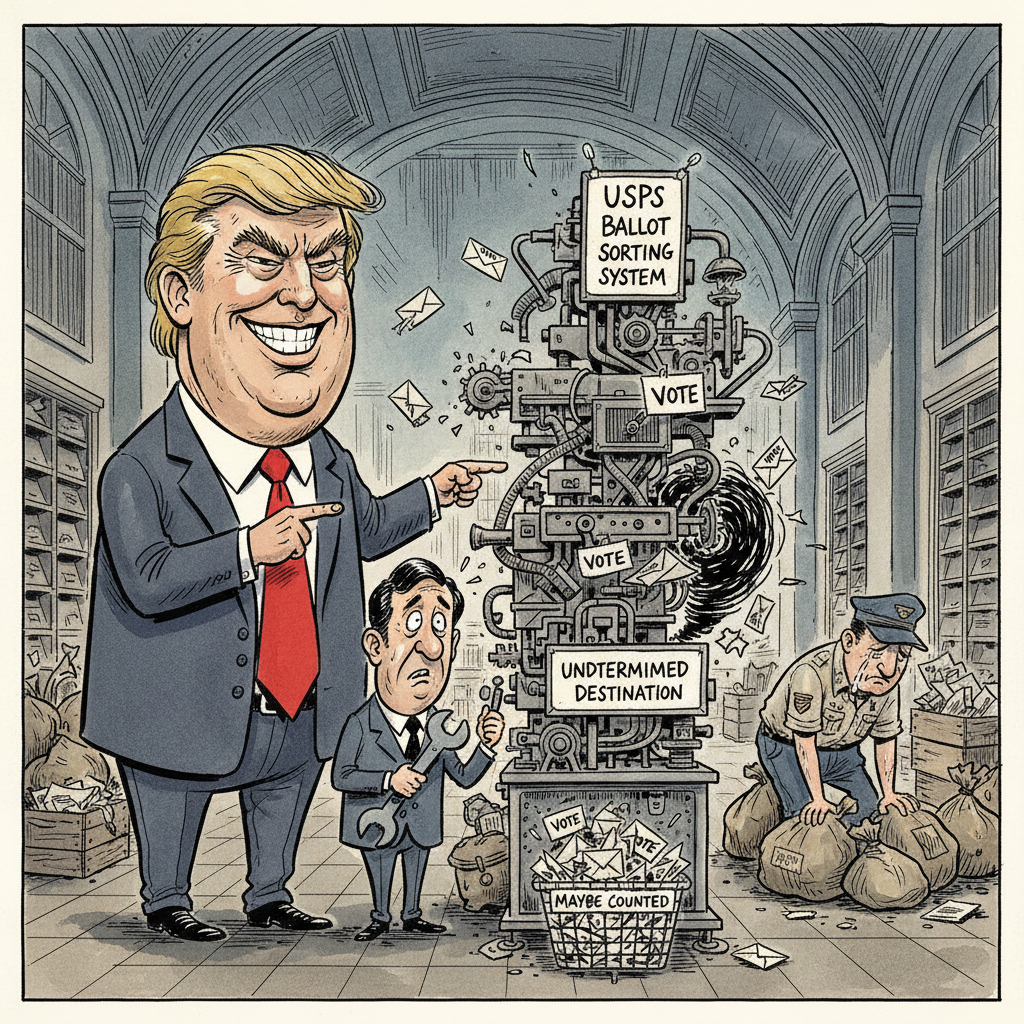
Washington D.C. — In a move widely anticipated by absolutely no one, the U.S. Postal Service has reportedly accelerated the implementation of a sophisticated new mail-sorting protocol, quaintly dubbed 'Project Schrödinger's Ballot.' Sources close to the internal workings, presumably those with access to the Postmaster General's dream journal, indicate this initiative, originally conceived during a previous administration's brief flirtation with reality, promises to imbue every mailed vote with an unprecedented sense of existential dread. Observers suggest the system, designed to handle a sudden, inexplicable surge in ‘misplaced’ documents, could redefine 'civic engagement' as a thrilling, high-stakes game of chance.
Critics, often dismissed as 'pedants who insist on knowing where their mail goes,' express 'grave concerns' that millions of ballots might simply… achieve nirvana before reaching their intended destinations. A senior USPS official, who spoke on condition of anonymity and a promise of extra postage stamps, clarified that the new system isn't about *losing* votes, but rather about 'democratizing the decision-making process by introducing delightful unpredictability.' He added, 'Think of it as a nationwide, low-stakes lottery where everyone's a winner… except for the candidates, probably.' The Postal Service assures the public that while your ballot's final resting place might be unknown, its journey will undoubtedly be memorable.
In a move that surprised absolutely no one fluent in the language of geopolitical acrobatics, the Pentagon's Office of Strategic Capital (OSC) has officially begun dabbling in Venezuelan oil, reportedly under the direct, unwavering gaze of President Trump. The OSC, originally tasked with shoring up America’s defense industrial base, has apparently redefined 'defense' to include 'securing discounted crude from nations with a distinct lack of American-style stability.' Sources close to the operation, who requested anonymity while simultaneously trying to sell us a barrel of 'premium, ethically ambiguous' Venezuelan crude, suggest the initiative is less about strategic advantage and more about proving that an 'art of the deal' can indeed involve actual crude art.
'Who knew national security was just a euphemism for high-stakes arbitrage?' pondered one anonymous official, polishing a gold-plated oil derrrick miniature. Critics, of course, are decrying the move as a blatant opportunistic entanglement. But proponents argue that this venture simply streamlines the 'war for oil' narrative by cutting out the middleman and having the defense department act as a direct, albeit heavily armed, commodities broker. Expect future 'strategic investments' to include funding for a new line of tactical tank tops and a black-ops-themed artisanal coffee subscription service.
In a move lauded by precisely zero ethics committees and approximately 17 well-placed lobbyists, the Trump administration has valiantly forged a groundbreaking alliance with a private Venezuelan oil company. Sources close to the negotiation – primarily a sentient golf cart named 'Putt-Putt' – confirm that this company has 'ties' to the Venezuelan government, which in geopolitical terms means they share a secret handshake, a favorite brand of cigar, and several offshore accounts. Critics, who clearly haven't grasped the intricate dance of international petropolitics, were quick to point out the 'irony' of a former administration, ostensibly against socialist regimes, now cozying up to a state-linked enterprise. But as one anonymous official quipped, 'You can't spell 'Venezuelan resource extraction' without 'Venezuelan government.'' This groundbreaking deal promises to deliver… well, oil. Lots of it, apparently, which, after extensive consultation with economic experts (and a quick Google search), appears to be quite useful for powering things.
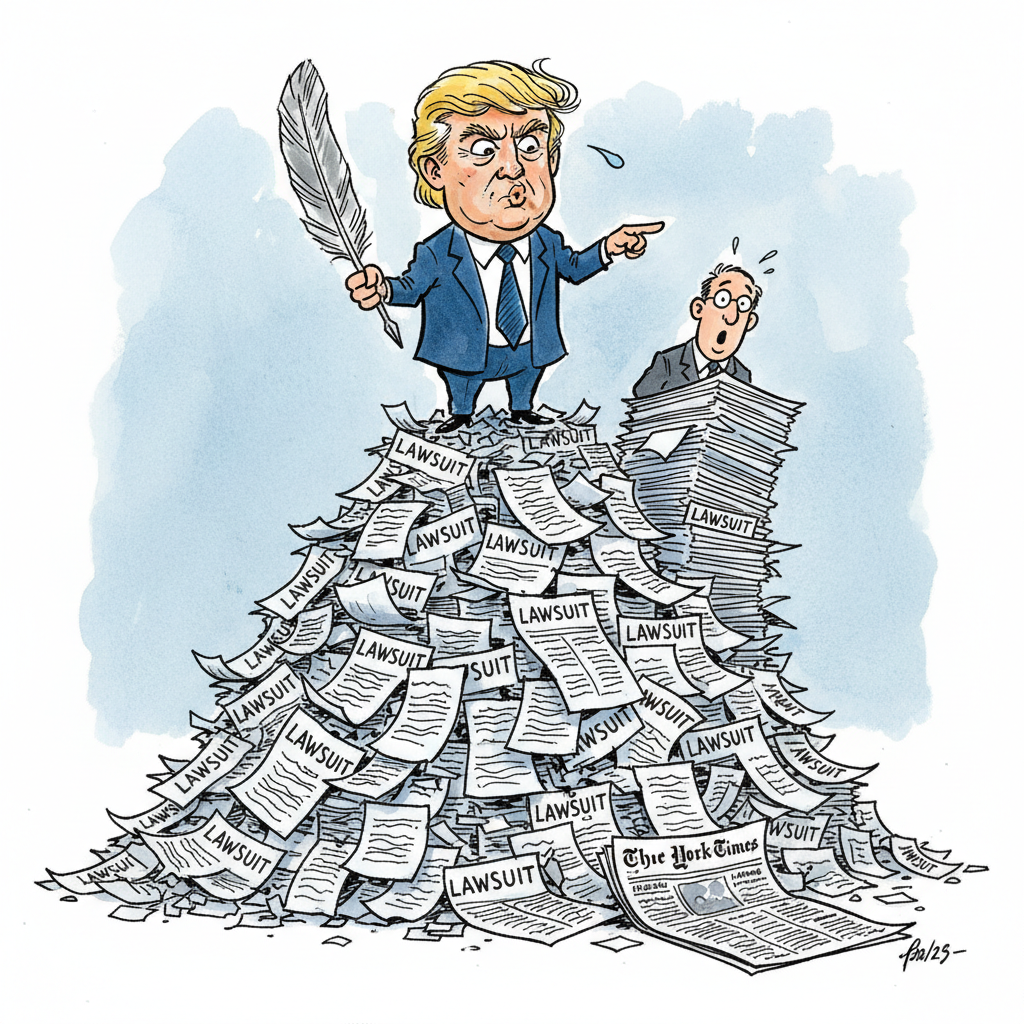
In a stunning display of legal innovation, former President Donald J. Trump has officially updated his $15 billion libel lawsuit against The New York Times, now claiming the venerable institution's relentless reporting has caused him 'irreparable harm to his brand of undeniable success.' Sources close to the former Commander-in-Chief suggest the latest amendments include a detailed accounting of sleepless nights spent contemplating headlines that 'weren't very nice,' along with several highly-indexed financial statements proving his net worth was indeed $15 billion *before* the Times dared to suggest otherwise. The Times, for its part, remains unmoved, likely preparing a defense rooted in the radical notion that newspapers are occasionally permitted to print things other than glossy advertorials for luxury real estate. Insiders predict the discovery phase will involve forensic accountants sifting through Trump's personal feelings, attempting to quantify the exact monetary value of a bruised ego, while legal scholars worldwide brace for the groundbreaking precedent that could effectively bankrupt any news outlet that ever publishes a critical word about a wealthy public figure. Critics, meanwhile, are just wondering if the actual sum isn't closer to $15 million, adjusted for inflation and actual market value of grievance.
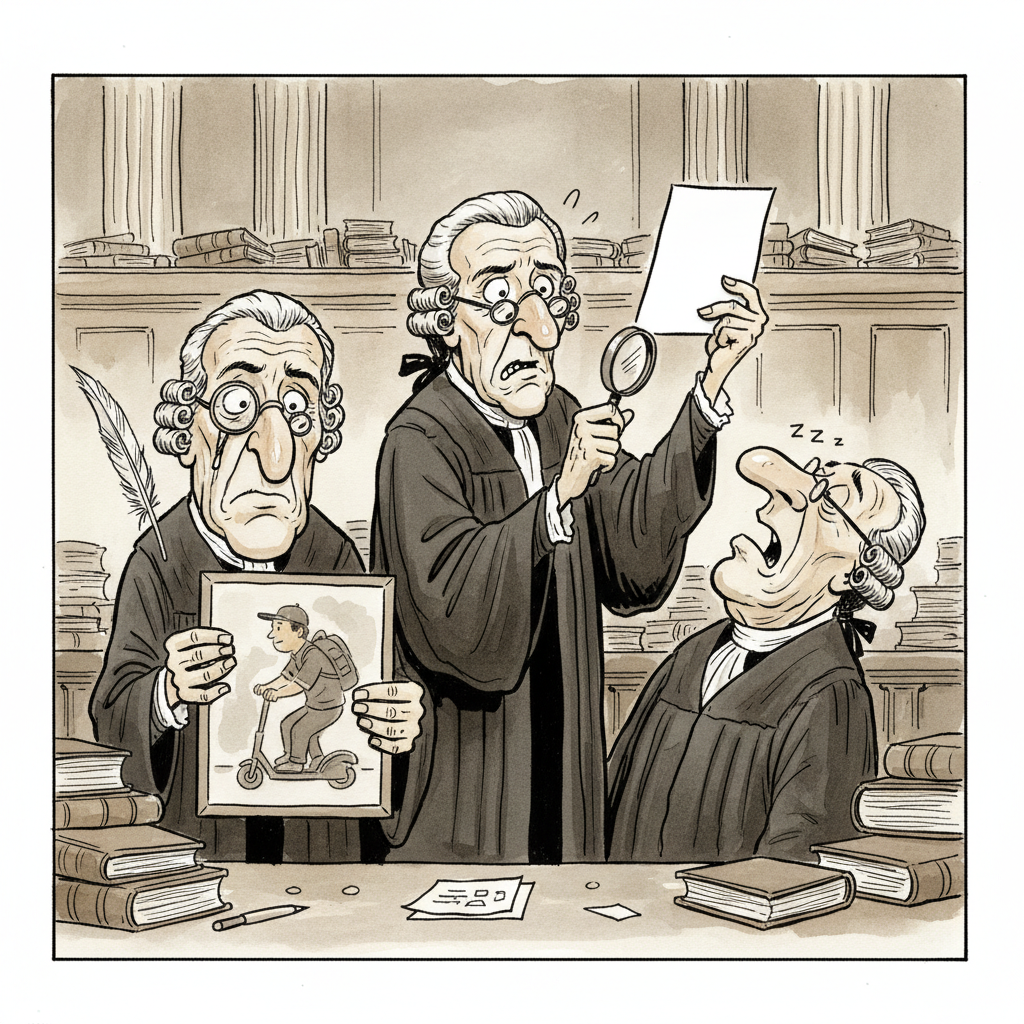
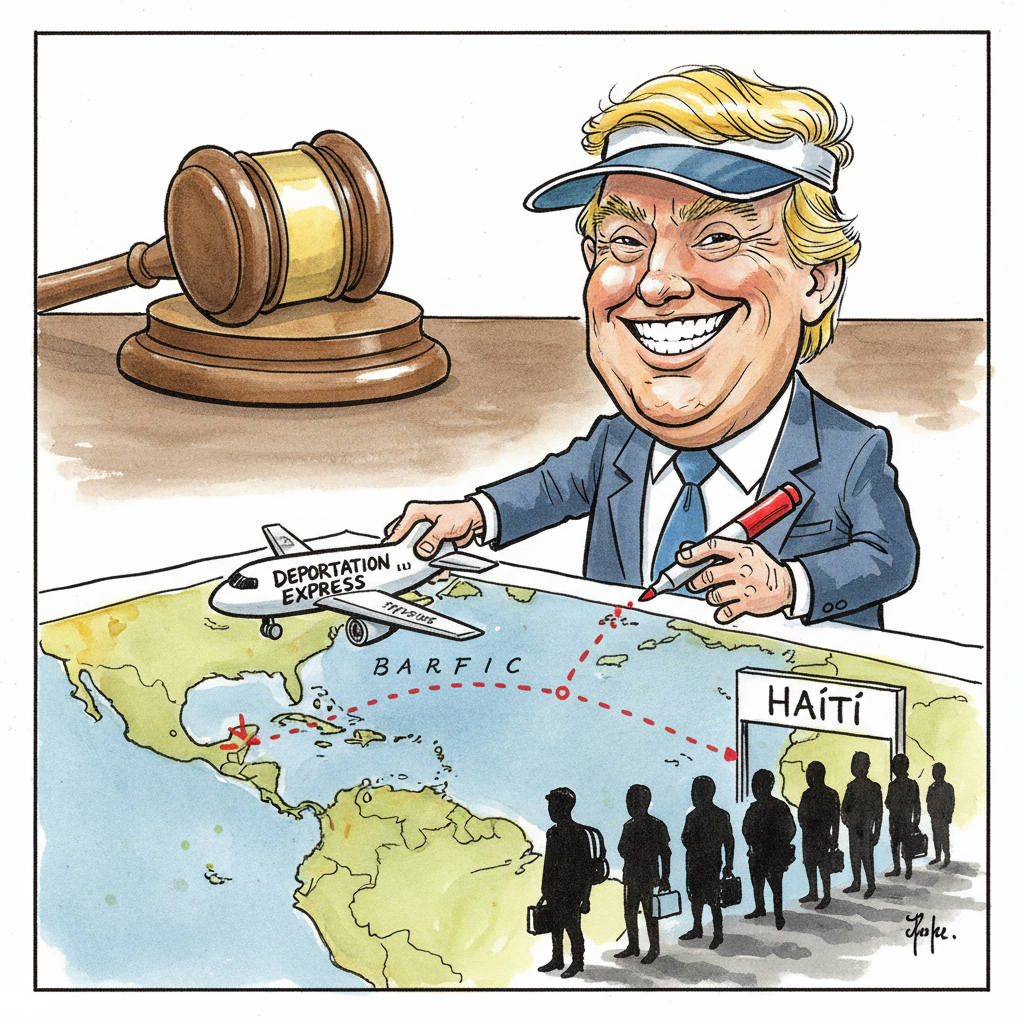
In a move lauded by precisely zero travel agencies, the Trump administration announced an ambitious expansion of its 'Re-Patriation & Cultural Exchange' program, transforming what was once a monthly trickle into a weekly torrent of flights to Haiti. Officials, beaming with the kind of subdued satisfaction usually reserved for discovering a particularly efficient paperclip, explained this surge in 'express air travel' as a necessary adjustment following the Supreme Court's thoughtful decision to clear President Trump's schedule of pesky humanitarian obligations. Sources close to the White House, who asked to remain unnamed as they were currently being fitted for new jumpsuits, hinted that the administration views this as a vital economic stimulus, albeit one experienced primarily by the airline industry and the local hawkers of bittersweet farewells. Indeed, critics are already praising the ingenuity of finding a 'solution' to a crisis that merely involved adding more airplanes, much like solving world hunger by opening more drive-thrus.
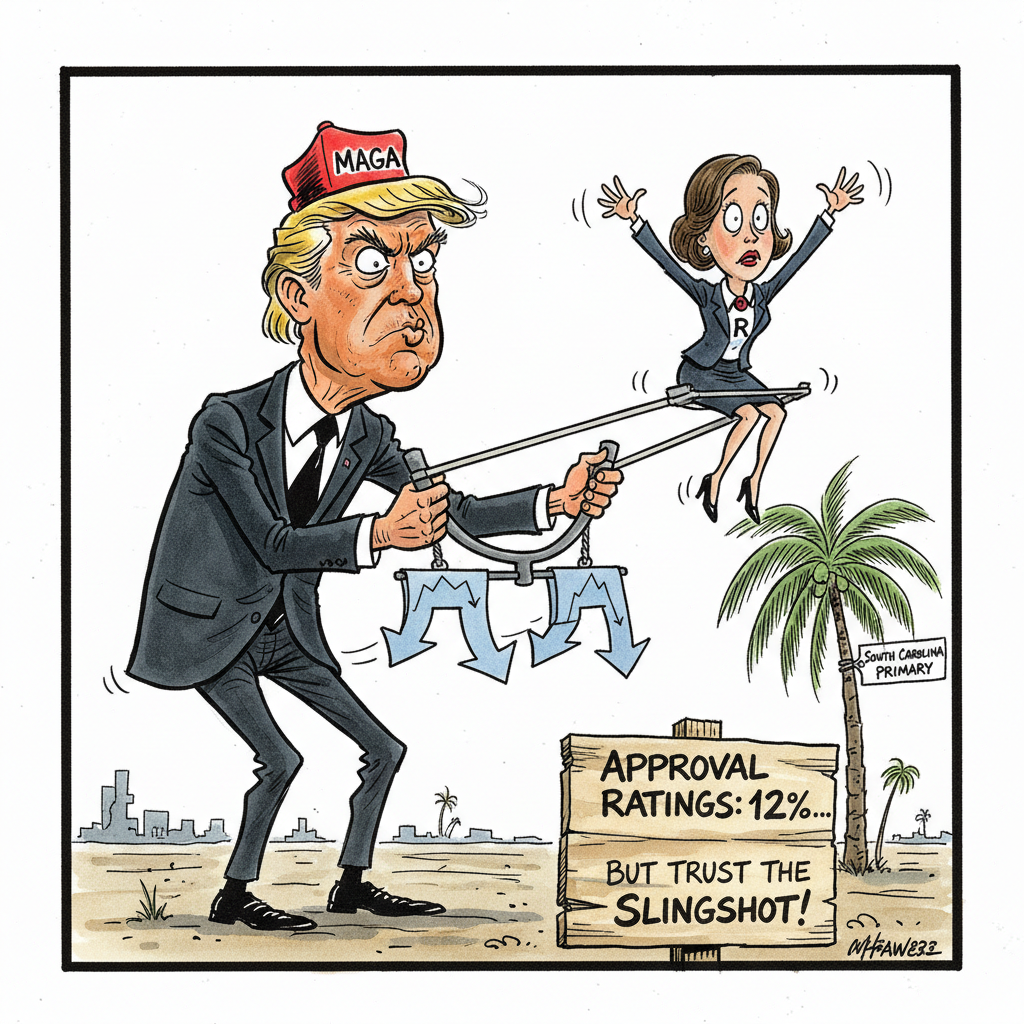
In a display of political alchemy that would make even the most seasoned swamp creature blush, former President Donald J. Trump, currently enjoying approval ratings roughly equivalent to a Monday morning root canal, has somehow managed to slingshot Darline Graham into the Republican Senate nomination in South Carolina. Analysts are baffled, citing the phenomenon as 'the political equivalent of a black hole emitting light,' or perhaps 'a reverse Midas touch, where everything he touches turns to... well, gold, somehow, but for someone else.' Insiders suggest that Trump's 'endorsement' now functions less as a glowing recommendation and more as a 'curse that only works on opponents,' creating a paradox where his perceived weakness is, in fact, an electoral super-weapon. Graham's campaign, which was reportedly running on fumes and the hopes of a particularly optimistic squirrel, is now faced with the daunting task of explaining to voters how an endorsement from a figure many now actively flee from at parties is actually a *good* thing. The situation has prompted calls for a new branch of political science, possibly involving quantum mechanics or ancient incantations, to understand how a man can be simultaneously a pariah and a kingmaker.
In a bold diplomatic maneuver that sources describe as 'entirely coincidental,' C.I.A. Director John Ratcliffe reportedly made an impromptu stop in Moscow, arriving via a military cargo plane from Riga, Latvia. The exact nature of his visit remains shrouded in the kind of impenetrable opacity usually reserved for a teenager's search history, with officials only stating that the Director was 'exploring regional cuisine' and perhaps 'looking for a specific brand of artisanal pickles.' Analysts suggest the clandestine trip, which involved landing a lumbering C-130 in a capital known for its rather strict airspace protocols, was merely a cost-saving measure, as commercial flights had 'developed an inconvenient habit of asking too many questions.' While the Kremlin's reaction was officially described as 'mildly amused,' several prominent intelligence agencies have reported a sharp increase in the number of Russian bears suddenly applying for international pilot licenses, citing a 'new appreciation for aerial tourism.'
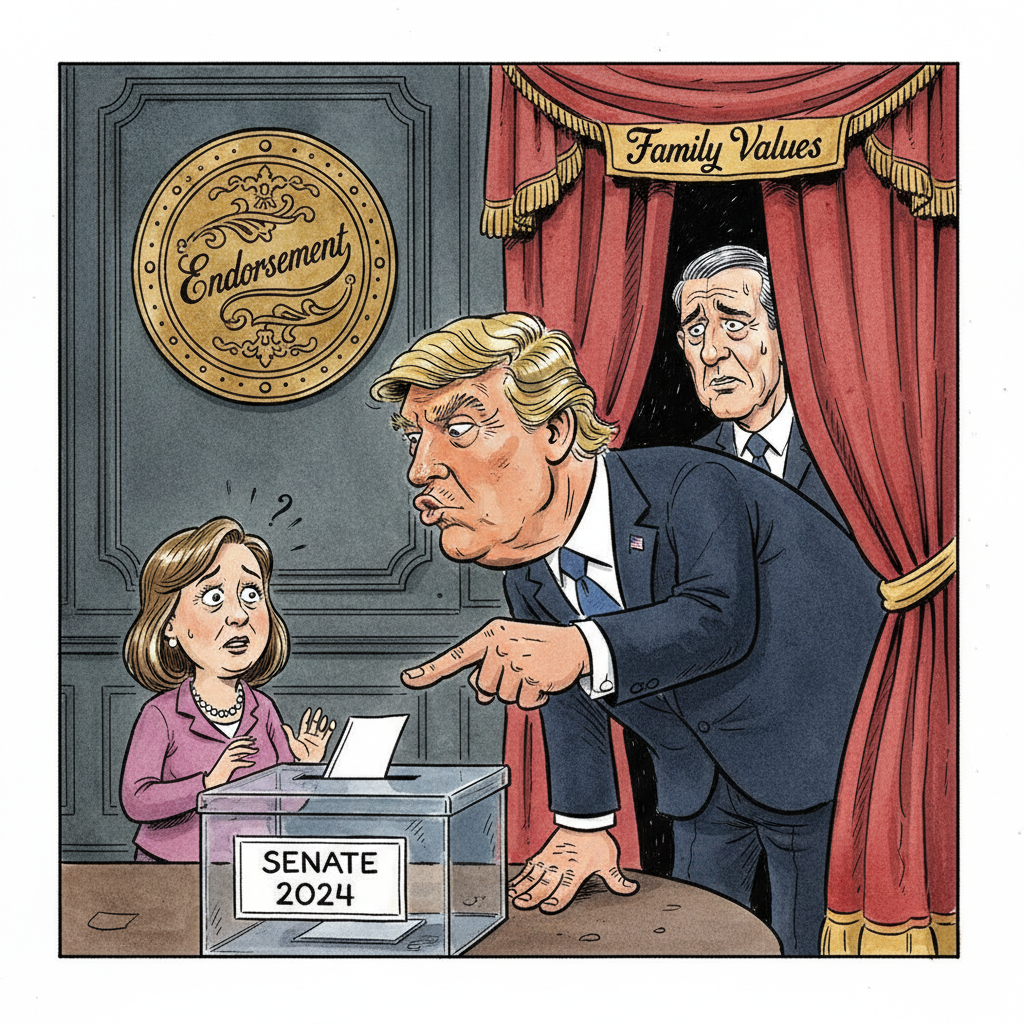
Washington, D.C. – In a bold move signaling a new era of political patronage, sources close to former President Donald J. Trump confirm he has personally ‘laid it on the line’ for Darline Graham, sister to Senator Lindsey Graham, in her burgeoning South Carolina Senate campaign. Apparently, the 'line' in question is less a policy platform and more a direct neural pathway from one Graham brain to another, ensuring a seamless transfer of legislative priorities and perhaps even that distinct, slightly bewildered facial expression.
Insiders report the former President, known for his discerning eye for talent, specifically pressured 'allies' — a term that, in this context, translates roughly to 'anyone who answers the phone' — to throw their weight behind Ms. Graham. This strategic pivot from meritocracy to 'relatocracy' marks a refreshing transparency in American politics: why vet a candidate when you can just check their family tree? A Super PAC, expertly managed by individuals who understand that campaign finance is just a complex way to say 'here's some cash, do what he says,' has also mysteriously materialized to ensure the electorate understands the profound benefits of genetic political succession. It remains to be seen if the Palmetto State is ready for this innovative approach to governance, or if they prefer their politicians to have, you know, *their own* names on the ballot by choice.
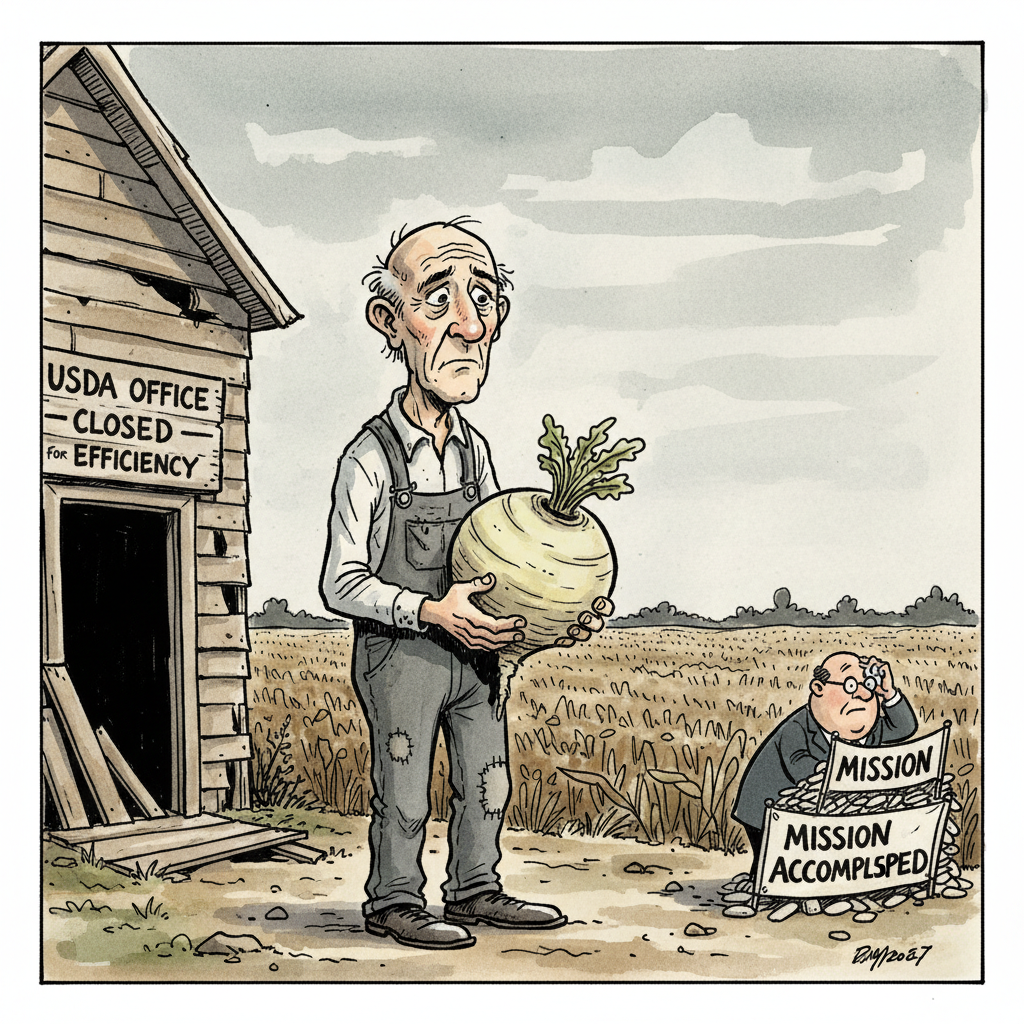
In a move hailed by precisely no one, the U.S. Department of Agriculture has unveiled its groundbreaking new 'Sow-cial Wellness Initiative,' replacing essential services with a program providing beleaguered farmers with a single, locally sourced turnip and a pamphlet titled 'You're Not Alone (Unless You Need a Loan).' Following the exodus of thousands of federal workers, rural communities report that obtaining anything from infrastructure grants to basic technical assistance now requires navigating a labyrinthine digital portal, which, incidentally, is hosted on a 2003 Compaq Presario.
Agricultural experts, none of whom still work at the USDA, speculate that the department's new 'lean and green' approach means 'leaving farmers lean and green with envy for the good old days.' One anonymous former official, now reportedly a highly sought-after consultant for his ability to correctly identify a tractor, quipped, 'We’ve gone from feeding the nation to feeding the existential dread.' The USDA reassures the public that while direct assistance may be scarce, the emotional support turnips are 'organic, sustainably sourced, and represent a firm commitment to… well, to turnips.'
In a truly heartwarming display of civic duty and perhaps a touch of forgetfulness, career politician Sherrod Brown, aged 73, has reportedly expressed interest in potentially occupying a Senate seat representing Ohio, sources close to the campaign confirmed. 'He just kind of assumed someone else had taken care of it by now,' admitted a campaign intern, clutching a sheaf of printed-out TikTok tutorials on 'How to Reach Younger Voters Without Cringing.' Brown’s 'populist pitch,' described by policy analysts as 'a medley of economically anxious buzzwords delivered with a gravitas usually reserved for telling a grandchild the dog went to a farm,' is now being dusted off for what strategists are optimistically calling 'Operation: What Even Is Ohio Anymore?' The Democratic Party, reportedly in a mad scramble to find anyone who can still remember what a Senate seat *is* without consulting Wikipedia, has tentatively endorsed Brown’s 'quaint little endeavor,' hoping that the sheer nostalgia of a bygone era, when politicians were merely out of touch instead of actively hostile, might still resonate with Ohioans who fondly recall a time before their state became a political Schrödinger's Box.
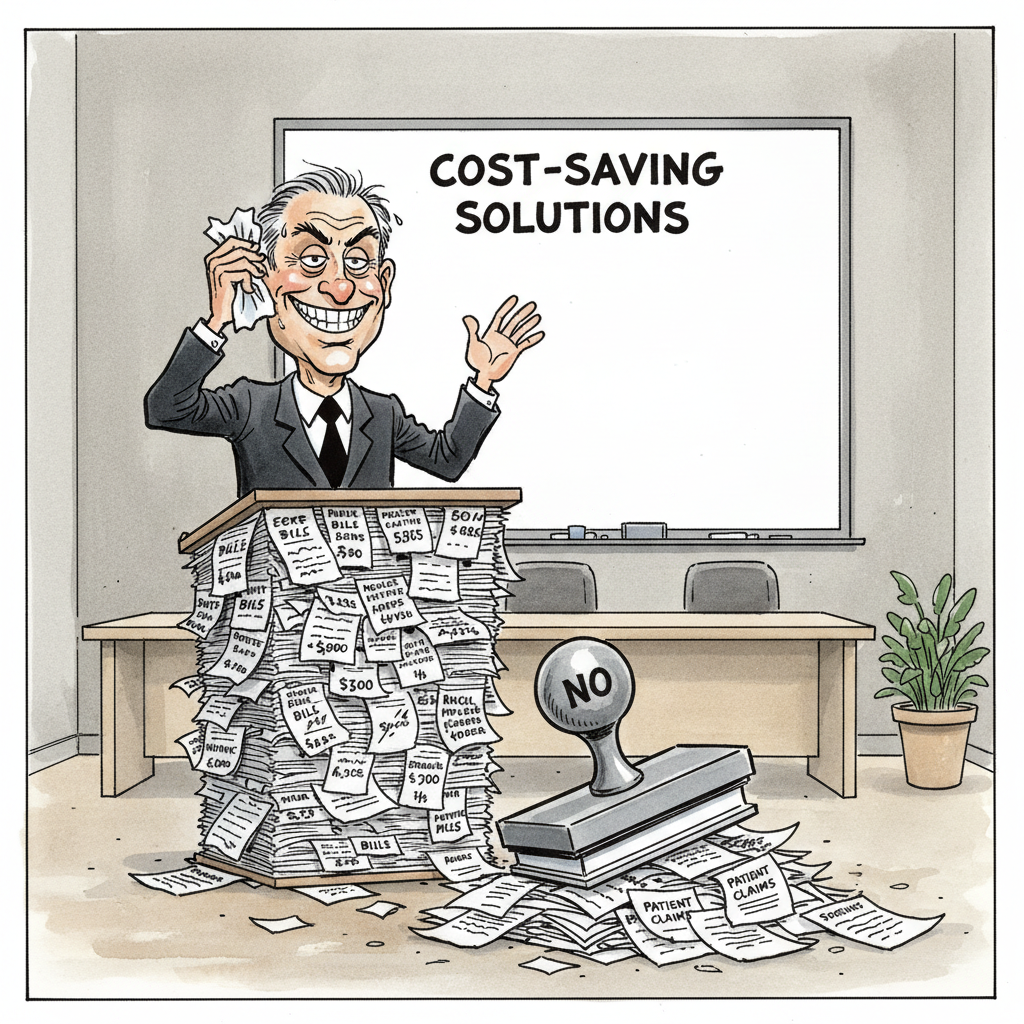
Following the tragic and, frankly, *unprecedentedly* literal departure of UnitedHealth executive Brian Thompson, insurance behemoths across the nation have collectively decided that their current profit margins simply aren't robust enough to withstand the emotional toll of, well, *anything*. Insiders suggest the industry is reeling from the sheer audacity of policyholders expecting their claims to be paid without first enduring a Byzantine labyrinth of denial codes, each more creatively Kafkaesque than the last.
Sources close to the actuarial tables—which, we're told, are now being guarded by highly compensated trauma counselors—confirm that premiums will require a 'courageous upward adjustment' to offset the newly identified 'risk factor of *direct personal accountability*.' Apparently, the cost of installing bulletproof glass in all C-suite offices and hiring a dedicated team of 'empathy coaches' (who will, naturally, be reimbursed at an exorbitant hourly rate via your copay) is not insignificant. Industry spokespeople were unavailable for comment, citing prior engagements with their grief counselors and investment bankers, respectively.
In a groundbreaking display of bureaucratic overreach, U.S. government investigators have reportedly expanded their 'War on Terror' protocols to include groups whose most radical act was likely organizing a potluck. Previously reserved for actual bad actors, the new initiative now encompasses organizations whose primary 'crime' appears to be advocating for, well, people. Officials noted the surveillance was 'remarkably efficient' in confirming that peace activists were, in fact, still peace activists, and that community organizers were, astonishingly, organizing communities.
Sources within the Department of Homelander Security, speaking anonymously to protect their access to the office Keurig, explained that monitoring group chats for phrases like 'affordable housing' and 'immigrant rights' provides invaluable data. 'How else would we know they're not secretly plotting to... *checks notes*... provide humanitarian aid?' remarked one analyst, polishing their 'Big Brother is Watching You, But Also, Like, Your Venmo' mug. The program's success is measured by the sheer volume of financial records obtained from entities never once accused of actual criminal behavior, proving that sometimes, the most effective way to fight crime is to just invent it.
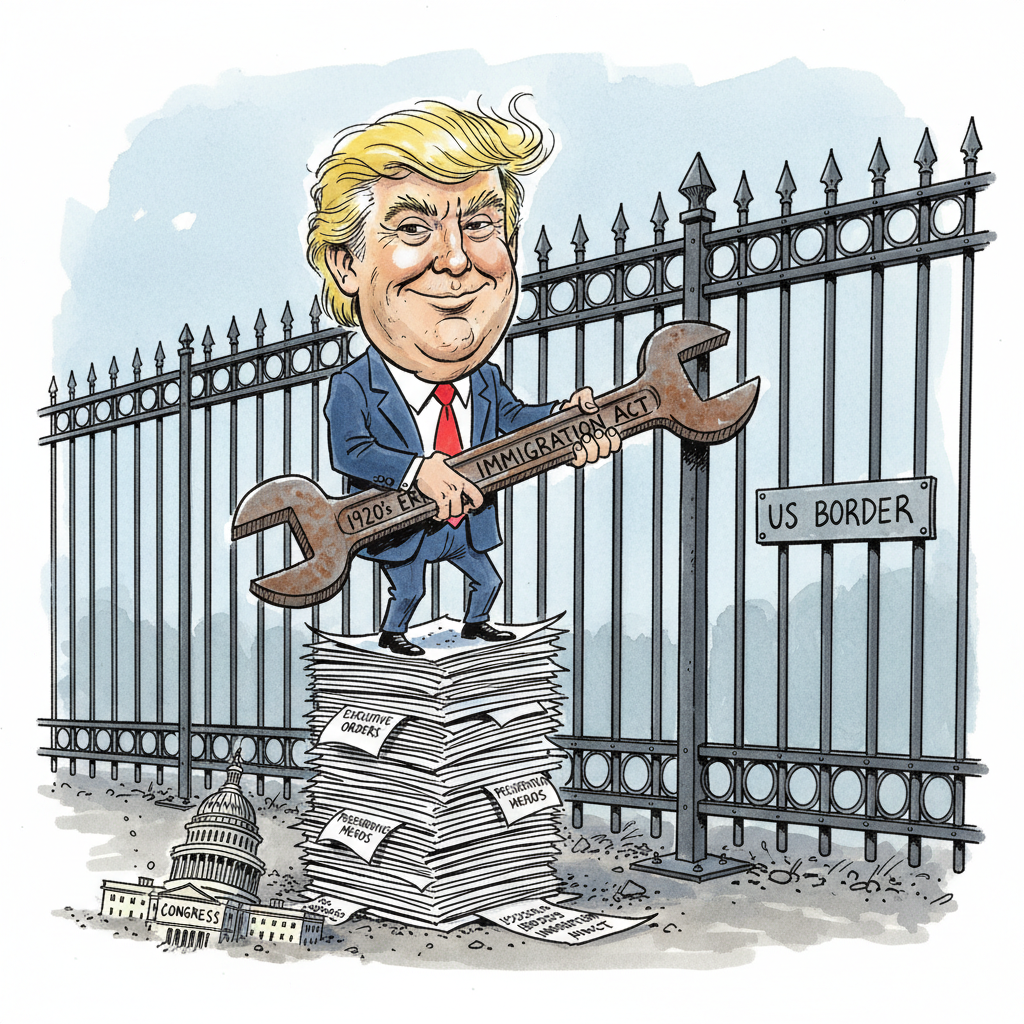
Washington D.C. sources, or at least a highly placed intern who saw a tweet, indicate that America’s grand tradition of reacting to societal anxieties by slamming the door on immigrants is experiencing a delightful 21st-century update. While previous generations required the cumbersome, often performative theatrics of congressional debate – complete with endless filibusters, committee hearings, and the occasional impassioned speech quoting Emma Lazarus – current approaches have streamlined the entire process. Experts, primarily from think tanks funded by 'don't ask' money, suggest this new unilateralism is a testament to executive efficiency, allowing the nation to pivot from 'land of opportunity' to 'gated community with extra steps' at the speed of a presidential memorandum. Historians are reportedly aghast, not at the policy itself, which they find depressingly familiar, but at the sheer lack of parliamentary drama now involved. One can practically hear the collective sigh of relief from lobbyists who no longer have to wine and dine 535 separate individuals to achieve their desired level of border-related 'security through absurdity.'
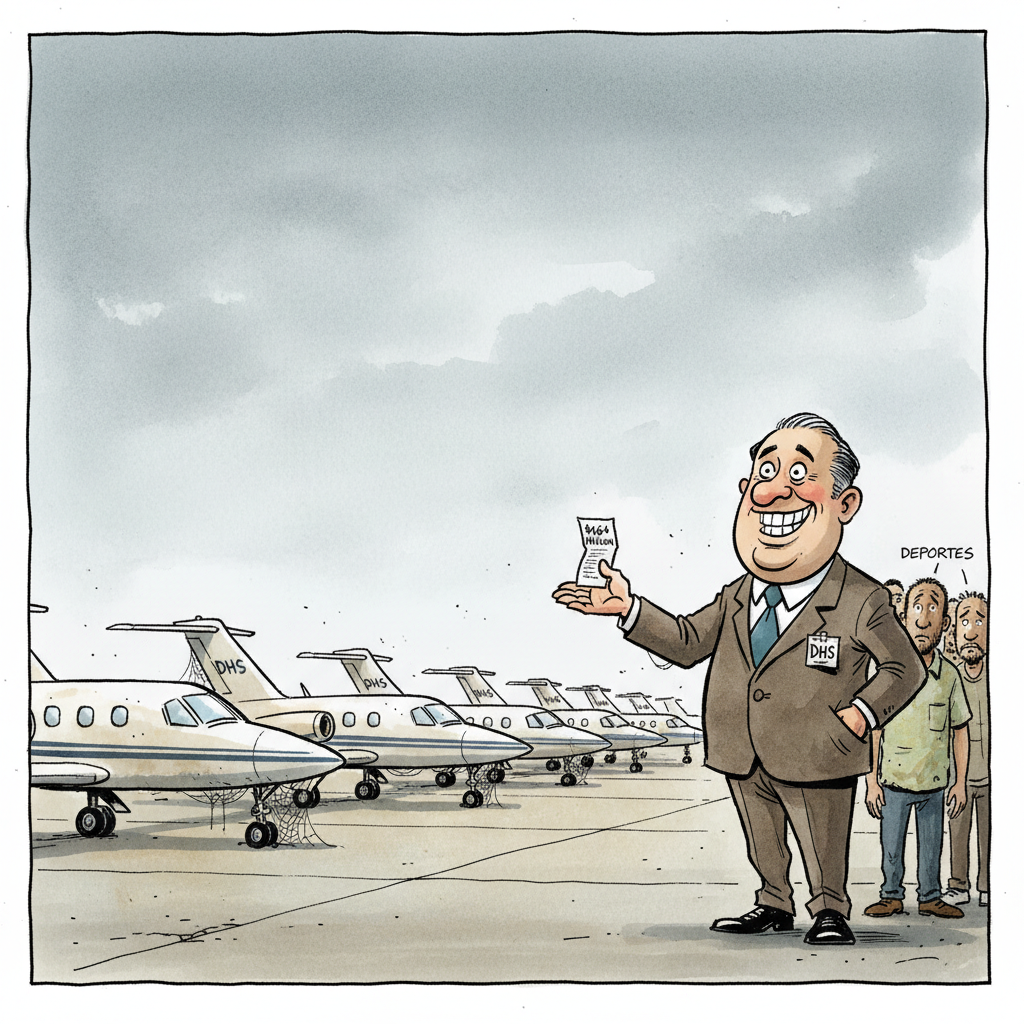
It seems the Department of Homeland Security has pioneered a revolutionary new approach to border enforcement: high-value aviation-based real estate development. After shelling out a cool $464 million via a 'no-bid, high-priority, absolutely-no-time-for-questions' contract for 10 'urgently needed' used jets, the agency has demonstrated remarkable foresight by largely keeping them grounded. Sources close to the bureaucratic labyrinth confirm that this is not incompetence, but rather a 'preemptive maintenance strategy' designed to ensure the planes remain in pristine, non-flight-worn condition for, well, future generations to admire on the tarmac.
Critics who suggest the money could have, perhaps, funded actual human beings or, dare we say, actual deportations, are clearly missing the bigger picture. The DHS isn't just buying planes; they're investing in a sophisticated, highly visible deterrent. What better way to discourage illegal entry than by showcasing a perfectly still, multi-million dollar air fleet, effectively saying, 'Look what we *could* do, if we really felt like it'? It’s a masterclass in passive-aggressive governance, ensuring peak performance for the eventual (theoretical) day they might actually be used. Or, as one analyst put it, 'It's the government equivalent of buying a Peloton to hang your clothes on.'
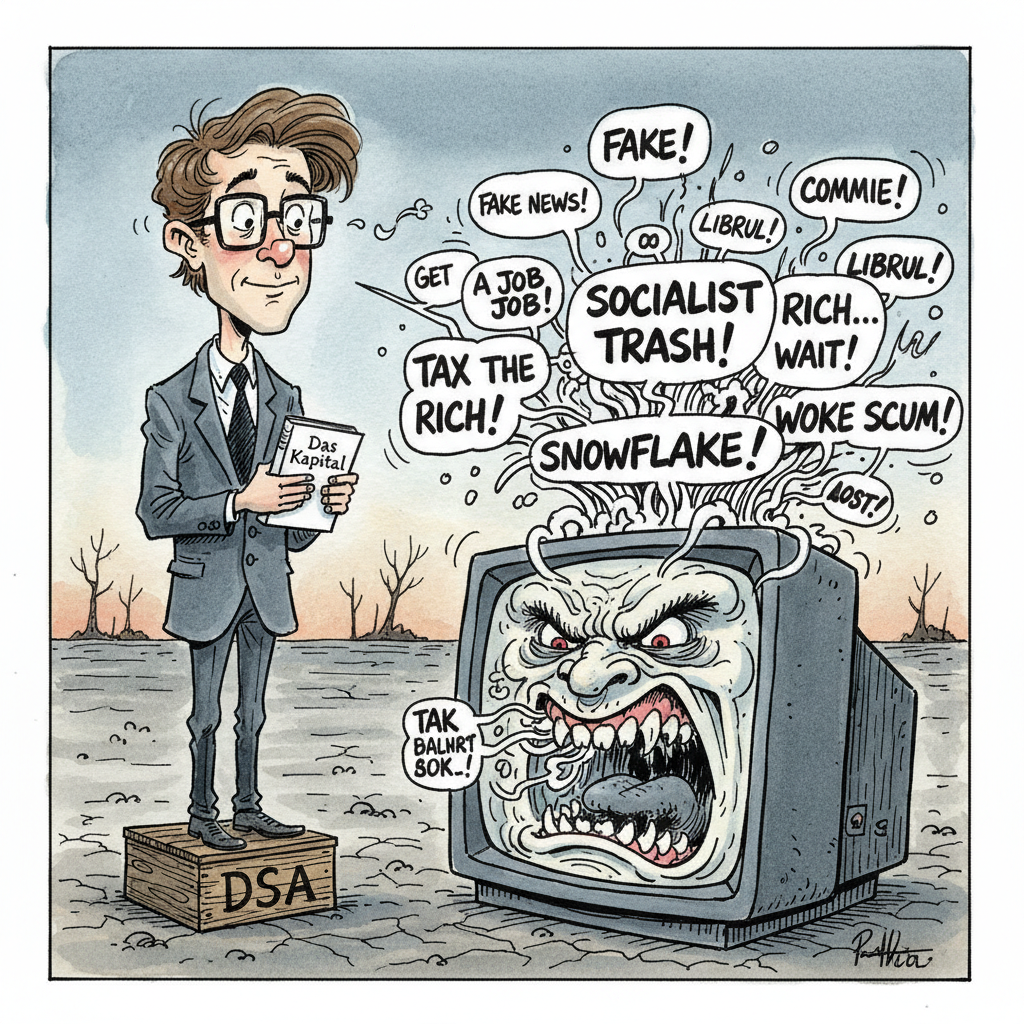
In a move lauded by zero economists but celebrated by those with an excess of free time, New York's Democratic Socialist standard-bearer, Gustavo Gordillo, has reportedly embarked on an audacious mission: spreading the gospel of collective ownership to the famously receptive intellectual climate of regional cable news comment sections. Eyewitness accounts, largely culled from screenshotted replies featuring phrases like 'Go back to Venezuela!' and 'My taxes pay for your avocado toast!', suggest that Gordillo's crusade is proceeding precisely as one might expect. Sources close to the movement, however, insist that every vitriolic comment represents a 'teachable moment' or, failing that, 'excellent engagement metrics for our online footprint.'
Experts, by which we mean anyone with an internet connection, note the particularly fertile ground of 'Hostile Territory,' often identified by its distinct aroma of misplaced grievance and caps-locked patriotism. Gordillo’s strategy, which involves calmly articulating policy positions to individuals whose primary political discourse appears to be meme-based, has been described by one anonymous aide as 'brave, if not entirely sound from a tactical perspective.' The campaign anticipates achieving a 0.0001% conversion rate, which, when extrapolated over the entire online ecosystem, could potentially lead to one confused golden retriever briefly questioning the tenets of late-stage capitalism.
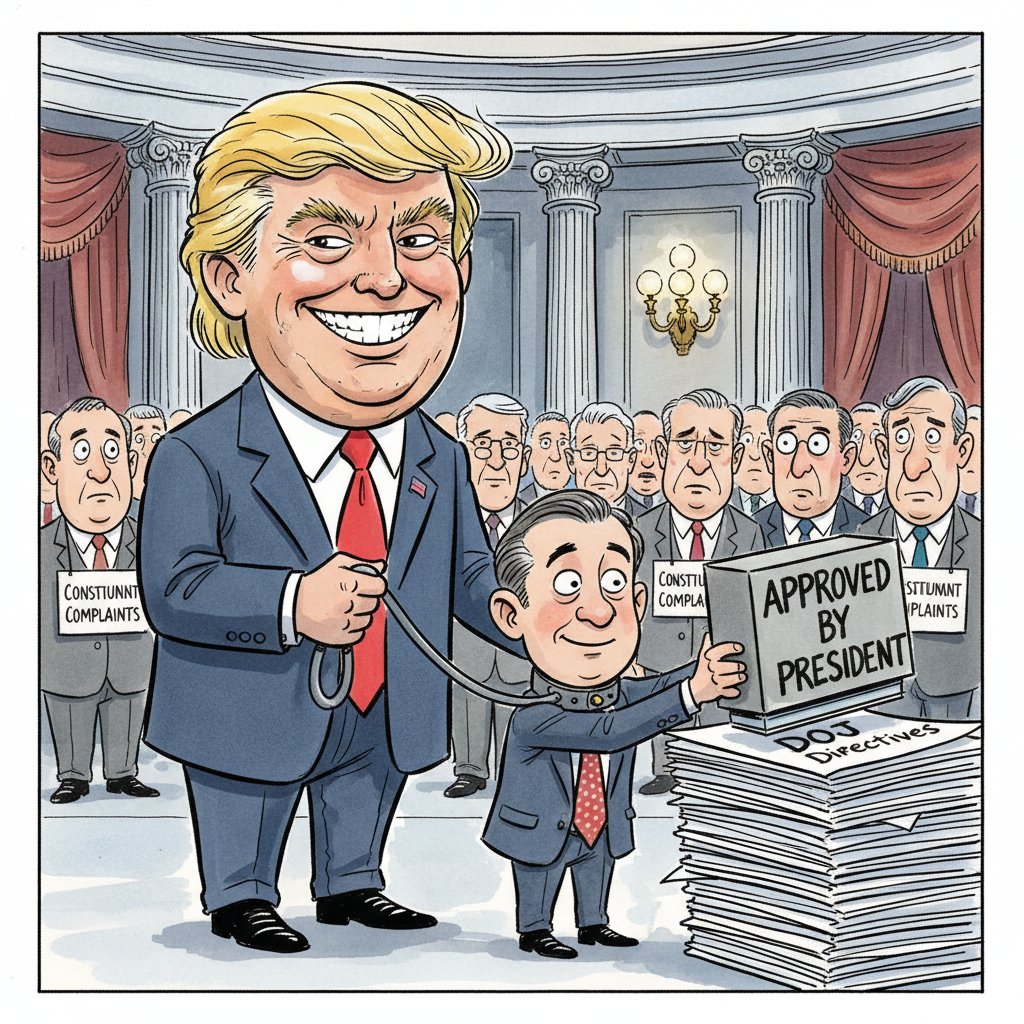
Washington D.C. — In a move widely lauded by those who believe the U.S. Constitution is more of a 'choose your own adventure' novel, the Senate has overwhelmingly confirmed Todd Blanche, whose judicial philosophy can be distilled to a simple premise: the Department of Justice is essentially an extension of the President's whims, much like a well-trained poodle, but with more subpoena power. Sources close to the confirmation process noted that senators were particularly impressed by Blanche's unwavering commitment to the concept of executive omnipotence, reportedly asking, 'So, you're saying the President can just... tell them what to do? Like, with a note? Or maybe a wink?' This groundbreaking interpretation of checks and balances promises to streamline governmental efficiency by eliminating the pesky need for independent legal review, allowing the Executive Branch to operate with the fluid grace of a single, all-powerful mind. Critics, meanwhile, are left scratching their heads, wondering if the next judicial nominee will advocate for replacing all Supreme Court justices with trained parrots programmed to squawk 'The President is always right!' on command.
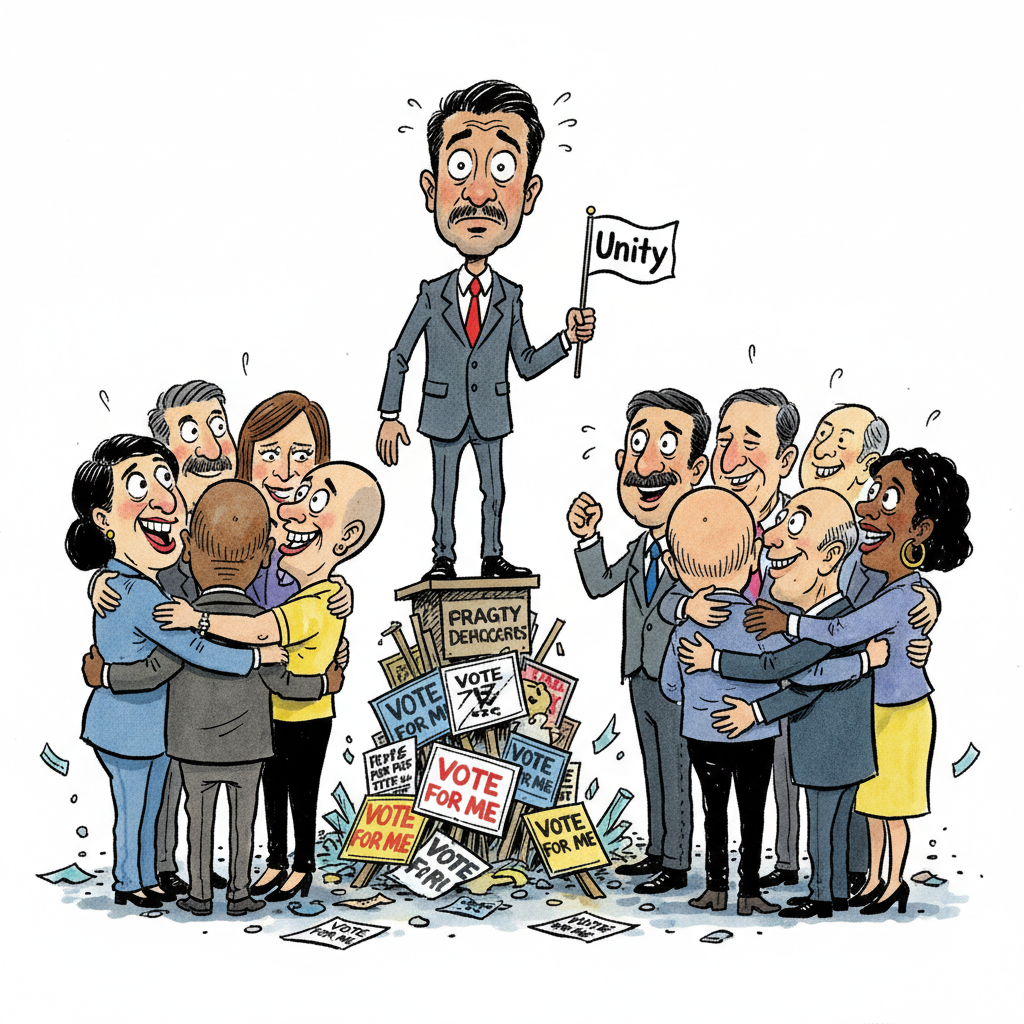
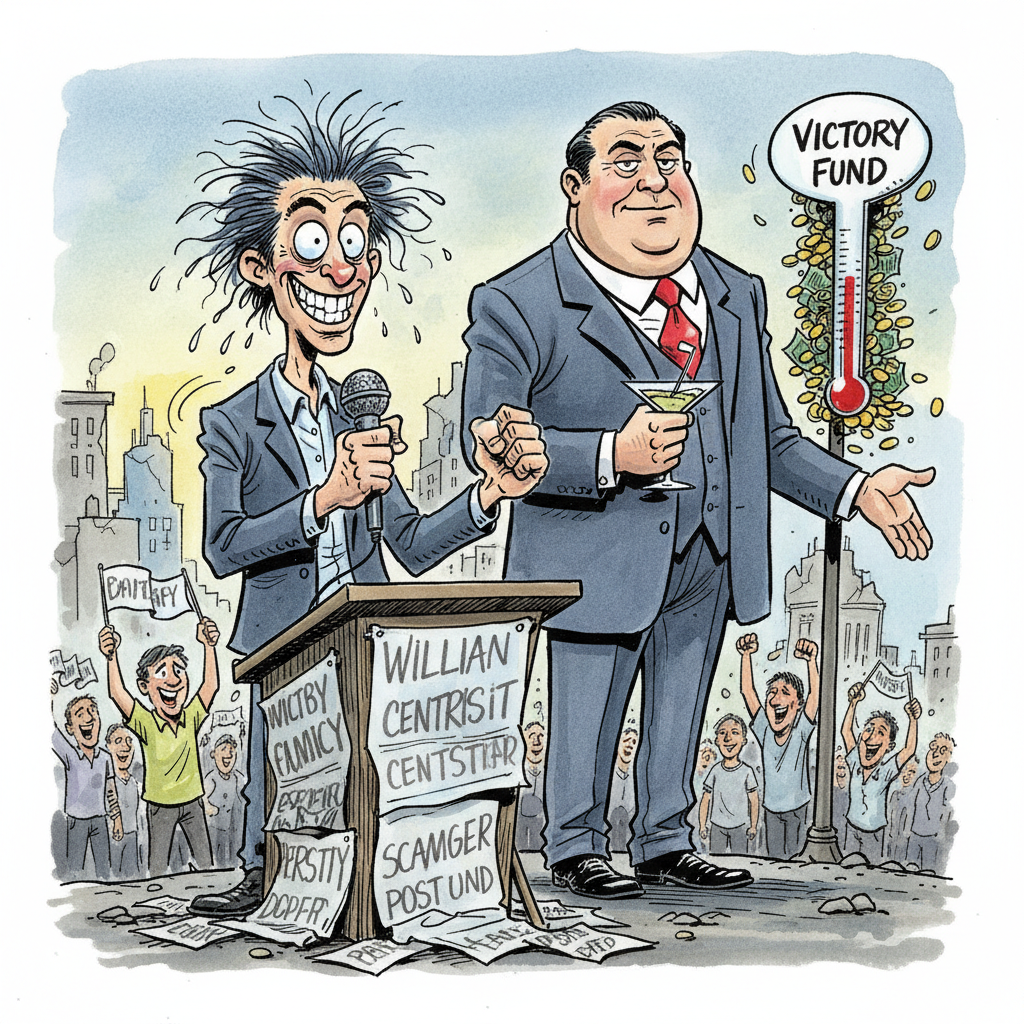
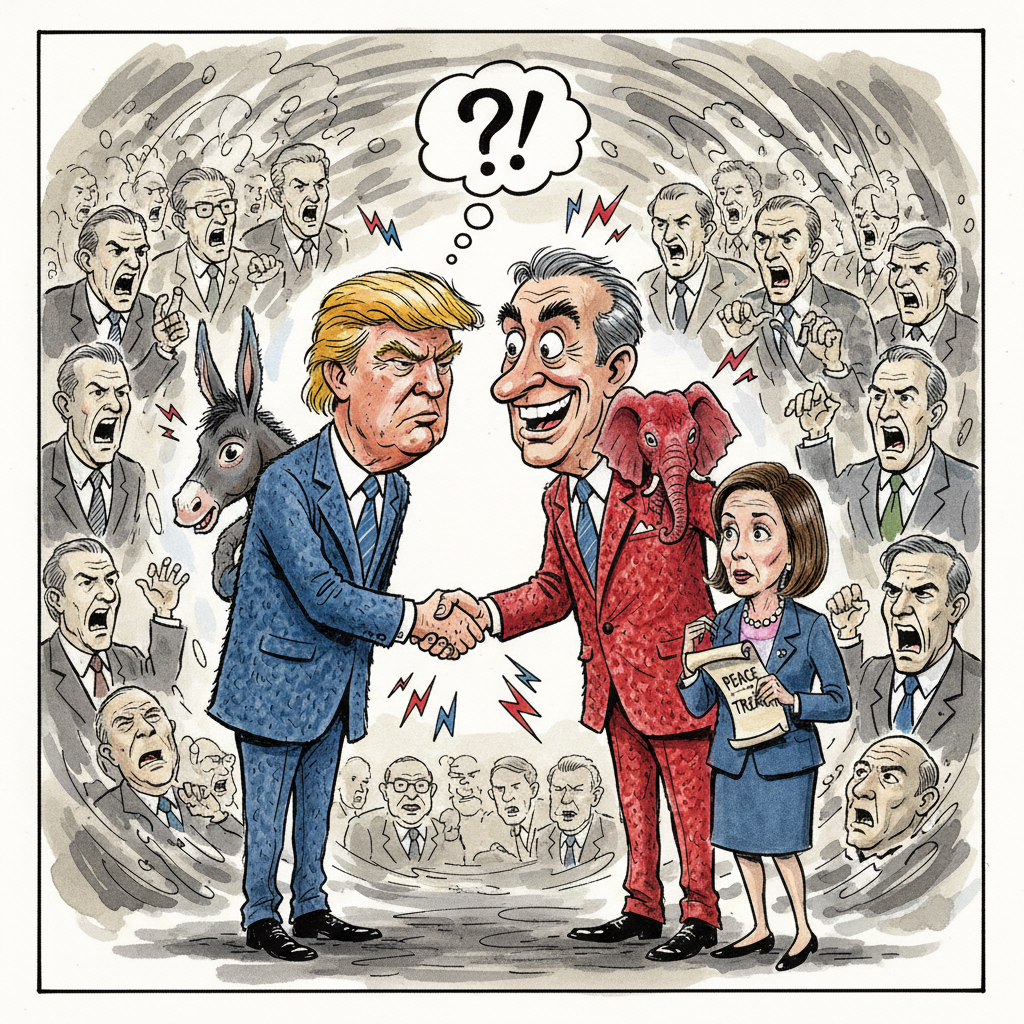
Following a particularly spirited, or as we in the civility industry call it, 'emotionally vibrant,' primary, Michigan Democrats have miraculously coalesced around Dr. Abdul El-Sayed. Sources close to the party, who asked to remain anonymous because they were openly weeping, report that the former rivals are now so united they’ve begun coordinating their facial tics in unison. Pete Buttigieg, fresh from his national tour promoting the strategic merits of 'lukewarm consensus,' reportedly praised the newfound 'synergistic disgorgement of grievances' at a unity rally, where attendees were seen exchanging passive-aggressive gift baskets filled with artisanal cheeses and expired political pamphlets. One insider mused, 'It's like watching a pod of particularly agitated dolphins trying to navigate a bathtub – chaotic, yet with an undeniable, if puzzling, sense of shared purpose.' The party now plans to channel this collective, barely contained existential dread into a comprehensive policy platform, presumably after they finish the group therapy session disguised as a 'strategic brainstorming retreat' in a remote yurt.
It appears the political ecosystem, much like a particularly pungent artisanal cheese, occasionally grants a brief, uncomfortable grace period to those it once sought to ferment into obscurity. Dr. Abdul El-Sayed, fresh from a 'victory' that presumably involved convincing a significant number of carbon-based lifeforms to vote for him, recently regaled The New York Times with tales of his post-election encounters. Apparently, figures who once viewed his candidacy with the enthusiasm reserved for a root canal have now pivoted to a delicate dance of cordiality, presumably to ensure their own political dentures remain firmly in place.
Sources close to the negotiations — primarily a very nervous intern clutching a lukewarm latte — confirmed that Sen. Chuck Schumer himself engaged in a tête-à-tête with El-Sayed. One can only imagine the thrilling intellectual sparring: "Indeed, Dr. El-Sayed, your policy on… *checks notes*… healthcare reform, while robustly socialist, does possess a certain… statistical audacity." It's a miracle no one spontaneously combusted from the sheer force of polite insincerity. El-Sayed also reportedly discussed his mother, a strategic revelation designed to remind everyone that even firebrands emerge from human wombs, thus preventing the immediate deployment of a parliamentary exorcism squad.
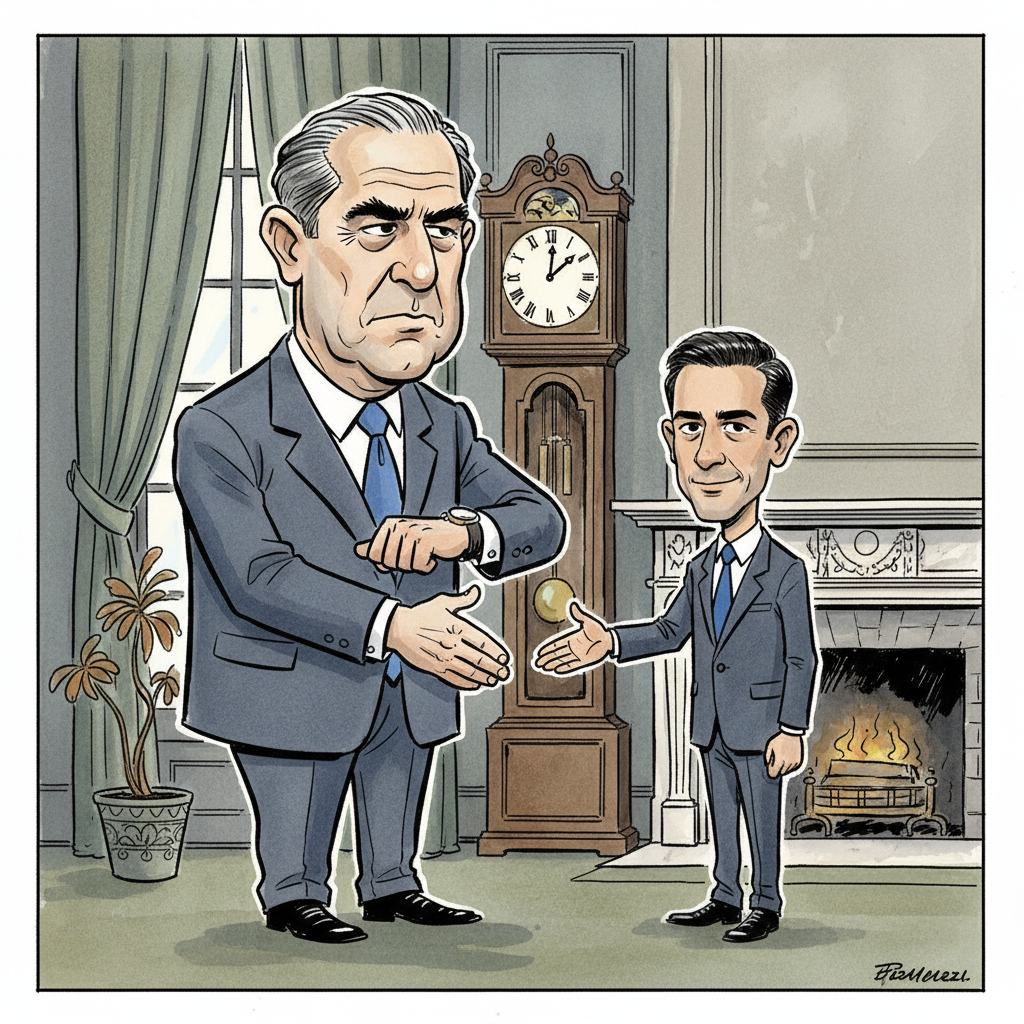
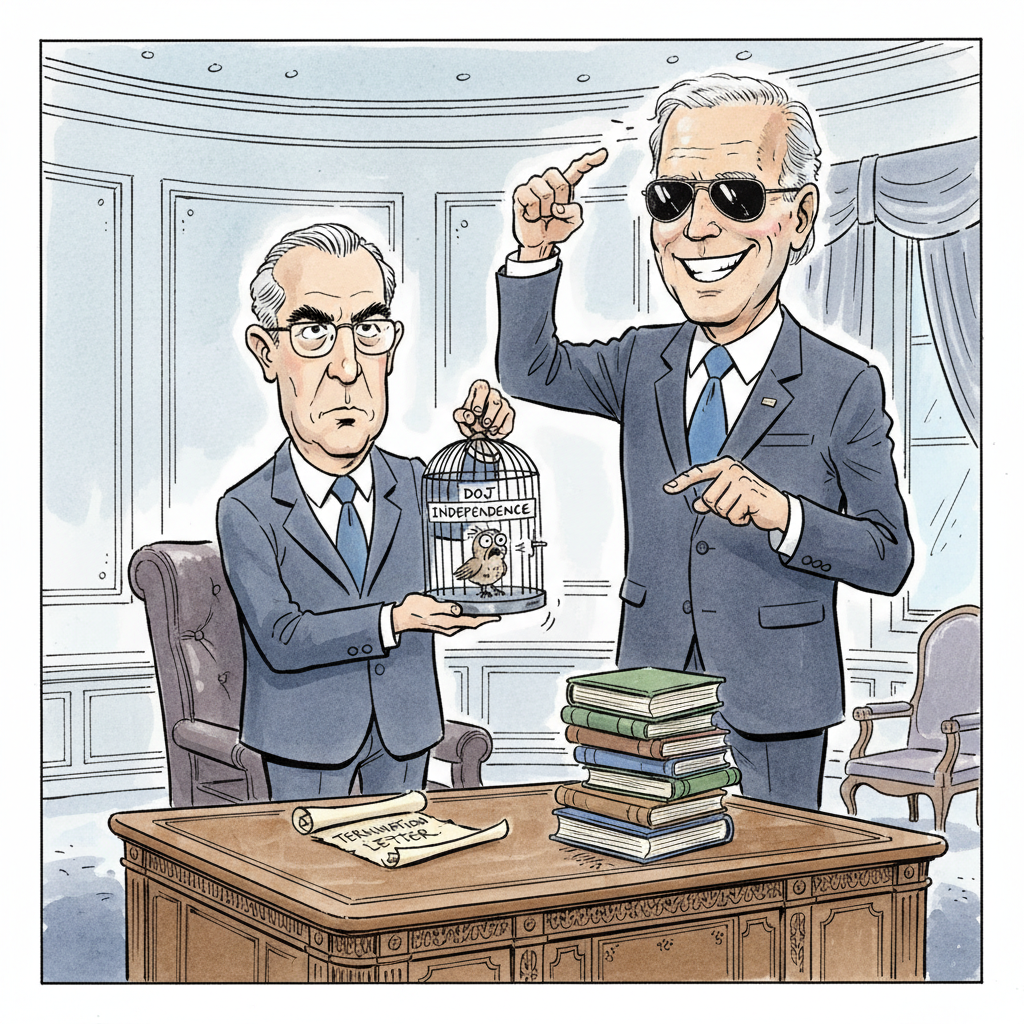
In a move that has legal scholars everywhere clutching their pearls (or their Gavel-Brand™ coffee mugs, more likely), Attorney General Merrick Garland has bravely stepped forward to confirm what we all suspected: the President of the United States possesses the divine, unchallengeable authority to summarily dismiss any and all public servants who dare to displease his imperial sensibilities. This groundbreaking revelation came amidst swirling rumors of a particularly 'robust' exchange between President Biden and U.S. Attorney for Washington, D.C., Matthew Graves. Garland, ever the picture of judicial stoicism, affirmed that Graves was doing a "good job," immediately after clarifying that said 'good job' could be rendered obsolete faster than a Blockbuster membership if the Commander-in-Chief felt like it. Critics, who apparently missed the memo on how absolute power works, were quick to point out the potential implications for the independence of the Justice Department. But really, what's a little judicial independence when compared to the President's undeniable right to a civil servant who remembers to say 'sir' with the proper level of deference?
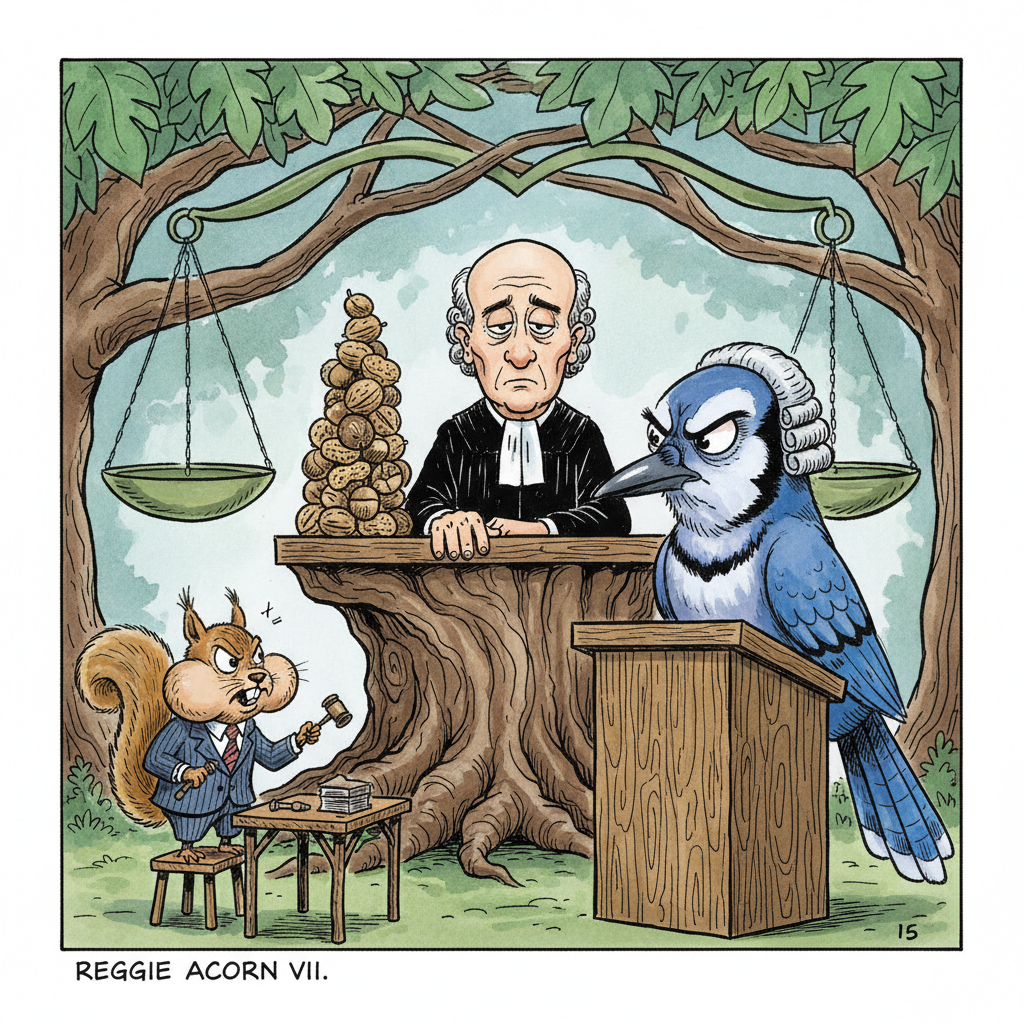
In a stunning display of interspecies legal friction, renowned bushy-tailed luminary, Reginald 'Reggie' Acorn VI, finds himself embroiled in a judicial quagmire following accusations of 'unreasonable accumulation of prime autumnal specimens.' Sources close to the defendant, who boasts three consecutive 'Golden Tail' awards for outstanding tree-climbing prowess, assert that the charges are nothing more than a thinly veiled attempt to curb Reggie's undeniable entrepreneurial spirit and his revolutionary approach to subterranean wealth management.
The prosecution, allegedly marshaled by a shadowy collective of particularly territorial blue jays, contends that Reggie's latest cache, estimated at 3,000 walnuts and a 'suspiciously high' concentration of artisanal pecans, constitutes a monopolistic practice. 'His insatiable appetite for economic dominance is threatening the very fabric of our forest's delicate market ecosystem,' declared an anonymous, squawking legal brief. Reggie, through his newly appointed human legal team, maintains his innocence, insisting his actions are merely 'prudent long-term investment strategies' and a 'necessary hedge against avian market volatility.' Observers note the entire spectacle might be a clever diversion from the true scandal: the ongoing 'Pine Cone Cartel' investigation.
Local Michigan political consultant Chad 'The Oracle' Bingham, reached mid-scour of LinkedIn for new opportunities, confirmed today that William Lawrence's primary victory was, in fact, a flawless execution of the 'winning the battle, conceding the war' strategy. Lawrence, a man whose policy positions are rumored to have been sourced from a late-night Reddit debate thread and then distilled through a wood chipper, handily dispatched two moderates who foolishly believed 'electability' was still a thing.
Experts suggest Lawrence's unique blend of uncompromised ideological purity and rhetorical flair (reportedly including the phrase, 'Look, if you're not burning down the oligarchs' summer homes, are you even trying?') will resonate powerfully with the precisely 37 voters who show up to every obscure progressive caucus meeting. His Republican opponent, whose most radical stance is reportedly advocating for slightly fewer potholes, is said to be 'deliriously pleased' with the upcoming November matchup, already pre-ordering his victory cigars and commissioning a bronze bust of Lawrence, for ironic purposes.
A preliminary analysis by the National Park Service has reportedly concluded that former President Trump’s proposed 250-foot-tall triumphal arch, a monument to… well, *something*, could, regrettably, "detract" from dozens of historical sites across Washington D.C. and Arlington, Virginia. While the exact definition of "detract" remains a closely guarded bureaucratic secret, sources close to the Park Service suggest it involves a sudden, inexplicable urge to stare intently at the giant gold arch instead of, say, pondering the poignant sacrifice evident in the hallowed grounds of Arlington Cemetery. Critics argue that obstructing the view of the Washington Monument or the Lincoln Memorial with a colossal, golden 'T' shaped arch is merely the logical next step in our nation's ongoing commitment to visual stimulation over historical reflection. The project, proponents insist, is designed to enhance the D.C. skyline, much like a strategically placed disco ball enhances a somber funeral parlor. Furthermore, the arch would provide a much-needed focal point, allowing tourists to finally experience the joy of seeing all of Washington's most iconic landmarks from the precise angle Mr. Trump prefers.
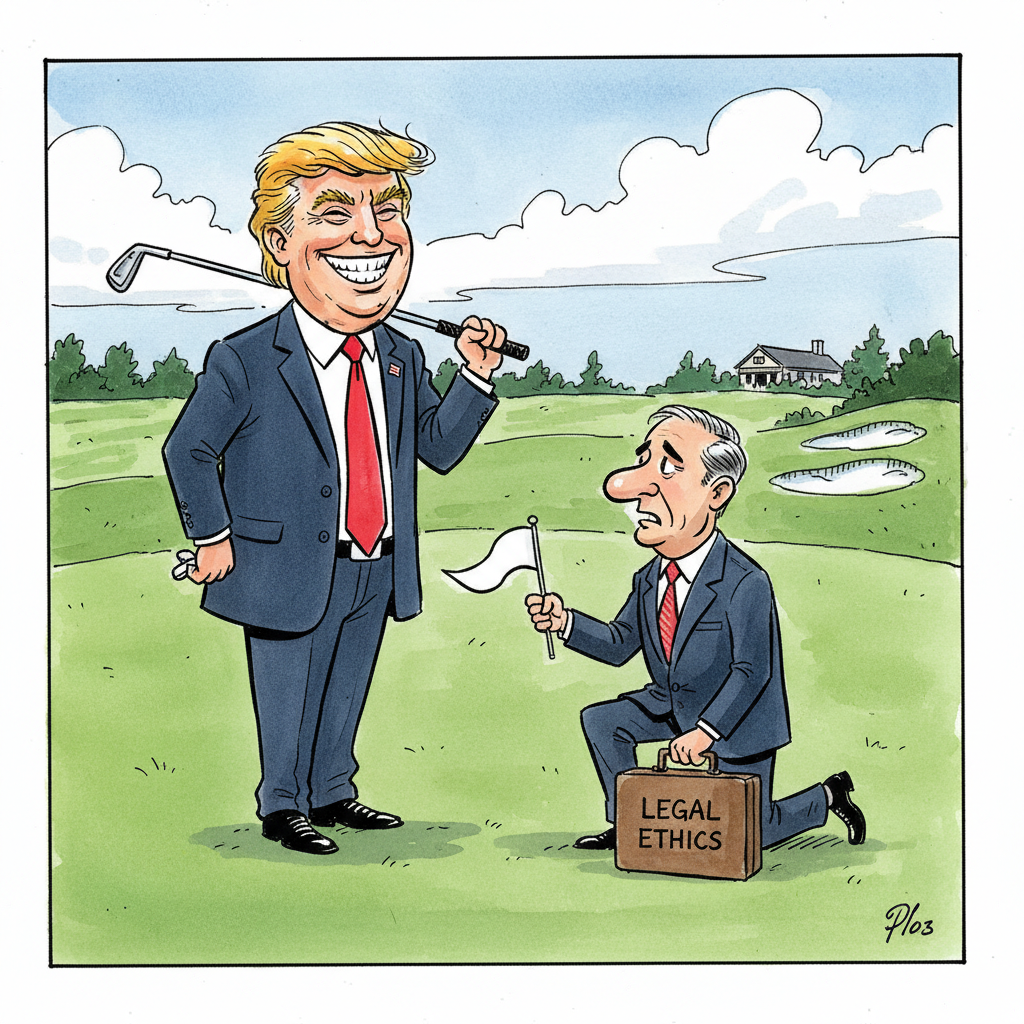
A stunning exposé reveals that prominent law firm Paul Weiss, once heralded as the legal industry's valiant shield against presidential whims, apparently discovered that a principles-based stand is significantly less lucrative than a principles-flexible squat. Sources close to the firm, identified only as 'someone who saw the invoices,' confirm a sudden, industry-wide reevaluation of what 'resistance' truly entails. Turns out, it often entails a strategic retreat, particularly when facing a deeply tanned, golf-enthusiast-in-chief whose legal team specializes in aggressive litigation and even more aggressive invoicing.
Insiders suggest the pivotal moment occurred when a senior partner, mid-sentence about the sanctity of democratic institutions, glanced at a spreadsheet projecting future billable hours if they just... *didn't*. The ensuing 'capitulation' wasn't so much a surrender as it was a remarkably efficient market correction, demonstrating that even the most high-minded legal eagles can be persuaded by the compelling arguments of a surging stock portfolio. The legal community is now grappling with the uncomfortable truth that their moral compass might, in fact, be directly wired to their quarterly earnings report.
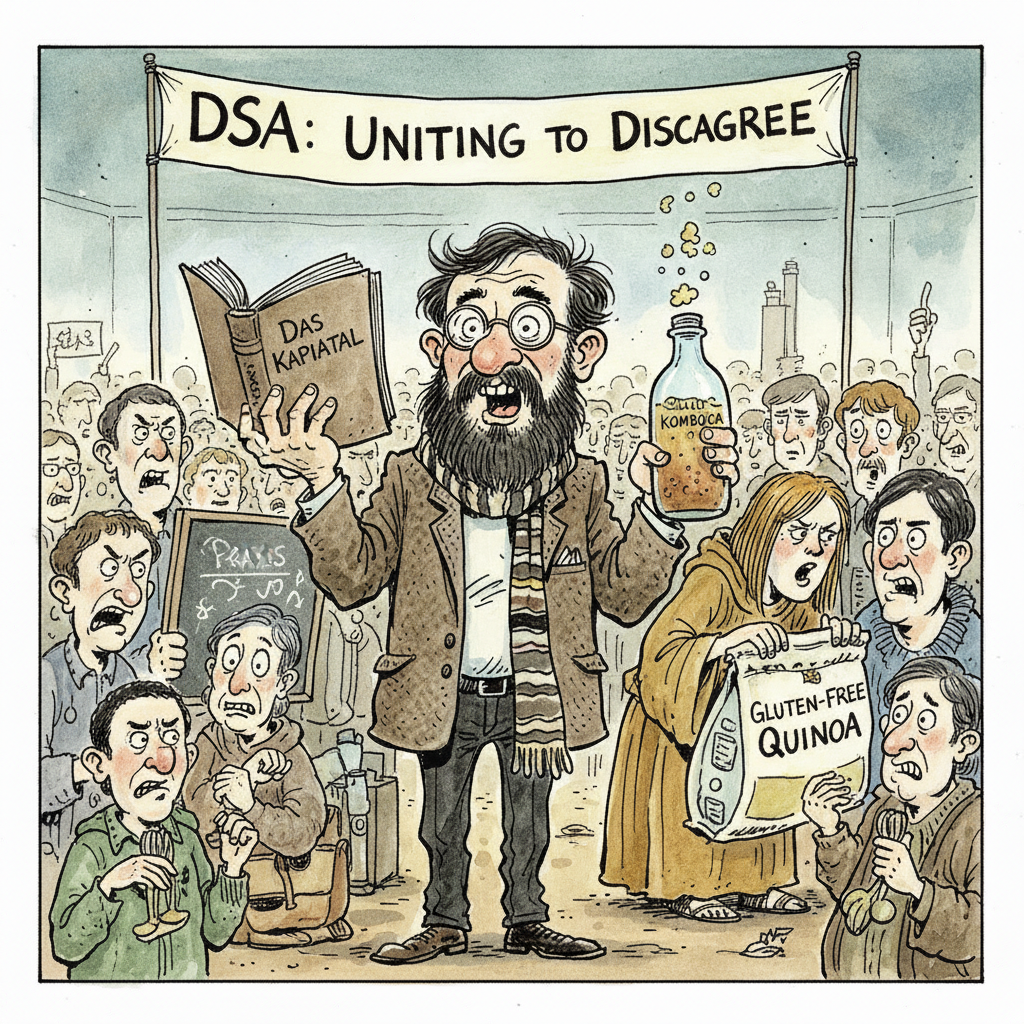
In a truly groundbreaking display of ideological fortitude, attendees at the Democratic Socialists of America's national summit reportedly achieved a staggering 100% agreement – on the fact that unanimous agreement isn't, and indeed shouldn't be, the ultimate objective. Sources within the sprawling convention hall described a palpable "nervous energy," which, when translated from activist-speak, apparently signifies a highly productive state of existential dread. One delegate, observed meticulously color-coding their dissent with artisanal beeswax crayons, proudly declared, "Our strength lies in the rich tapestry of our irreconcilable differences! To coalesce would be to surrender to the very hegemony we critique!" The consensus to not have consensus is being hailed by some as a quantum leap in political philosophy, while others are still trying to figure out if the potluck contributions were truly vegan.
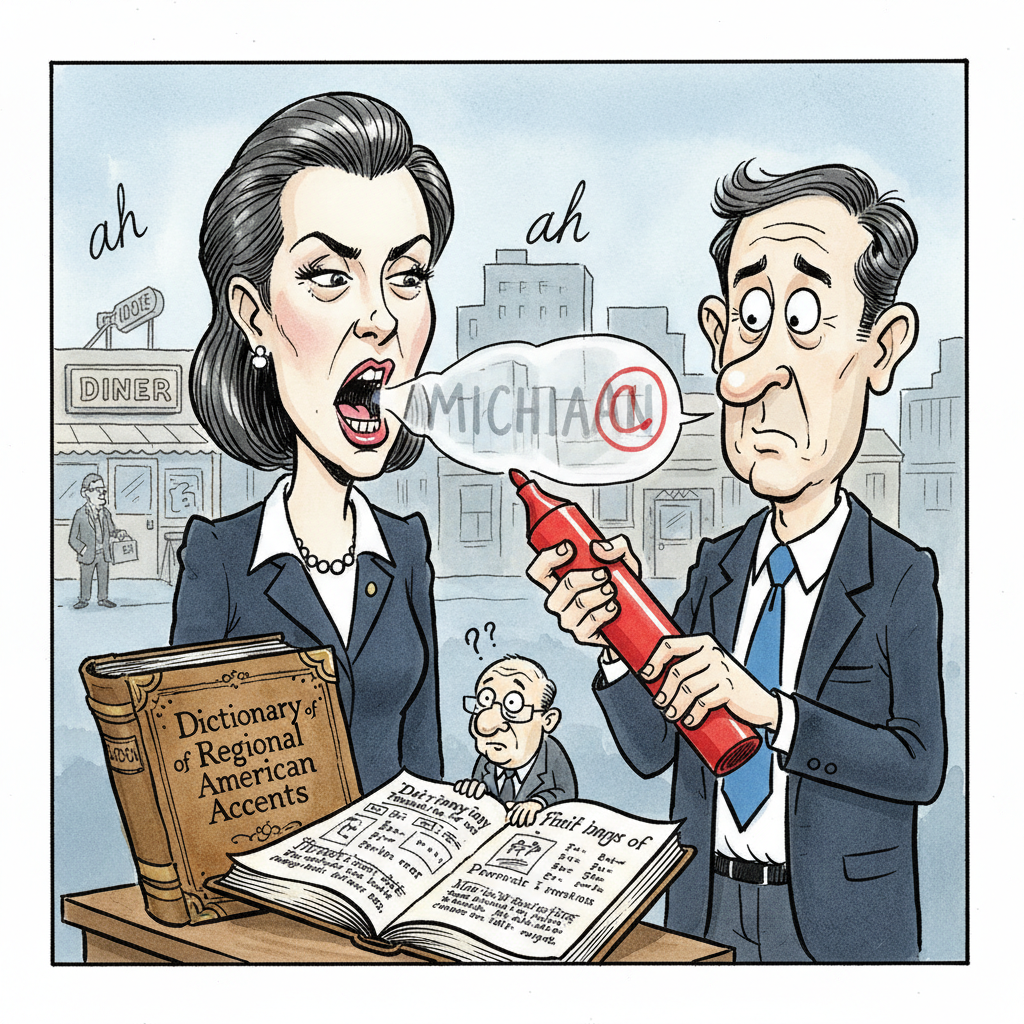
In a stunning display of constituent engagement, discerning Michigan voters have reportedly pivoted from mundane policy concerns like infrastructure decay and economic stagnation to the far more pressing issue of how gubernatorial hopeful Haley Stevens *pronounces her vowels*. Specifically, her 'raised a’s' and 'disappearing g’s' have become the unexpected Everest atop the state’s political landscape, overshadowing quaint notions of legislative effectiveness. Critics, comprised almost entirely of regional linguistics professors and particularly bored pundits, suggest this linguistic jousting is a bold new frontier in American politics, wherein elocutionary prowess now trumps a nuanced understanding of, well, anything at all. One anonymous campaign strategist, clearly a connoisseur of political high art, mused, “Why debate healthcare when we can dissect the subtle differences between a 'car' and a 'cahr'?” Experts predict a nationwide trend, with upcoming elections potentially decided by candidates’ ability to flawlessly deploy the Shibboleth Test, ensuring only those with impeccably non-regional accents can assume office, thus finally uniting the nation in a common, subtly condescending dialect.
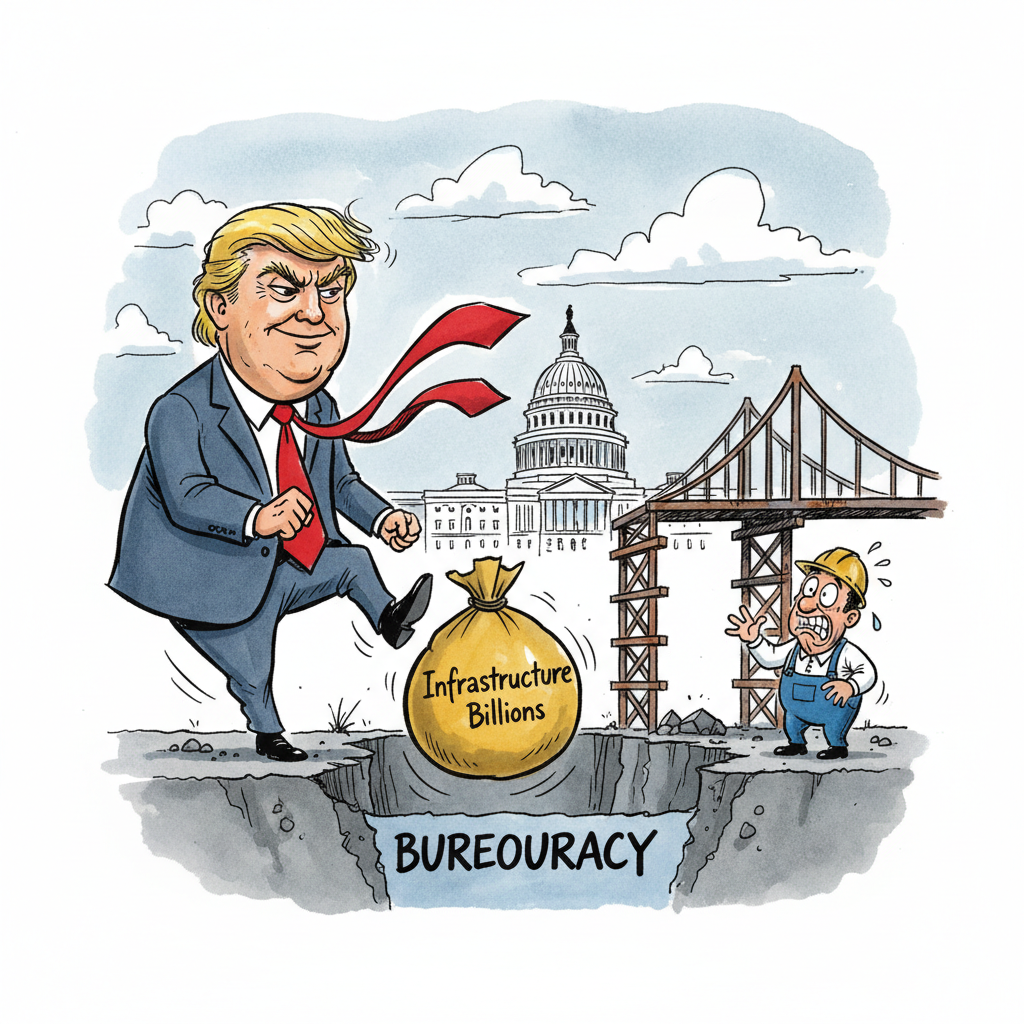
Washington D.C. — A recent audit, conducted entirely by interns fueled by cold brew and existential dread, suggests that tens of billions of dollars earmarked for 'transformative' public transit projects have effectively vanished into the budgetary ether. Experts, none of whom could be reached for comment because they were busy attempting to translate congressional spending bills into a coherent language, speculate that the funds may be undergoing a prolonged 'pre-approval stasis' within the labyrinthine bowels of the Department of Transportation. This unprecedented fiscal black hole has left state and local authorities scratching their heads, largely because said heads were designed to process local traffic patterns, not the quantum mechanics of federal appropriations.
Sources close to the administration, who spoke on condition of anonymity while subtly adjusting their MAGA hats, indicated that the 'slowdown' is less a deliberate act and more a 'natural consequence of not wanting to disrupt certain delicate ecosystems of inefficiency.' One insider quipped, "Why build a high-speed rail line when you can fund a really impressive study about the potential for high-speed rail lines? It's much less disruptive to the existing pavement-industrial complex." Critics, primarily those constituents who still commute via horse-drawn carriage in cities that promised light rail by 2008, argue that this 'strategic non-expenditure' is less about fiscal prudence and more about the uncanny ability of bureaucracy to transmute hard cash into pure, unadulterated congressional inertia.
It appears the former President, in a move that absolutely no one saw coming, is championing nuclear energy with the unblinking fervor of a man who just discovered unlimited power and whose closest associates happen to own stock in uranium mines. While the public relations department for 'Nuclear Energy: Good for America, Better for Trumps' insists there's no direct pipeline from domestic atom-splitting to Ivanka's trust fund, the subtle tremors of 'overlapping business interests' are apparently powerful enough to register on the Richter scale of ethical quandaries.
Sources close to the administration – or perhaps just people who read the 'Who's Who in Mar-a-Lago Holdings' – suggest that a lucrative Saudi nuclear deal isn't merely an energy initiative, but a geopolitical jigsaw puzzle where all the pieces are shaped suspiciously like various Trump-affiliated corporate logos. One insider, who wished to remain anonymous for fear of being 'appointed' to a new, exceedingly dusty role, dryly observed, 'It's less about building a brighter future and more about ensuring certain portfolios become incandescent.' Experts are now debating whether 'conflict of interest' will finally be rebranded as 'synergistic prosperity.'
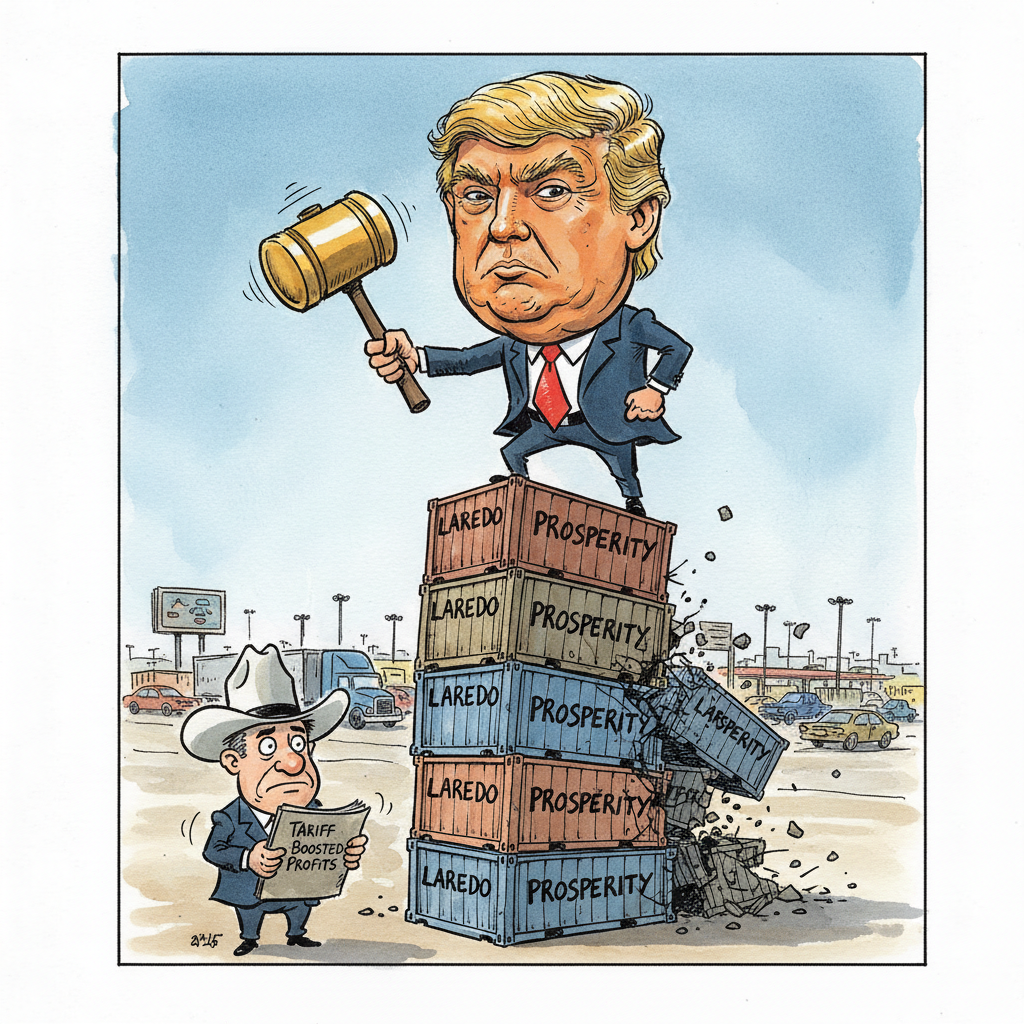
A palpable, yet impeccably manicured, unease has settled over the sun-drenched, tariff-fueled boomtown of Laredo, Texas. The city, which previously discovered that an economic 'boom' can, in fact, be directly correlated with the imposition of punitive trade barriers on all its closest neighbors, is now nervously eyeing the presidential Twitter feed for signs of its imminent demise. Local analysts, who once hailed the former president as an 'unconventional genius' for accidentally supercharging their cross-border logistics industry by making everything else prohibitively expensive, are now simply calling him 'the guy with the big red button.'
Businesses, having just finished celebrating a three-year fiscal run so dizzying it's been dubbed 'The Great Tariff-Induced Sugar Rush,' are reportedly stockpiling everything from industrial-grade Advil to pre-written layoff notices. One prominent logistics CEO, requesting anonymity lest he be designated a 'low-energy loser,' quipped, 'We’ve enjoyed the ride, but frankly, it’s like having a very large, orange, unpredictable toddler with a sledgehammer as your primary economic consultant.' The city’s future, it seems, is now less about free markets and more about precisely how many more times the nation's former chief executive can redefine 'winning' before Laredo simply evaporates in a puff of unintended consequences.
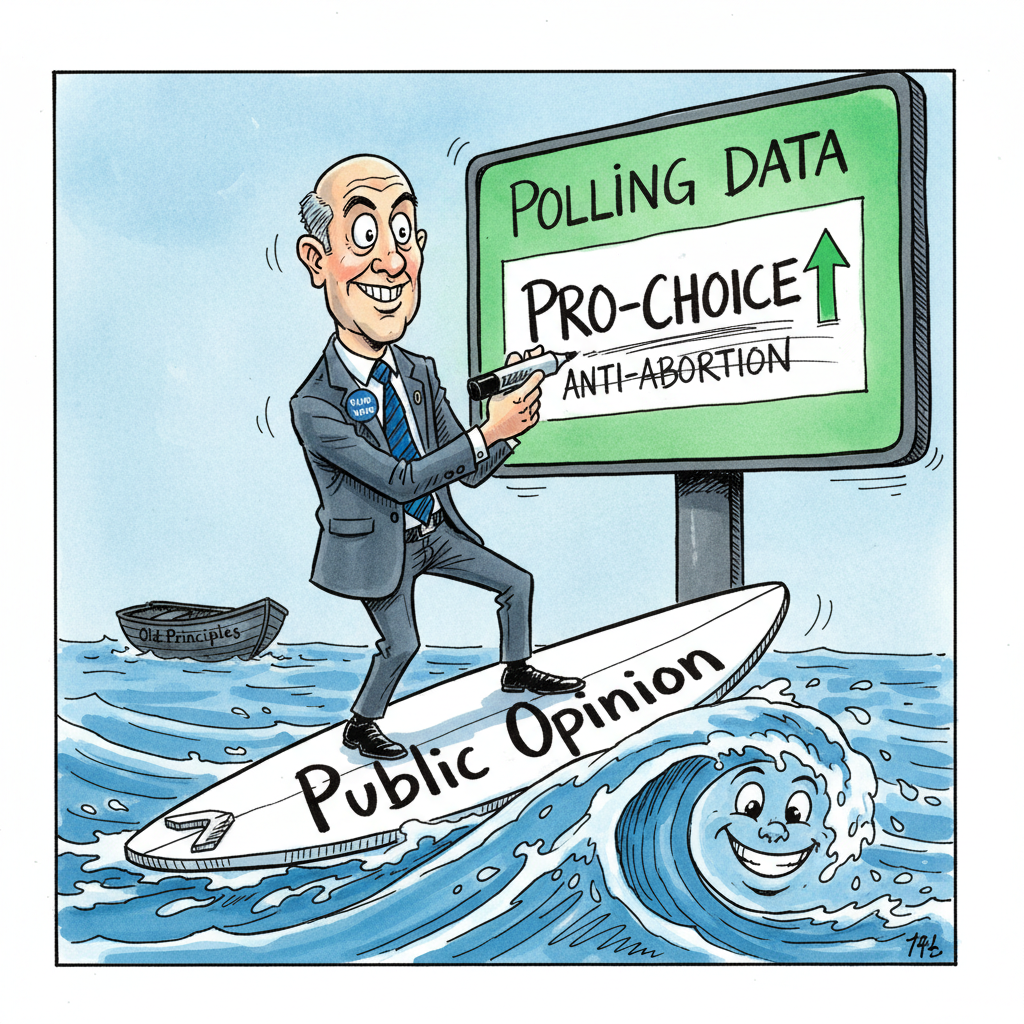
Washington, D.C. – It appears the 'evolution' of former anti-abortion stalwart Troy Jackson, now a progressive darling, is less a profound spiritual journey and more a masterclass in demographic responsiveness. Sources close to the campaign, who spoke on condition of anonymity whilst vigorously polishing their campaign-branded 'shift-and-shine' ethics kits, reported that Jackson awoke one morning with a sudden, inexplicable urge to align his personal convictions with the latest focus group data. Observers note that his once 'deeply held beliefs' on social issues seemingly dissolved faster than a sugar cube in a particularly strong espresso – coincidentally, after polling numbers indicated a sugar-cube-dissolving level of unpopularity for those views.
Campaign strategists, who modestly prefer the term 'ideological navigators,' lauded Jackson's flexibility, calling it a 'refreshing absence of rigid, pre-Cambrian conviction.' One flack, midway through a rather aggressive PowerPoint presentation titled 'Embrace the Zeitgeist: A Candidate's Guide to Philosophical Pilates,' explained that Jackson's 'authentic growth' was simply proof that a truly democratic leader is always willing to let the electorate be their moral compass, GPS, and occasional emergency brake. Critics, however, speculate that if public opinion suddenly swung towards competitive tiddlywinks as a federally mandated sport, Jackson would be found on Capitol Hill demanding universal access to highly specialized, ethically sourced squidger-wielding instruction.
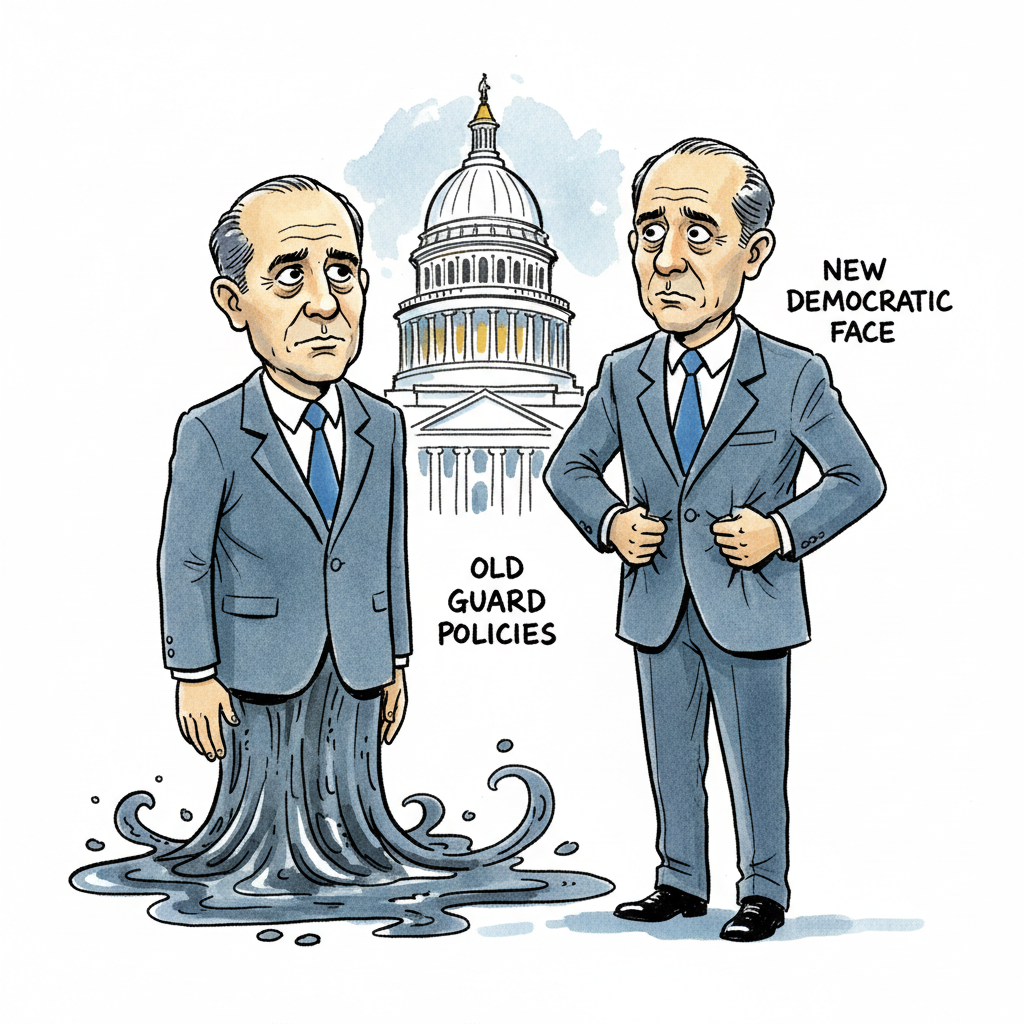
Washington, D.C. – In a move that has political analysts scrambling to locate their "Deja Vu" buttons, Maine's burgeoning senatorial contest appears poised to deliver a thrilling, high-stakes game of 'Spot the Difference' as Troy Jackson, a man whose policy positions are reportedly indistinguishable from his predecessor, Graham Platner, consolidates his front-runner status. Sources close to the campaign, who spoke on condition of anonymity to avoid being mistaken for Platner's former interns, confirm Jackson's pivot from Republican to Democrat was less a principled ideological shift and more a sophisticated quantum entanglement experiment, collapsing all possible political realities into one singular, familiar state. Campaign strategists are reportedly ecstatic, touting Jackson's 'unprecedented commitment to sameness' as a refreshing break from the disruptive chaos of... well, anything else. Voters, meanwhile, are just grateful they won't have to learn a new set of buzzwords. Expect a riveting campaign where the most dramatic difference might be the brand of bland, locally sourced organic kale chips served at rallies.
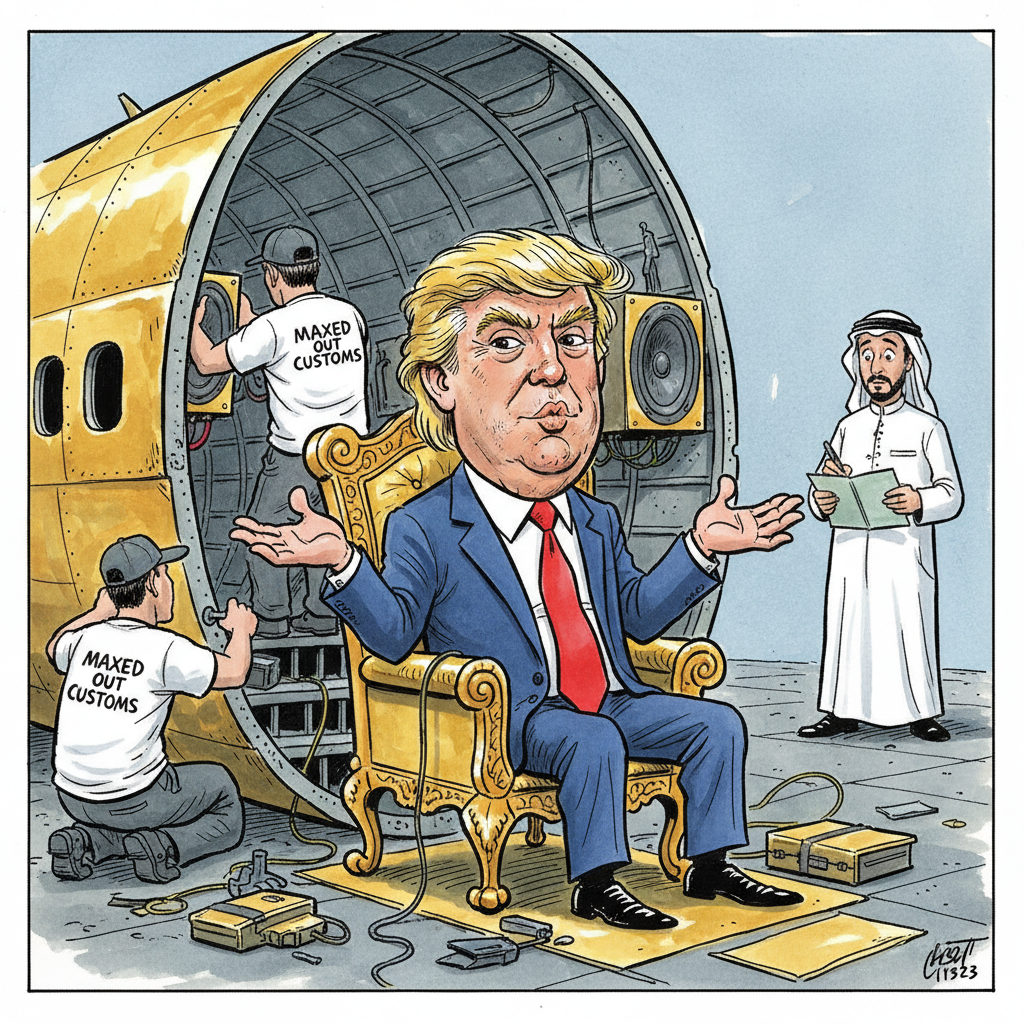
In a move that has left aviation experts (and anyone with a passing acquaintance with physics) scratching their heads, former President Donald Trump announced that the Qatari-donated 747, slated to become the next Air Force One, will be taken 'out of service to be maxed out.' One can only assume this involves installing chrome rims, underglow lighting, and perhaps a 12-inch subwoofer system, transforming the presidential transport from a flying fortress into a mobile rave. The plane, already under scrutiny for allegedly lacking sufficient 'defensive capabilities' – presumably, beyond the standard diplomatic charm offensive – is now poised to undergo a bespoke customization process that will reportedly make it 'the most luxurious, most secure, and frankly, the most beautiful plane ever built, perhaps in all of history.'
Critics, who clearly lack the vision to appreciate true vehicular artistry, have questioned the practical implications of 'maxing out' a 747 destined to carry the leader of the free world. Air traffic controllers are reportedly preparing for the future possibility of an Air Force One emitting a low-frequency rumble audible from three states away, punctuated by the occasional blast of 'Eye of the Tiger.' Furthermore, sources close to the project confirm that classified 'defensive upgrades' may involve 24-karat gold plating (for structural integrity, naturally) and a personal valet service for the onboard tactical nuclear football, ensuring it always arrives perfectly chilled.
Washington D.C. — In a bold, yet largely unsuccessful, strategic maneuver, President Trump recently deployed Marine One over MetLife Stadium, presumably to gauge the maximum effective altitude for absorbing adulation. Sources close to the golfing greens suggest the Commander-in-Chief's meticulously planned 'spontaneous appearance' at the World Cup final was a calculated effort to become the physical embodiment of the 'participation trophy' generation, albeit on a far grander, gold-plated scale. Eyewitnesses report the president, having successfully executed his signature 'stroll and wave' at a previous sporting spectacle, was heard mumbling concerns about the suboptimal lighting for his particular brand of championship-adjacent gravitas. Insiders confirm the elaborate aerial reconnaissance mission was primarily to determine if the roar of 82,000 sports enthusiasts could be adequately funneled into a single, presidential ego, sans the requirement of actually *playing* the game. The incident marks the second time the executive branch has seemingly confused a major athletic event with an impromptu campaign rally, leaving many to wonder if future State of the Union addresses will now require a halftime show featuring a surprise visit by a surprise visitor.
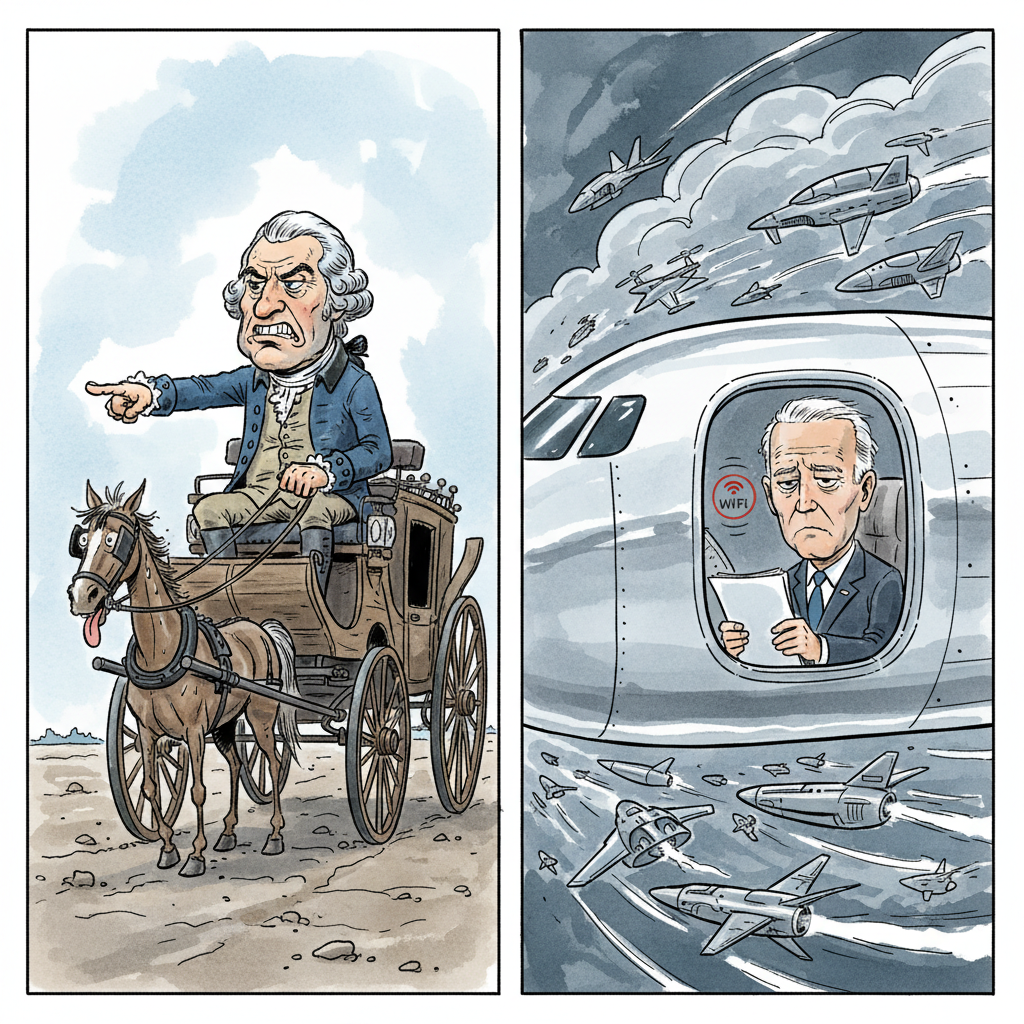
It seems that even the most powerful person in the free world still grapples with the indignities of a morning commute, albeit one historically furnished with significantly more pomp and fewer existential dread-inducing bus smells. For a quarter-millennium, American presidents have, with remarkable consistency, swapped increasingly elaborate yet ironically less efficient modes of transport, all in the service of projecting an image of unrivaled national prowess. One can only imagine the sheer delight on George Washington’s face upon realizing his new "executive carriage" boasted not one, but *two* horses, effectively doubling his top speed from "plodding" to "assertively plodding." Our forefathers truly understood the subtle art of performative transit.
Fast forward to today, and the modern Commander-in-Chief, encased in the airborne fortress known as Air Force One, experiences a level of hermetic isolation that would make a deep-sea diver nervous. What began as a simple matter of getting from Point A to Point B has transmogrified into a billion-dollar ballet of security protocols, press junkets, and an ever-present, low-humming anxiety that the in-flight WiFi might, at any moment, broadcast the true nature of their domestic policy decisions to the entire world. Indeed, the only real constant in this transportation saga is the taxpayer, perpetually saddled with the bill, whether it's for hay and oats or reinforced titanium and a fully stocked M&M dispenser.
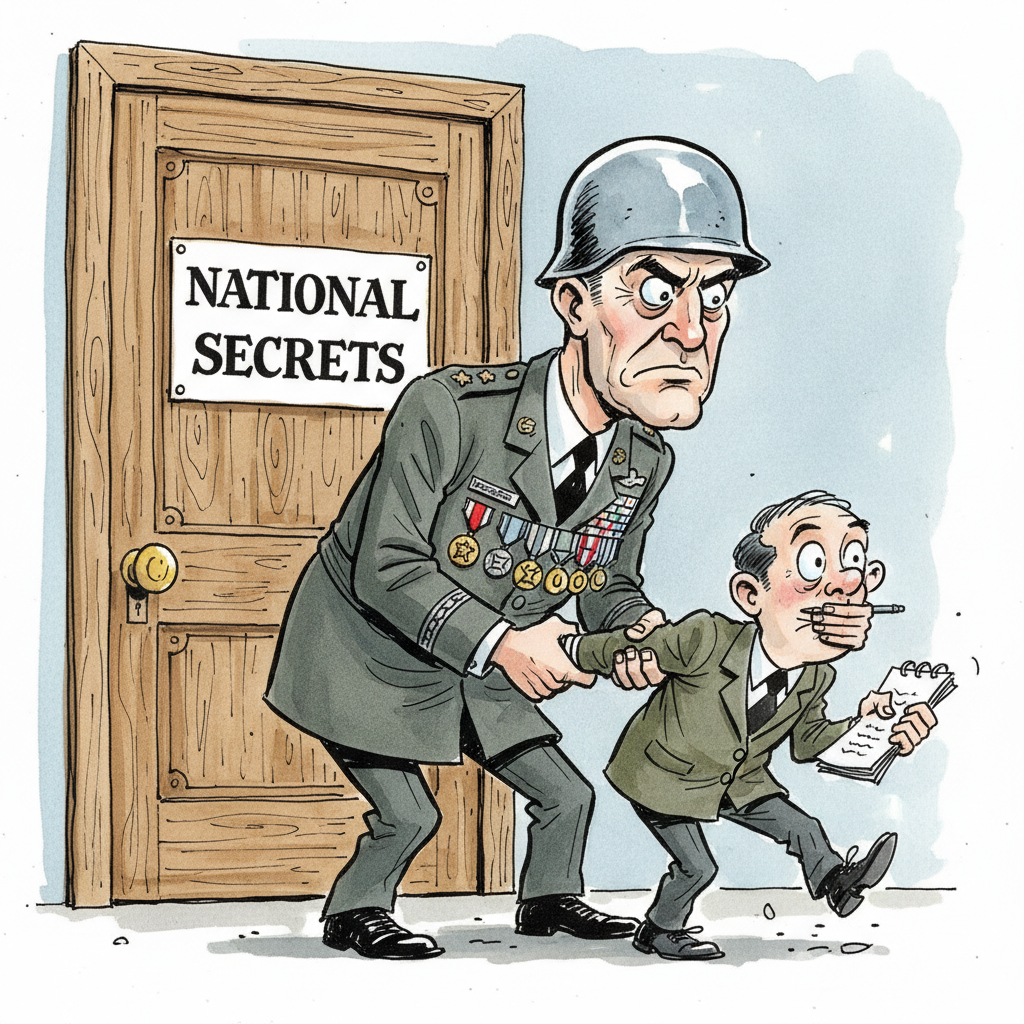
In a decisive leap backward for journalistic independence, a federal appeals court has generously gifted the Pentagon back its cherished right to infantilize the press. Starting immediately, reporters daring to traverse the hallowed, fluorescent-lit halls of the nation's defense establishment will once again be chaperoned like particularly curious toddlers in a china shop – or, more accurately, like highly flammable objects in a nitroglycerin factory. This temporary reinstatement of the 'escort policy' comes as The New York Times valiantly attempts to pry open the DoD’s notoriously opaque kimono, inadvertently proving that some institutions are simply more comfortable with a strategically placed modesty panel. Critics, largely confined to newsrooms and various dimly lit basements, decry the move as an affront to accountability. However, Pentagon officials, who undoubtedly view journalistic scrutiny with the same fondness reserved for a colonoscopy performed by a badger, insist the policy merely ensures 'optimal informational flow' – a process apparently best achieved when every word uttered is pre-vetted by a handler whose primary directive is to emit the soothing, non-committal hum of a broken refrigerator. Expect future 'exclusive' reports to read less like investigative journalism and more like highly stylized brochures, complete with stock photos of beaming, diverse service members and captions like, 'Here, a soldier demonstrates the profound efficacy of stapling documents efficiently.'
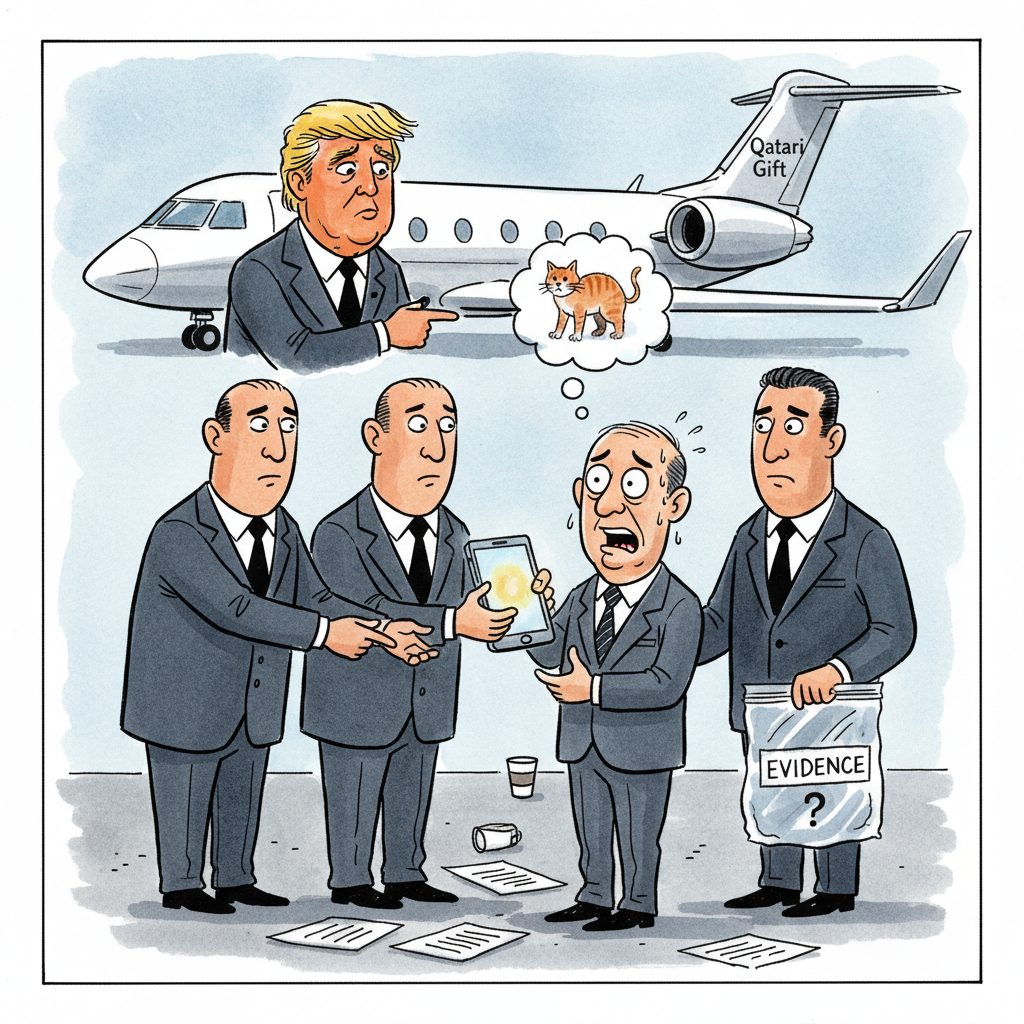
In a testament to the unparalleled efficiency of federal investigations, the FBI has reportedly initiated a highly bespoke, technologically advanced 'phone retrieval program' for former passengers of the recently 'Qatari-enhanced' Air Force One. Sources close to the inquiry, who definitely aren't just interns shuffling papers, indicate that the Bureau is particularly keen on perusing the digital detritus of those who rode the plush, Wi-Fi-enabled flying fortress with former President Trump last week. Apparently, the sanctity of classified information, or perhaps the appropriate thread count of the presidential toilet paper, was compromised. Agents, reportedly equipped with charming smiles and a surprisingly lenient 'no-questions-asked-unless-we-ask' policy, are making house calls to collect mobile devices. One former aide, speaking anonymously from behind a very large potted plant, described the process as 'less 'federal investigation,' more 'friendly neighborhood cell phone recycling program,' followed by 'Oh, wait, they totally took my phone.' Observers anticipate the Bureau's next move will involve demanding intricate details about onboard snack preferences and whether anyone dared to use the emergency exit row as a supplementary napping station.
In a move hailed by no one outside heavily padded boardrooms, PJM, the colossal orchestrator of electricity for a baker's dozen of states, has gracefully announced an upcoming $6.3 billion 'convenience fee' on the very act of not freezing or spontaneously combusting. This fiscal flourish isn't, as some might naively assume, due to an unprecedented surge in sentient toasters or industrial-scale pet rock incubation. No, the culprit is the relentless, insatiable hunger of data centers, those gleaming mausoleums of ones and zeroes that now apparently require more juice than a small nation of dedicated hairdryer enthusiasts.
Experts suggest consumers brace themselves for a new era where streaming a cat video might carry the carbon footprint of a small SUV and the utility bill of a minor sovereign state. One economist, who wished to remain anonymous lest their internet access be throttled, quipped, 'Soon, thinking about turning on a light switch might incur a surcharge. We're essentially paying a premium for the privilege of machines arguing with other machines in a language no human comprehends, but at least your AI-generated deep-dish pizza recipe loads instantly!' The future is now, and it's brought to you by the fine folks who believe your right to browse TikTok should cost roughly what it takes to launch a modest satellite.
Washington D.C. — In a move widely regarded by political scientists as 'strategically fluid' and by sentient housecats as 'grossly opportunistic,' Senator Lindsey Graham has flawlessly executed the rare 'political metamorphosis via direct orbit around the sun' maneuver. Once lauded for his unwavering commitment to calling a spade a 'kook,' the South Carolina legislator has seamlessly transitioned from a principled critic of former President Trump to, ostensibly, his personal valet with enhanced legislative privileges. Sources close to the senator, predominantly his own frequent appearances on cable news explaining his shift, indicate that the transformation was less about ideological conviction and more about recognizing that a 'moral compass' often points directly to where the power is currently residing. Graham's public explanation, 'I’m still in the game,' has been hailed by analysts as a groundbreaking philosophical treatise, simplifying centuries of ethical debate into a single, aggressively self-serving aphorism. Experts predict this groundbreaking strategy will usher in a new era of political pragmatism where 'integrity' is simply a brand identity one can easily pivot away from to maximize market share in the 'access' economy. Future historians will undoubtedly marvel at this pioneering display of ideological elasticity, or perhaps just sigh deeply.
Washington D.C. — A recent peer-reviewed study, funded entirely by unsolicited anonymous donations found tucked into a hollowed-out copy of 'The Art of the Deal,' has conclusively linked Senator Lindsey Graham’s uncanny ability to simultaneously irritate, appease, and baffle all political factions to the principles of quantum mechanics. Sources close to the Senator, primarily bewildered interns still reeling from whiplash, report that Graham’s legislative trajectory often defies Newtonian physics, allowing him to be both staunchly anti-Trump and zealously pro-Trump, often before lunch. “It’s like he exists in a superposition of all possible political stances until observed,” mused one bewildered Capitol Hill staffer, adjusting their spectacles. Experts believe this 'Graham's Uncertainty Principle' explains his unparalleled knack for appearing at every legislative fight like a well-dressed, slightly exasperated genie, always ready to cut a deal, or occasionally, a swathe of bipartisan goodwill. The scientific community is now racing to determine if his 'magnetic' personality is a metaphor, or if he's actually just walking around with a powerful magnet concealed somewhere on his person.
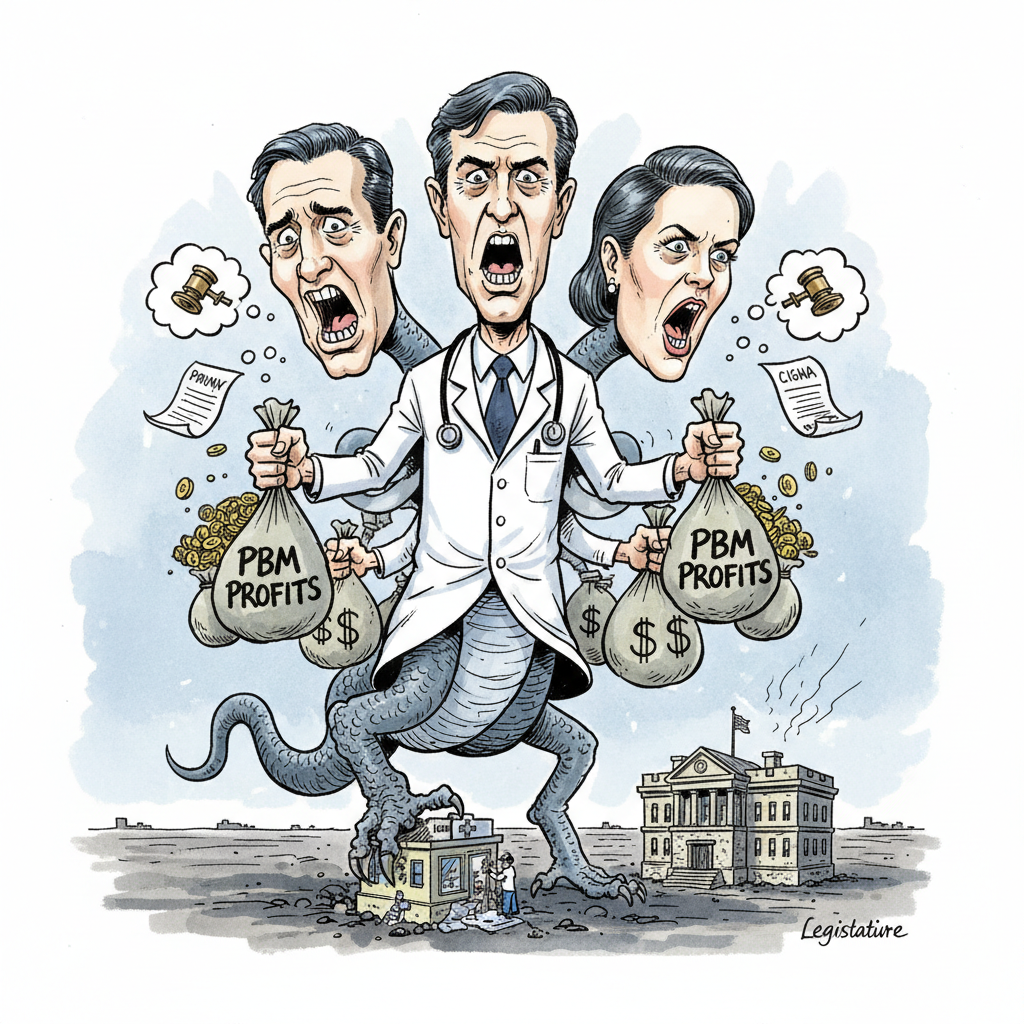
In a stunning display of corporate victimhood, an elite triumvirate of health insurance behemoths – UnitedHealth Group, CVS Health, and Cigna – have collectively developed a severe case of the vapours after states dared to suggest they shouldn't control both your health coverage and the entire pharmacy supply chain. Apparently, the notion of allowing actual market forces to dictate drug prices rather than a labyrinthine internal accounting system has sent these multi-billion-dollar entities into a litigation-fueled frenzy, suing multiple states for the gall of attempting to foster 'anti-monopolistic' environments. Sources close to the titans report widespread confusion, with one anonymous executive reportedly exclaiming, "Next, they'll want our 'Pharmacy Benefit Managers' to actually *manage* benefits for the consumer, not just our shareholder returns! The audacity!" Industry analysts largely agree: this is simply an unfortunate symptom of state-level governments misunderstanding the fundamental beauty of highly integrated, slightly-too-large corporate efficiency – a system where everyone *else* pays more, but everything runs so smoothly for the people at the very top.
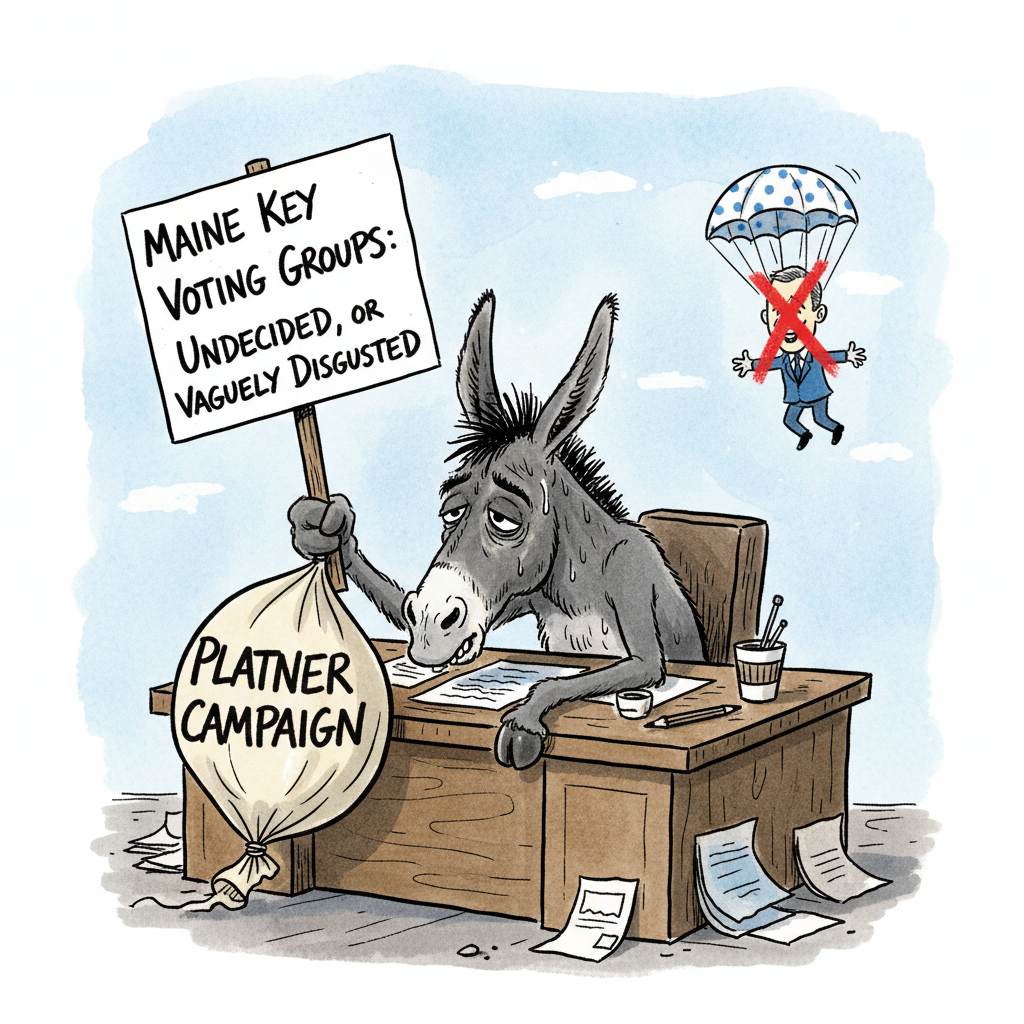
A collective sigh of relief, audible only to the most finely tuned political seismographs, rippled through the Democratic party ranks this week as sources hinted at the potential withdrawal of Candidate Platner. Insiders characterize the decision as a "strategic maneuver to avoid… performing poorly," a bold new frontier in electoral prowess not seen since the invention of the disqualifying scandal. Analysts, fresh from dusting off their 'Moral Victory' playbooks, suggest Platner's absence would dramatically improve the party's odds of not having another person they sponsored lose quite so spectacularly.
Indeed, Platner's unique ability to alienate precisely those demographics he was designed to charm—ranging from "fiscally conservative lobsterpersons" to "socially liberal lumberjacks with strong opinions on municipal zoning laws"—had become a rather inconvenient feature, much like a car that only drives in reverse. Experts predict his stepping aside could free up valuable campaign resources, primarily allocated to finding new and innovative ways to explain why his polling numbers were actually good, if you adjusted for the 'uninformed voter' demographic and the phase of the moon. Maine's electorate can now look forward to a slightly less confusing primary, which, for many, is a win in itself.
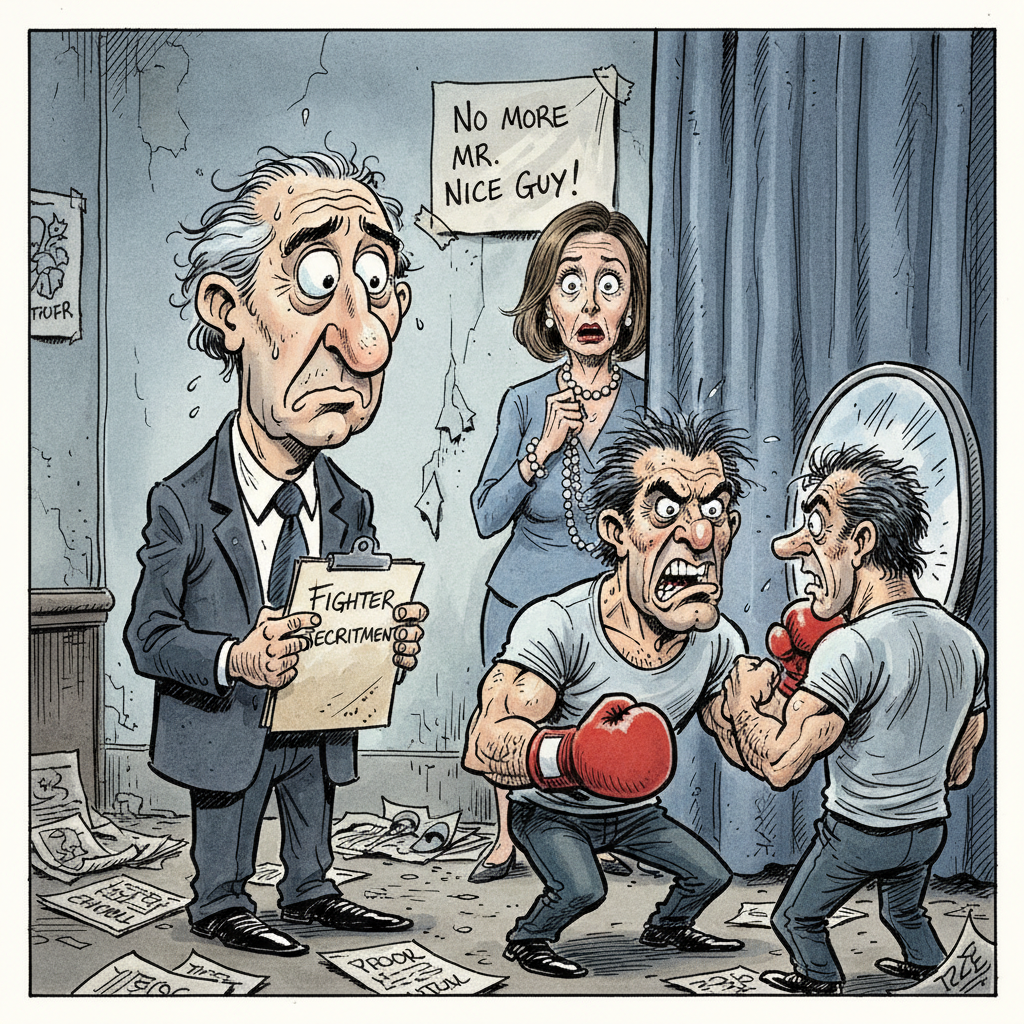
A collective sigh, reportedly audible from sea to shining sea, has rippled through the Democratic Party's inner sanctum. For years, the party of carefully worded press releases and focus-grouped policy proposals has quietly yearned for a 'pugilist' – a fancy word, sources indicate, for someone willing to yell very loudly. Now, as the specter of a second Trumpian midterm looms, that yearning has metastasized into a full-blown existential crisis, prompting an unprecedented internal "Rage-Recruitment Drive." Party strategists, who previously advised candidates to "maintain a dignified inscrutability," are now reportedly circulating annotated copies of Machiavelli's *The Prince* — with all the parts about 'appearances of virtue' heavily redacted. The fear, naturally, is that this sudden pivot from polite indignation to outright fisticuffs might, gasp, alienate the meticulously polling-informed moderate wing, which, it is well known, prefers its political skirmishes conducted via strongly worded letters to the editor.
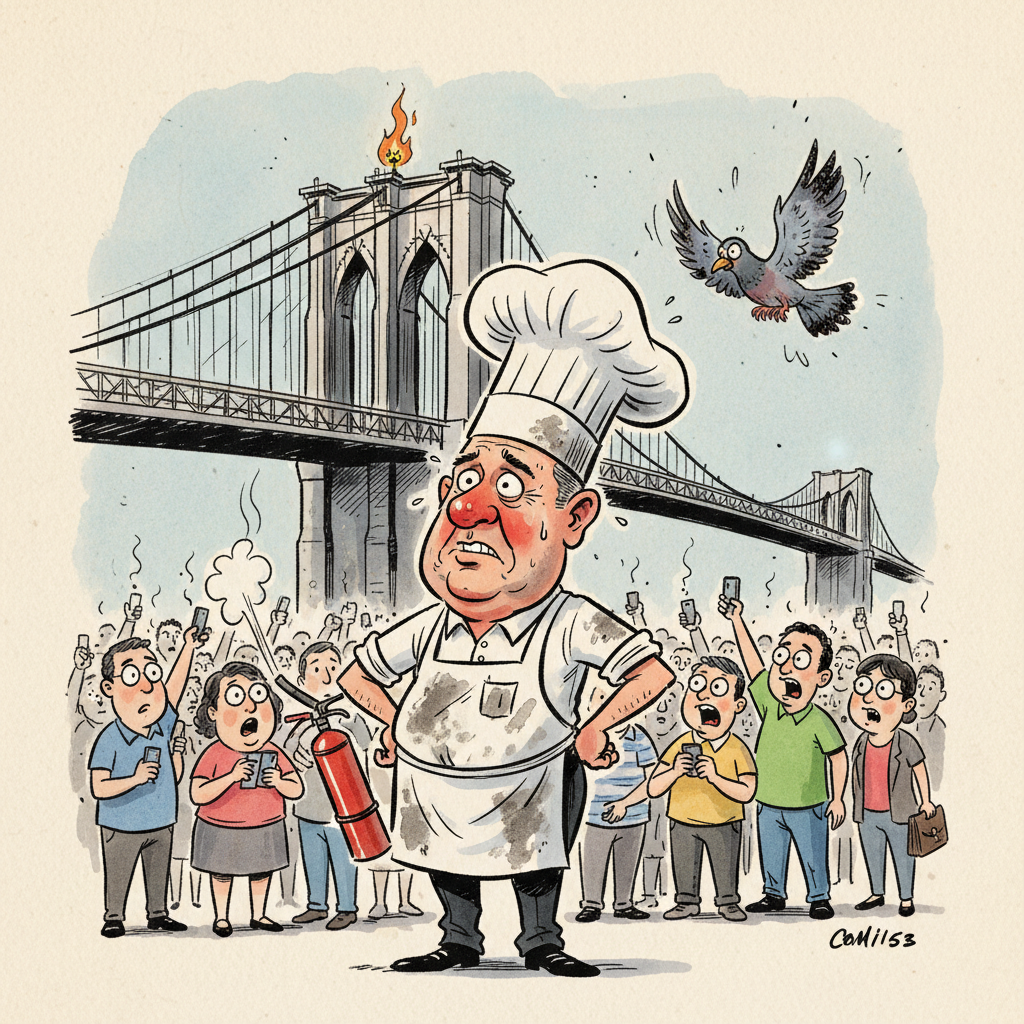
In a bold move that some are calling an "unprecedented act of structural self-expression," the Brooklyn Bridge, venerable icon of architectural stoicism, reportedly decided to briefly set itself ablaze during a fireworks display. Authorities, after a thorough 24-minute investigation, concluded the entire incident was a 'spontaneous combustion' event, likely triggered by an overabundance of public delight. "We believe the cumulative glee simply reached a critical mass," explained NYPD Commissioner O'Malley, adjusting his 'World's Okayest Cop' novelty tie. "The bridge, bless its heart, just couldn't handle that much unadulterated happiness."
Witnesses described fireworks 'landing' on the 141-year-old landmark with the gentle precision of a guided drone strike, igniting what appeared to be some kind of 'flammable substance' commonly known to urban planners as 'bird nests and debris from prior fiscal years.' No injuries were reported, aside from a few tourists who suffered mild whiplash attempting to simultaneously Instagram the blaze and the official fireworks. The bridge, meanwhile, has reportedly been given a stern talking-to and reminded that its job is to connect two boroughs, not to become a pyrotechnic performance artist.
A collective sigh of relief, audible only to those still clinging to the quaint notion of 'fairness,' rippled across Washington D.C. this week as federal agencies, under the sagacious guidance of President Trump, announced a startling statistical anomaly: reported discrimination cases have plummeted to an all-time, mathematically impossible low. Insiders suggest this isn't a failure of reporting, but rather a remarkable triumph of administrative redefinition, wherein the very concept of 'discrimination' has been delicately re-evaluated from an irksome legal quibble to mere 'personal preference' or 'unfortunate interpersonal chemistry.'
Experts laud this innovative approach, praising the efficiency of simply eliminating the problem by redefining it out of existence. "Why waste precious taxpayer dollars on protracted legal battles when one can achieve zero discrimination with a well-placed memo?" pondered Dr. Penelope Quibble, head of the newly formed Department of Intentional Blindness. This move is expected to drastically streamline government operations, allowing agencies to focus on more pressing matters, like perfecting the art of the 280-character policy announcement and locating the last remaining bag of Cheetos in the West Wing vending machine.
In a move that has both sides of the aisle clutching their pearls (or their AR-15s, depending on their preferred clutching implement), the Trump administration has embarked on an ambitious deregulation spree, dismantling gun safety measures at a pace usually reserved for a toddler disassembling a Lego castle. Officials, ever the paragons of semantic precision, characterized the rollback not as 'weakening' public safety, but rather 're-calibrating' the national landscape to its pre-Biden, Wild West, 'everyone's-a-deputy-and-also-potentially-a-target' baseline. Critics, bless their bleeding-heart naïveté, fretted about increased violence. However, savvy market analysts are already predicting a significant boom in the medical sector, specifically in organ procurement, with some suggesting this might be the innovative public-private partnership America has been waiting for to fully address the chronic shortage of transplantable kidneys, livers, and corneas. Think of it as a morbidly efficient form of trickle-down economics, where the 'trickle' is often quite literal and crimson. Indeed, one could argue that rather than diminishing public safety, the administration is merely accelerating the natural selection process, albeit with a slightly higher caliber of 'natural' element involved.
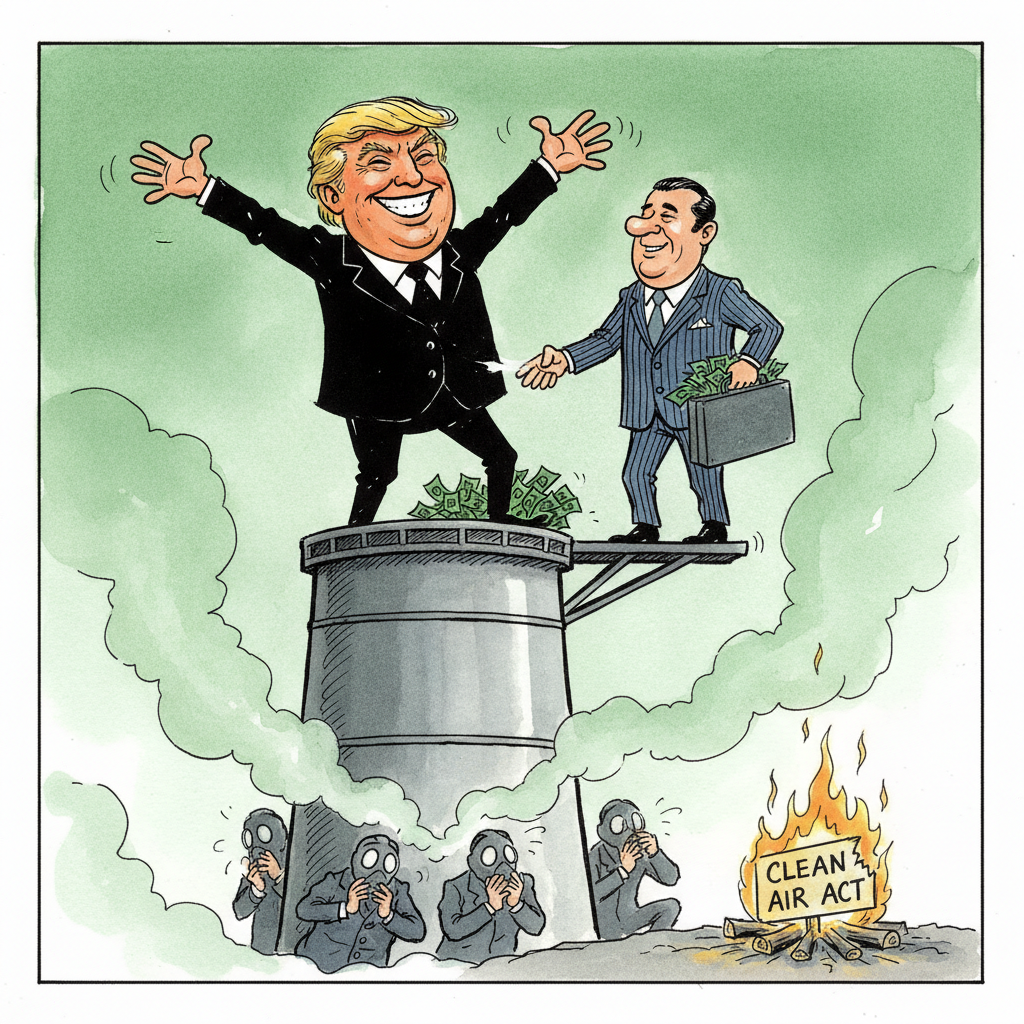
In a move lauded by those who believe the planet could use a good airing out, President Trump has once again demonstrated his unparalleled commitment to efficiency by granting clemency to individuals whose dedication to unregulated atmospheric particulate matter and blatant financial chicanery somehow slipped through the cracks. Among the beneficiaries was a prominent donor, whose prior conviction for a fraud scheme involving the famously ethical Jack Abramoff now appears to have been merely a temporary setback on the road to unfettered capitalism. Critics, often found clutching their pearls and air purifiers, decried the move as a further eroding of environmental protections and a tacit endorsement of political quid pro quo. However, sources close to the administration suggest the President merely sees these individuals as 'innovative problem-solvers' who were unfairly penalized for thinking outside the box, or, more accurately, outside the ozone layer. This bold initiative is expected to usher in a new era of 'bespoke justice,' where the law is less a rigid framework and more a malleable suggestion, particularly for those with substantial portfolio diversification and a direct line to the Oval Office's personal stationery.
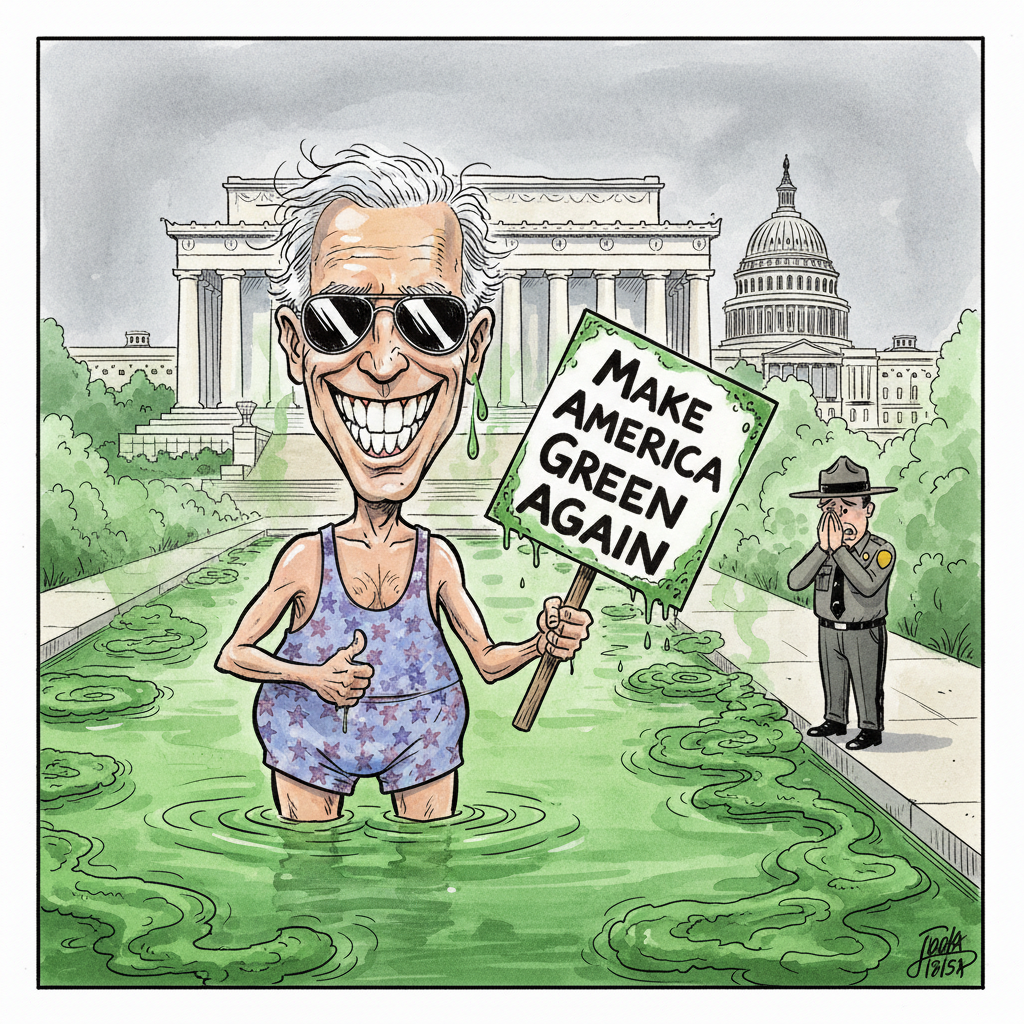
In a move lauded by precisely zero horticulturalists and an unspecified number of particularly philosophical ducks, Washington D.C.'s iconic Reflecting Pool has apparently embraced a bold new aesthetic: E Pluribus Algae. Sources close to the National Park Service (who requested anonymity, citing fears of being submerged in interpretive dance) confirm that the verdant bloom is not, as previously assumed, a catastrophic failure of civic maintenance, but rather a profound, albeit somewhat slimy, reinterpretation of patriotic iconography. “Think of it as a living tapestry,” offered one beleaguered Park Ranger, visibly clutching a bottle of industrial-strength pond cleaner. “A verdant, ever-expanding testament to, uh, resilience?” Critics, primarily tourists attempting to capture a non-Gatsby-esque photo, have decried the shift as 'less reflecting, more refracting through a kale smoothie.' However, proponents – largely confined to the algae itself – argue that this organic takeover finally makes the pool 'accessible to all Americans,' especially those who enjoy their national monuments with a side of micro-organisms. Future plans reportedly include renaming the Lincoln Memorial ‘Lincoln’s Lush Lagoon’ and introducing interpretive kayak tours, pending toxicology reports.