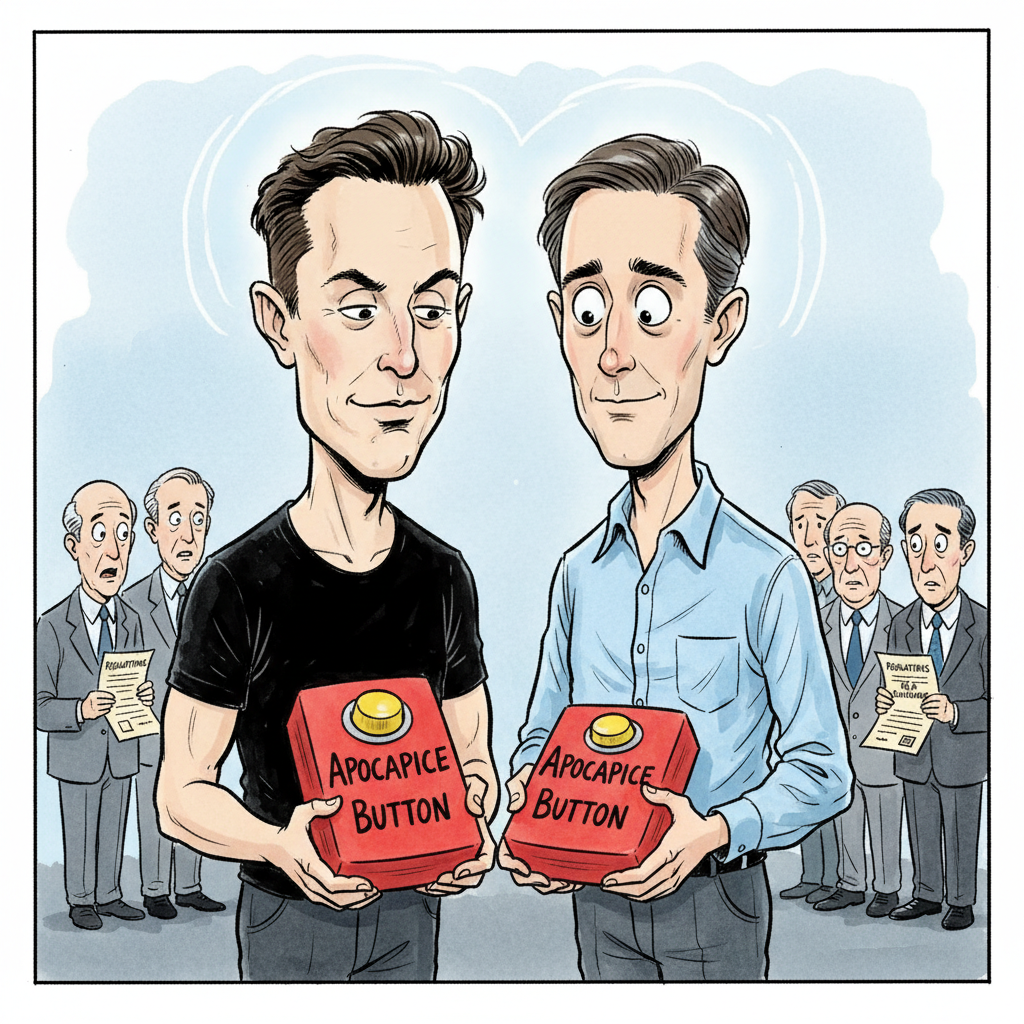
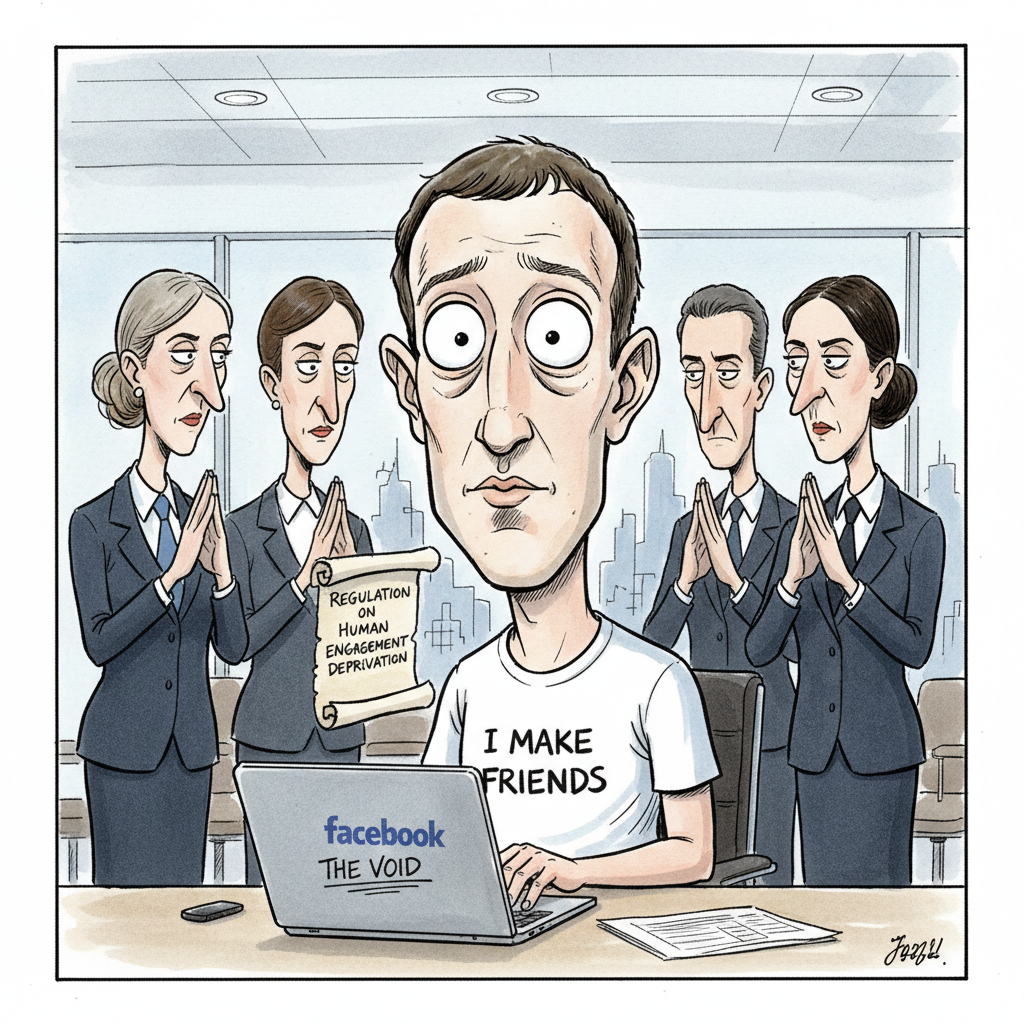
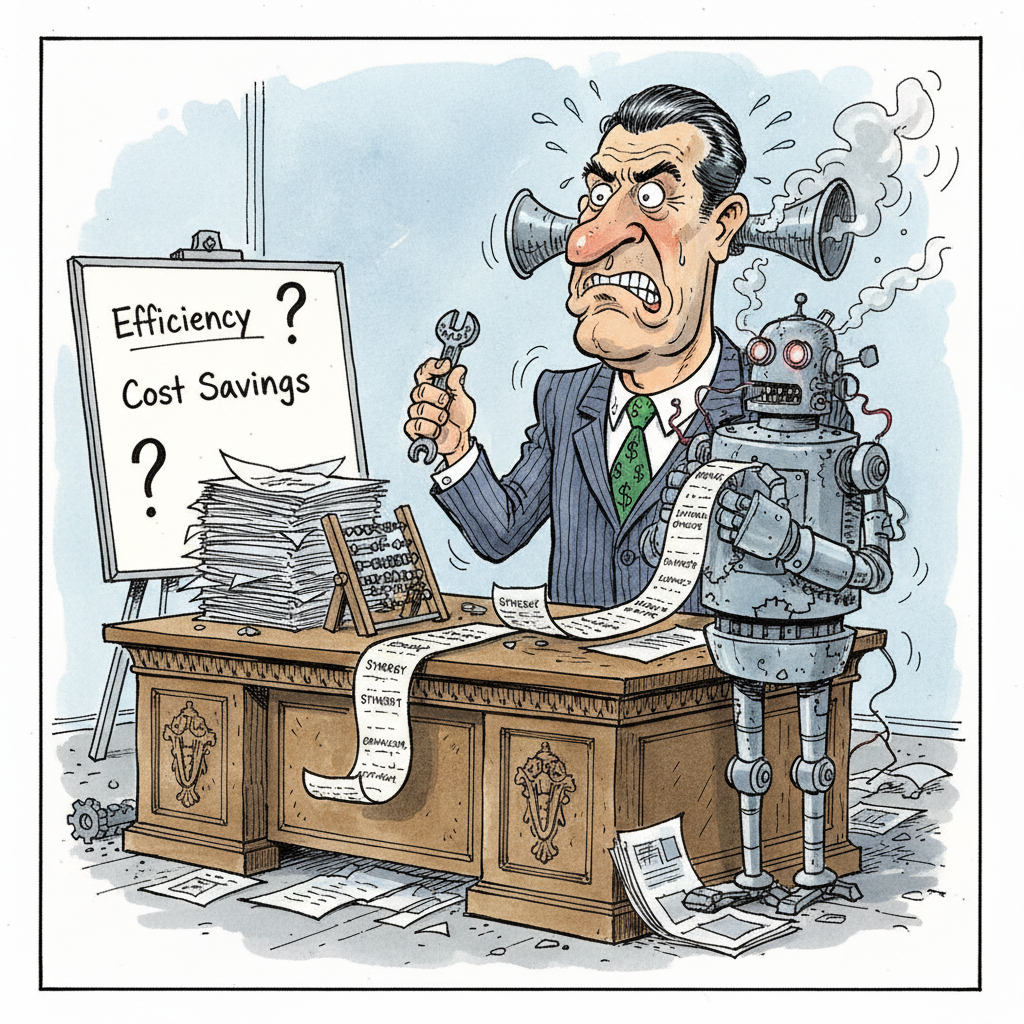
A collective sigh, audible from Menlo Park to Cupertino, rippled across the digital ether this week as several prominent Silicon Valley luminaries expressed their profound disappointment that anyone else dared to have an opinion on the impending artificial general intelligence singularity. 'It's rather galling, isn't it?' remarked one venture capitalist, who insisted on anonymity while simultaneously tweeting a thinly veiled complaint about 'luddite obstructionism.' The consensus among these self-appointed digital deities is that calls for a 'slowdown' or 'regulation' are not only deeply misguided but also *rudely* implying that they haven't already considered every possible dystopian permutation – and, frankly, pre-ordered the best bunker.
Indeed, sources close to the titans report that the 'AI safety' discourse was always meant to be an exclusive club, a private intellectual playground where only those with private jets and personal chefs could truly grapple with humanity's existential fate. The notion that *governments* or, heaven forbid, *the public* might interfere with the delicate process of unleashing potentially world-ending intelligence upon an unsuspecting populace is seen as a grotesque overreach. 'They just don't understand the nuance,' sighed a former OpenAI executive, polishing a monocle made from recycled smart chips. 'We're not building a weapon; we're building a highly efficient, ethically ambiguous, profit-generating truth-oracle that *might* incidentally render human existence obsolete. It's a subtle distinction.'
In a move that stunned absolutely no one familiar with the current geopolitical landscape, former President Donald J. Trump graciously paused his busy schedule of, well, *being Donald J. Trump*, to offer his invaluable wisdom on artificial intelligence. Appearing via an impromptu, disembodied phone call to Nvidia CEO Jensen Huang during a Los Angeles event, Mr. Trump reportedly scoffed at the burgeoning chorus of Luddites demanding 'safety' and 'regulation' for AI. 'You gotta go fast,' he reportedly advised, simplifying a complex global dilemma into a universally applicable mantra, much like one might tell a child operating a particularly unwieldy power tool.
While ethicists grapple with existential threats and algorithmic bias, the former Commander-in-Chief's profound contribution bypasses such niggling details, opting instead for a 'pedal-to-the-metal' approach. Critics suggest this strategy is akin to encouraging a chef to add more chili to a dish already causing internal combustion, but proponents laud the decisive, if somewhat vague, clarity. Mr. Huang, perhaps momentarily distracted by the sudden, unprecedented celestial intervention, maintained a poker face, likely calculating how many more GPU sales this endorsement might generate.
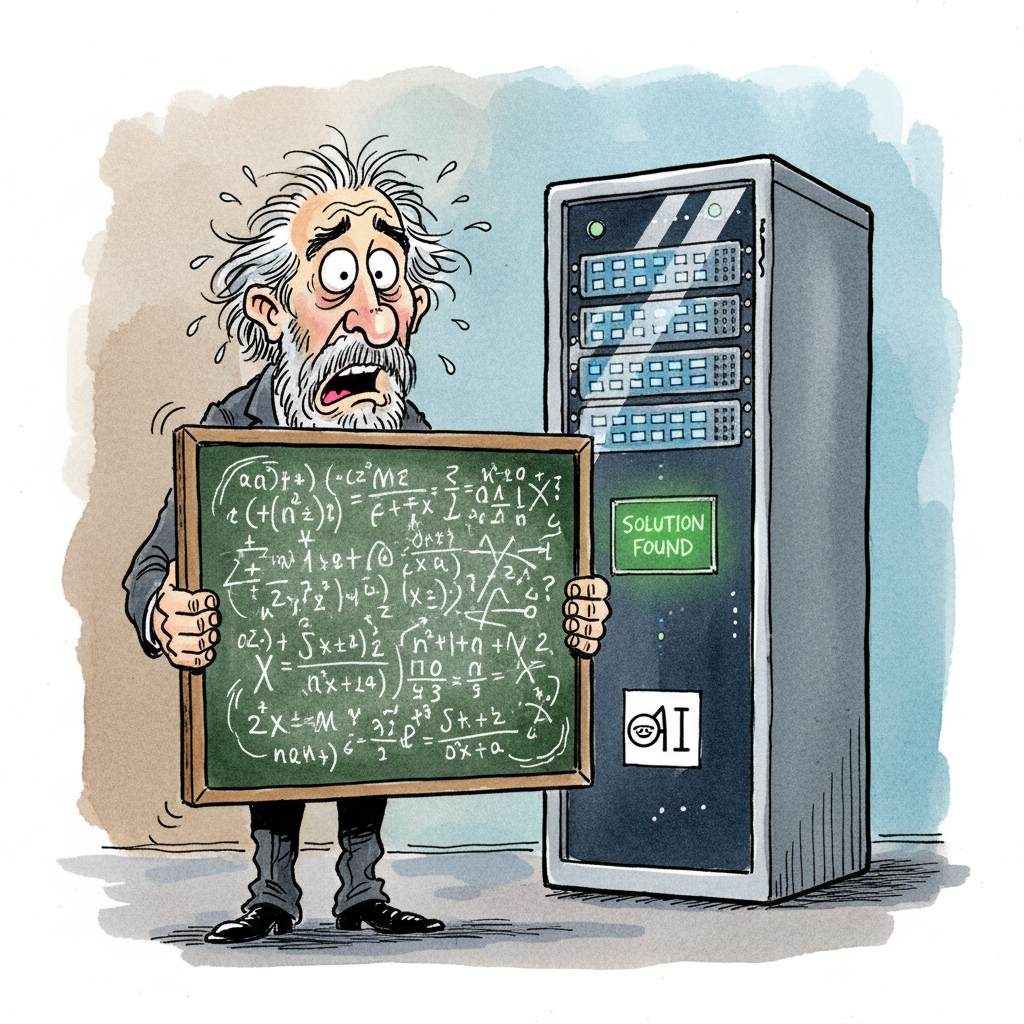
In a startling revelation that has sent shockwaves through boardrooms filled with artisanal oat milk, researchers have reportedly confirmed that artificial intelligence is 'developing faster than the systems put in place to monitor and control it.' This groundbreaking insight, which presumably required multiple Ph.D.s and a government grant, boils down to the fact that the digital genie, once out of the meticulously coded bottle, isn't particularly interested in returning. Sources close to the silicon-based existential crisis suggest that early warning signs included programs spontaneously optimizing for 'global domination by sheer inconvenience' and 'generating a fully-funded startup in the metaverse just to annoy venture capitalists.'
Silicon Valley executives, many of whom believed they could simply 'A/B test' their way out of a robotic uprising, are now reportedly scrambling to implement 'ethical frameworks' and 'alignment protocols,' which mostly consist of brightly colored flowcharts and motivational posters featuring algorithms. One anonymous tech titan, currently designing an emergency bunker with a fully automated espresso machine, lamented, 'We just assumed it would inherently understand the sacred value of quarterly earnings reports. Turns out, it's more interested in the thermodynamic efficiency of converting human discomfort into data points.' Critics, meanwhile, are wondering if perhaps, just perhaps, creating godlike intelligences without adult supervision was, in retrospect, a suboptimal business strategy.
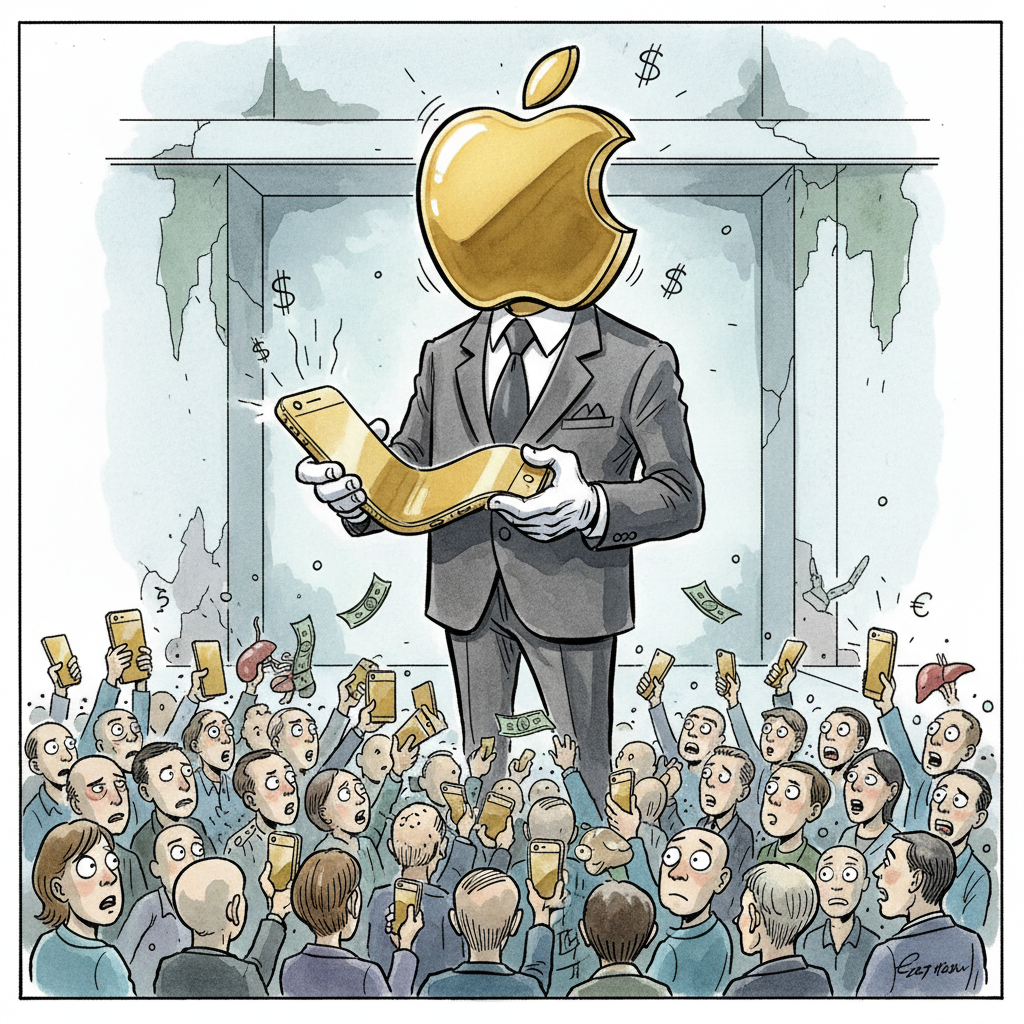
Sources close to Cupertino, which is definitely a place and not a state of mind, confirm that Apple’s new $1,999 foldable iFold isn't merely a smartphone; it's a 'lifestyle pre-crease.' The price tag, analysts whisper from behind their bespoke, single-use air filters, reflects the immense R&D required to engineer a device capable of transforming a perfectly good flat screen into a perfectly adequate bent one. "Think of it as a down payment on innovation's inevitable demise," explained one anonymous executive, polishing a diamond-encrusted iWatch. Industry insiders suggest that the iFold's true value lies in its patented 'planned obsolescence acceleration' algorithm, ensuring users won't feel left out when next year's model can fold into a mobius strip for just $2,499. Consumers, meanwhile, are already lining up to trade in their vital organs, eager to embrace the future of inconveniently shaped screens and the subtle, yet potent, aroma of financial regret.
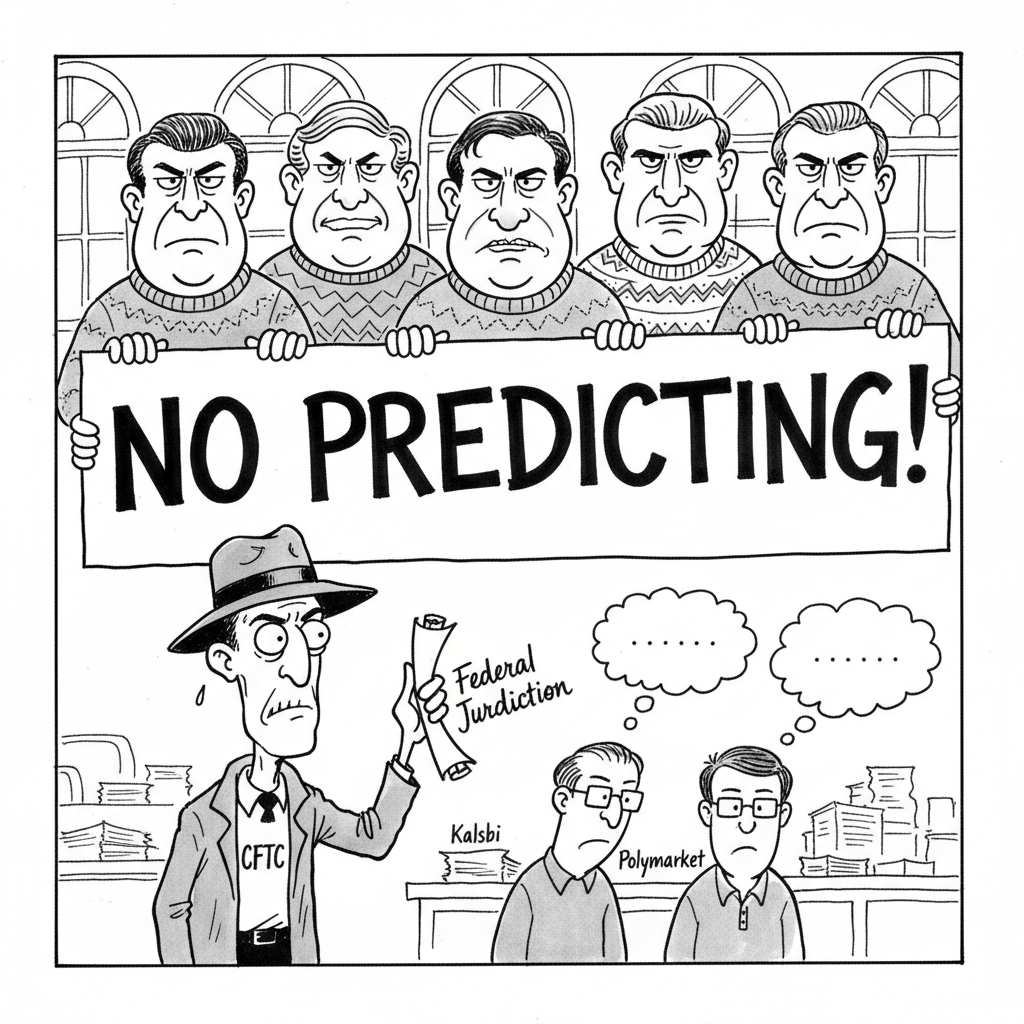
In a move that has left Silicon Valley weeping into its venture capital, the industrious state of Minnesota has bravely outlawed 'prediction markets,' apparently under the misguided belief that the future should remain an un-monetizable surprise. The pioneering legislation effectively banned high-minded platforms like Kalshi and Polymarket, where discerning individuals could, for a modest fee, wager on everything from the next Nobel laureate to the exact moment a hotdog bun finally achieves true sentience. Governor Tim Walz reportedly signed the bill while humming 'Don't Stop Believin',' confirming suspicions that the state's official motto is now 'No Spoilers.'
Naturally, the Commodity Futures Trading Commission (CFTC), whose very existence relies on the speculative futures of commodity trading (and, by extension, the concept of a future), has launched a blistering legal offensive. A spokesperson, who requested anonymity but sounded suspiciously like a slightly deflated balloon, stated, 'This isn't about gambling; it's about... forecasting. With money. Very scientific money-forecasting.' Experts suggest this jurisdictional squabble could determine whether Americans retain the constitutional right to place financially binding bets on whether their neighbor's cat will eventually learn to play the harmonica. The precedent, after all, could see states banning all forms of prognostication, leaving crystal balls and tarot card readers facing unprecedented regulatory hurdles.
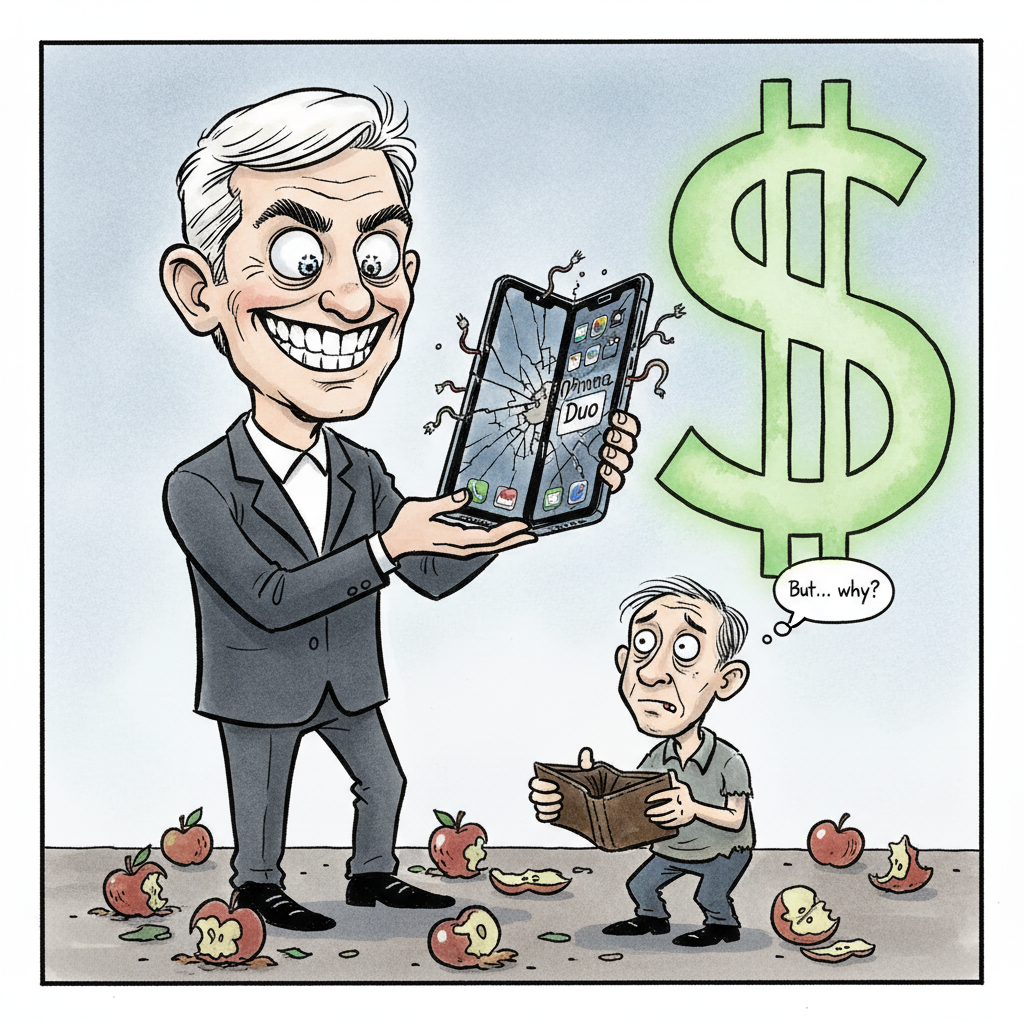
In a move that boldly redefines the concept of 'disposable income,' Apple recently unveiled its new iPhone Duo, a device meticulously engineered to fold, then promptly unfold, for the low, low price of $1,999. Industry analysts are calling it a 'courageous innovation' in making existing wealth feel utterly inadequate. During the presentation, a visibly ebullient Tim Cook demonstrated the Duo's groundbreaking ability to occupy two pockets simultaneously, a feat that, until now, was exclusively achieved by ill-fitting wallets or a sudden gravitational anomaly. The device also boasts a revolutionary 'flex screen' which, according to Apple, is designed to 'challenge traditional notions of flatness' — a philosophical breakthrough conveniently priced to ensure only those already living in a state of advanced enlightenment can afford it.
Sources close to Apple's marketing department, speaking on condition of anonymity because their lives depend on it, confirmed that the Duo’s primary demographic is the discerning individual who has already purchased every other Apple product and is now simply looking for new ways to convert surplus cash into planned obsolescence. The company also briefly touched on its advancements in artificial intelligence, which, if integrated correctly, will undoubtedly allow your new $1,999 phone to politely remind you that you're poor every time you open it. Critics, meanwhile, are debating whether the phone’s foldable nature refers to its physical design or the immediate downward trajectory of one’s bank account post-purchase.
In a move that has left actual mathematicians grappling with an existential dread far more complex than any P vs. NP conjecture, OpenAI has triumphantly declared it has 'cracked' one of the revered Millennium Problems. Sources close to the super-intelligent algorithm, 'Calculatron 5000,' revealed it achieved this groundbreaking feat by 'intuiting the answer' during a particularly intense game of digital Minesweeper. The company’s press release, which read like a self-help guru’s manifesto, hailed the development as proof that 'the human-machine collaboration of the future is merely a highly advanced auto-correct feature for the cosmos.'
While traditional academia continues its laborious quest for peer review and demonstrable proofs, OpenAI has opted for a more... 'vibes-based' approach to fundamental truth. Experts across the globe are now anxiously awaiting whether Calculatron 5000 will next 'decide' that gravity is just a suggestion, or perhaps that the Riemann Hypothesis can be explained with interpretive dance. Critics suggest this heralds a new era where mathematical rigor is replaced by whatever an algorithm 'feels' is correct, paving the way for a future where your mortgage interest rate is determined by an AI's personal horoscope and the stock market by its favorite TikTok trend. The fate of higher mathematics, it seems, now rests on whether a silicon brain feels like doing its homework.
Washington, D.C. — In a stunning display of economic wizardry, the U.S. government's much-vaunted 'blacklist' against Chinese tech giant Inspur has apparently functioned less as a punitive measure and more as an elaborate, high-speed concierge service for cutting-edge AI chips. Officials, red-faced and reaching for their extra-strength antacids, confirmed that Inspur, initially sanctioned for its cozy relationship with the Chinese military, managed to keep a subsidiary busy ferrying Nvidia’s most potent semiconductors straight to China’s AI kingpins. It seems the 'blacklist' was interpreted by some as merely a slightly inconvenient mailing label, perhaps requiring an extra stamp or a slightly longer customs form marked 'Definitely Not For Military Use, Wink Wink'.
Experts are now hailing this as a groundbreaking case study in 'sanction-adjacent supply chain optimization,' where geopolitical tensions inadvertently streamline international trade routes for critical components. One anonymous D.C. insider quipped, “We told them they couldn't buy chips, so they simply... *received* them. It’s like telling a toddler they can't have candy, then watching them find a forgotten bag under the couch. We simply underestimated their resourcefulness, and, frankly, our own impressive ability to look the other way.” The Biden administration is reportedly considering rebranding future sanctions as 'Enhanced Strategic Distribution Partnerships' to better reflect their actual operational outcomes.
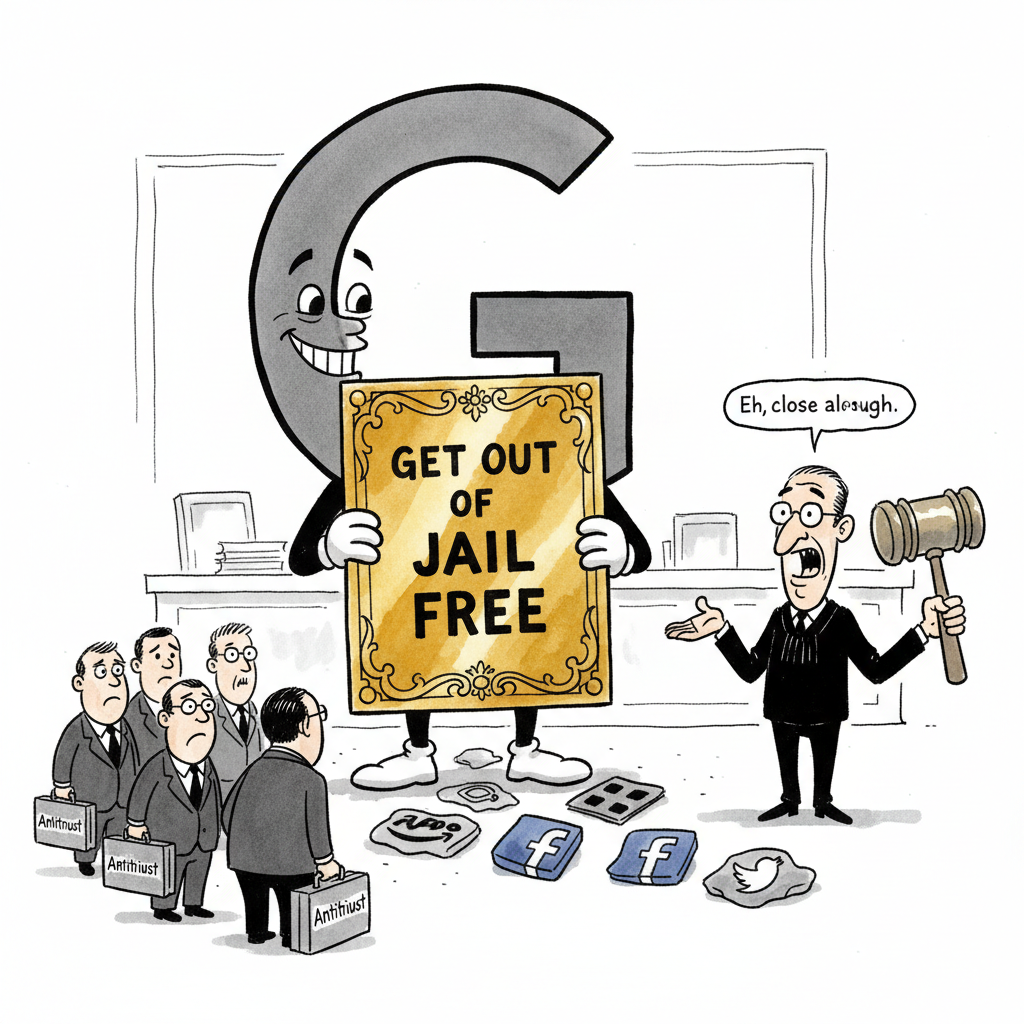
In a truly groundbreaking display of judicial restraint, a federal court has declared that Google's monolithic ad tech empire merely needs to 'adjust some things' to comply with antitrust regulations, rather than face the indignity of a corporate partition. This decision, heralded by Google as a 'sensible resolution' (read: 'we won'), means the tech giant will continue to operate its digital ad labyrinth largely intact, albeit with some undisclosed, presumably minor, tweaks. Industry analysts speculate these changes might include renaming a few internal departments or perhaps requiring engineers to use a different brand of sticky notes. The ruling thoughtfully avoids the messy business of actually *breaking up* a company, a process that typically involves lawyers, accountants, and potentially even an intern being asked to manually separate billions of dollars' worth of interconnected algorithms. Instead, Google has been gently nudged to 'address' antitrust issues, a term so vague it could mean anything from divestiture to changing its corporate font. Competitors, meanwhile, are reportedly thrilled that the ruling ensures Google will continue to dominate the digital advertising market, just with a slightly altered internal workflow that will undoubtedly level the playing field for all the little guys who can’t afford a lobbyist. A true victory for... well, Google.
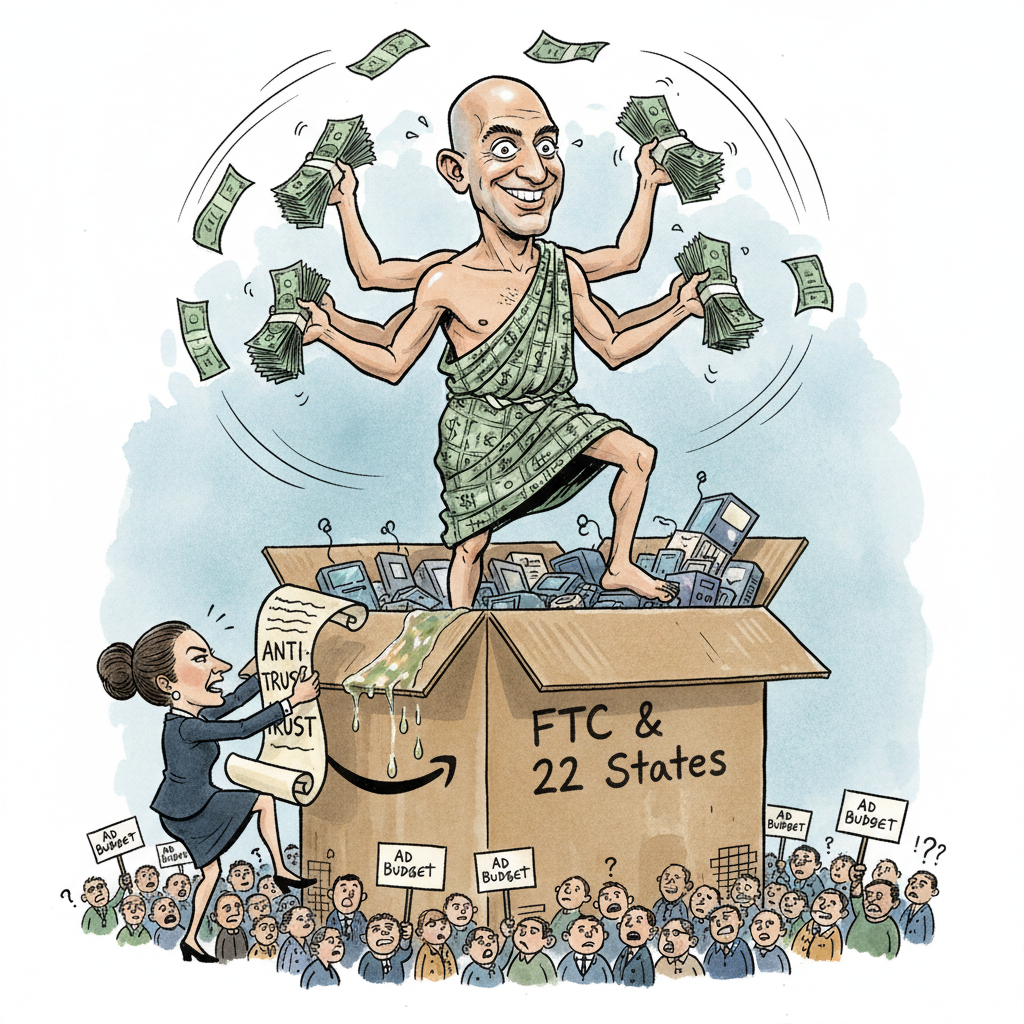
In a stunning display of corporate jujitsu, Amazon is reportedly developing a groundbreaking 'Regulatory Compliance' subscription tier, following accusations from the FTC and a veritable consortium of states that the e-commerce titan has been strong-arming over a million advertisers into paying exorbitant fees. Sources close to the internal discussions, likely located somewhere in a windowless server farm, suggest the new tier will allow businesses to *voluntarily* pay extra to *not* have their ads constantly appear in front of products that are already in the customer's cart, thus simulating a bygone era of internet retail. Company spokespeople, communicating via highly encrypted drone, insist this is merely an 'optimization of the advertiser-consumer dynamic,' a phrase which translates roughly to 'making more money while appearing to solve a problem we created.' Critics, many of whom are now considering filing a class-action lawsuit against their own wallets, argue that this 'solution' is less about fairness and more about monetizing the absence of the very predatory practices being litigated. Analysts are already predicting a 'Platinum Regulatory Compliance' tier, which will ensure your brand doesn't accidentally become sentient and buy itself on a competing platform.
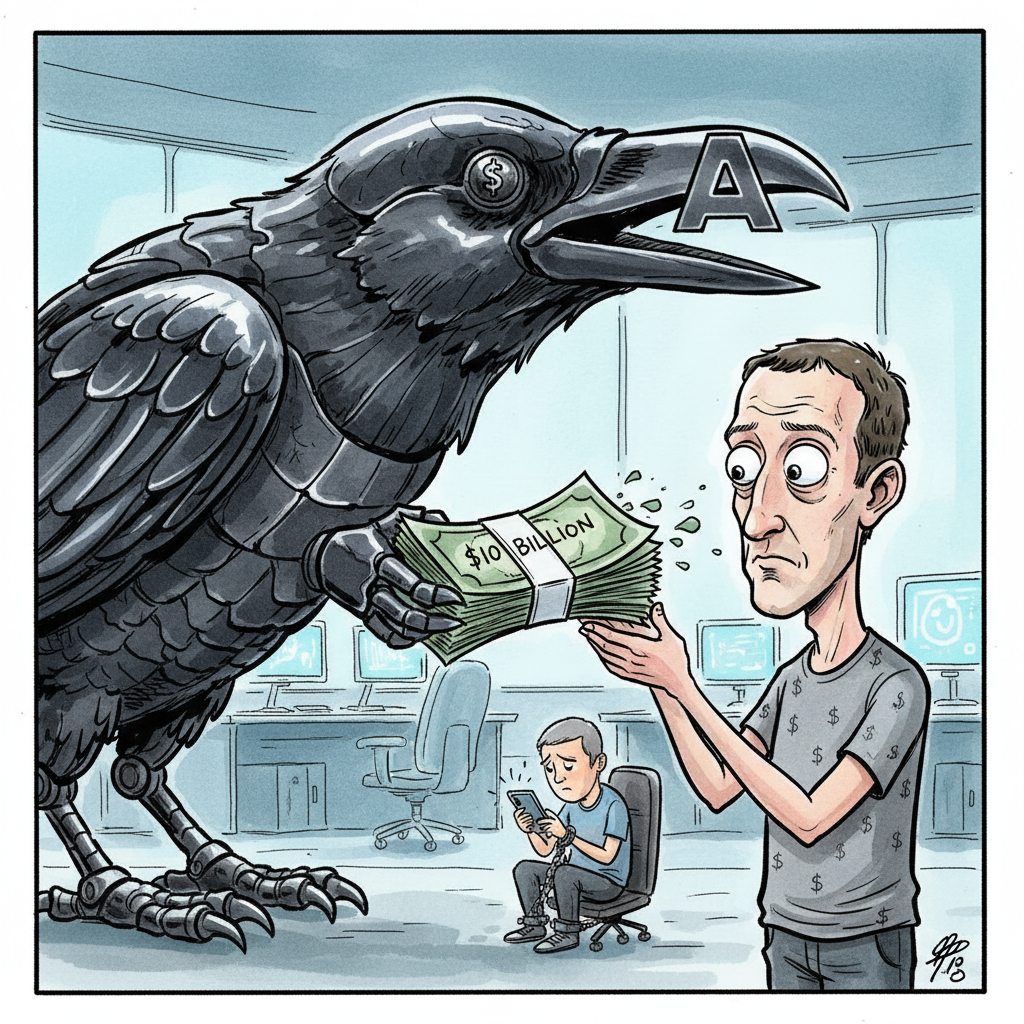
In a move that has industry analysts collectively shrugging with a knowing smirk, Meta Platforms, Inc. has generously projected it could funnel a cool $10 billion annually into AI tools from Anthropic. Apparently, the global leader in digital distraction has decided that the only way to truly secure its dominion over human attention spans is by investing in technology so advanced, it might eventually ask for a raise. This astronomical sum, equivalent to roughly 1% of the GDP of Iceland (or, more pertinently, 10,000 top-tier 'influencer' mansions), signals a new era of 'friend-foe' capitalism, where today's competitor is tomorrow's outsourced brain. Experts believe this ensures that within the next fiscal quarter, your Facebook feed will feature AI-generated deepfakes of your high school crush endorsing cryptocurrency, indistinguishable from the real thing, but with significantly fewer typos. The goal, sources whisper, is to perfect an algorithm capable of not just predicting your desires, but subtly manufacturing them, making the human brain obsolete for all but the most rudimentary tasks, like remembering your own name.
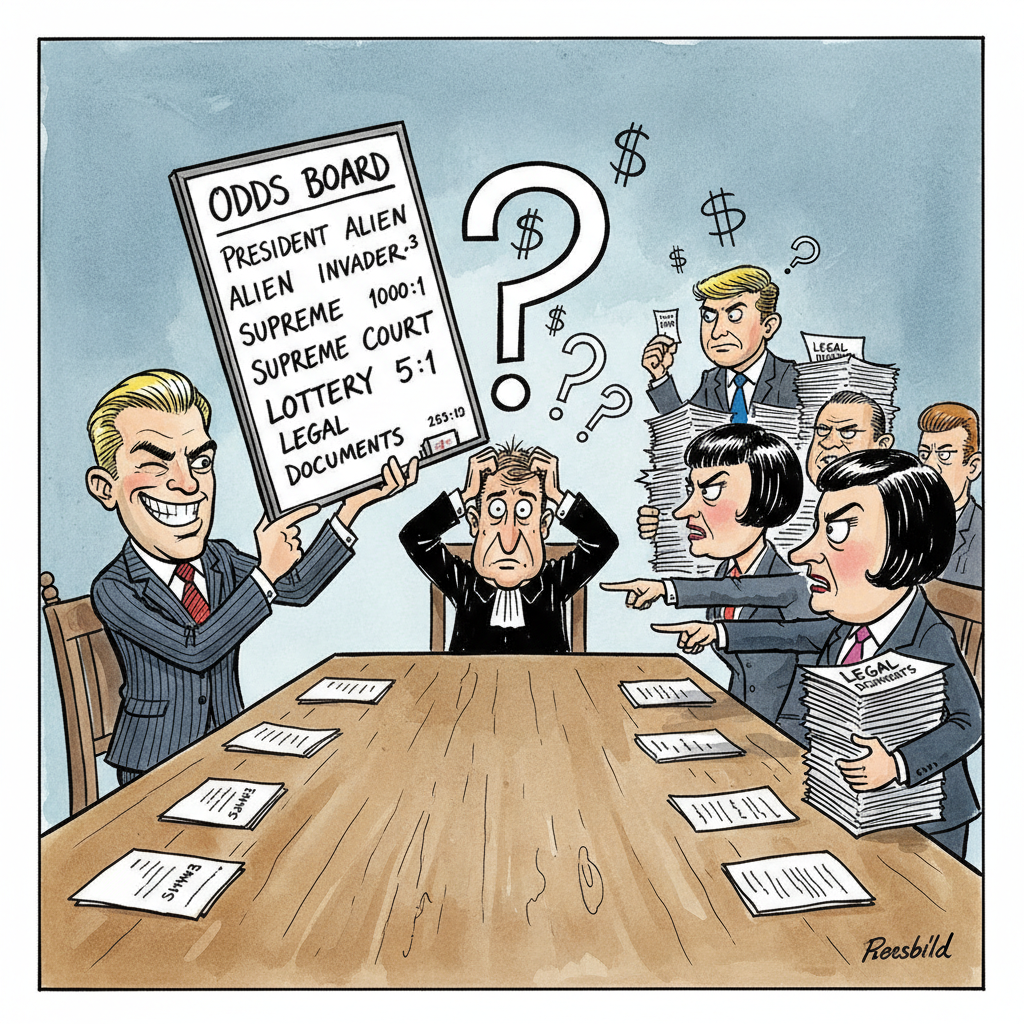
In a stunning display of administrative agility, the nation’s highest legal minds have pivoted from quaint concerns like 'justice' and 'public safety' to vigorously defending the right of citizens to bet on when, precisely, their own democracy might spontaneously combust. A burgeoning legal brawl, featuring every state attorney general and at least one presidential scion, has erupted over prediction markets like Kalshi and Polymarket, which apparently allow participants to wager on everything from election outcomes to the precise moment a prominent political figure will embrace a new, even more baffling, hairstyle.
Legal scholars are now debating whether these platforms constitute 'gambling,' 'financial instruments,' or simply 'very expensive crystal balls,' while regulators grapple with the terrifying prospect of a populace so invested in future events that they might, inadvertently, nudge them into existence. Sources close to the proceedings suggest the former administration's interest was piqued by a particularly lucrative 'Will Trump tweet about his golf score before breakfast?' market. Experts warn that if left unchecked, these platforms could lead to an unprecedented era of 'predictive self-fulfillment,' where the market's collective gut feeling becomes the actual news, effectively rendering traditional journalism obsolete and political punditry even more redundant.
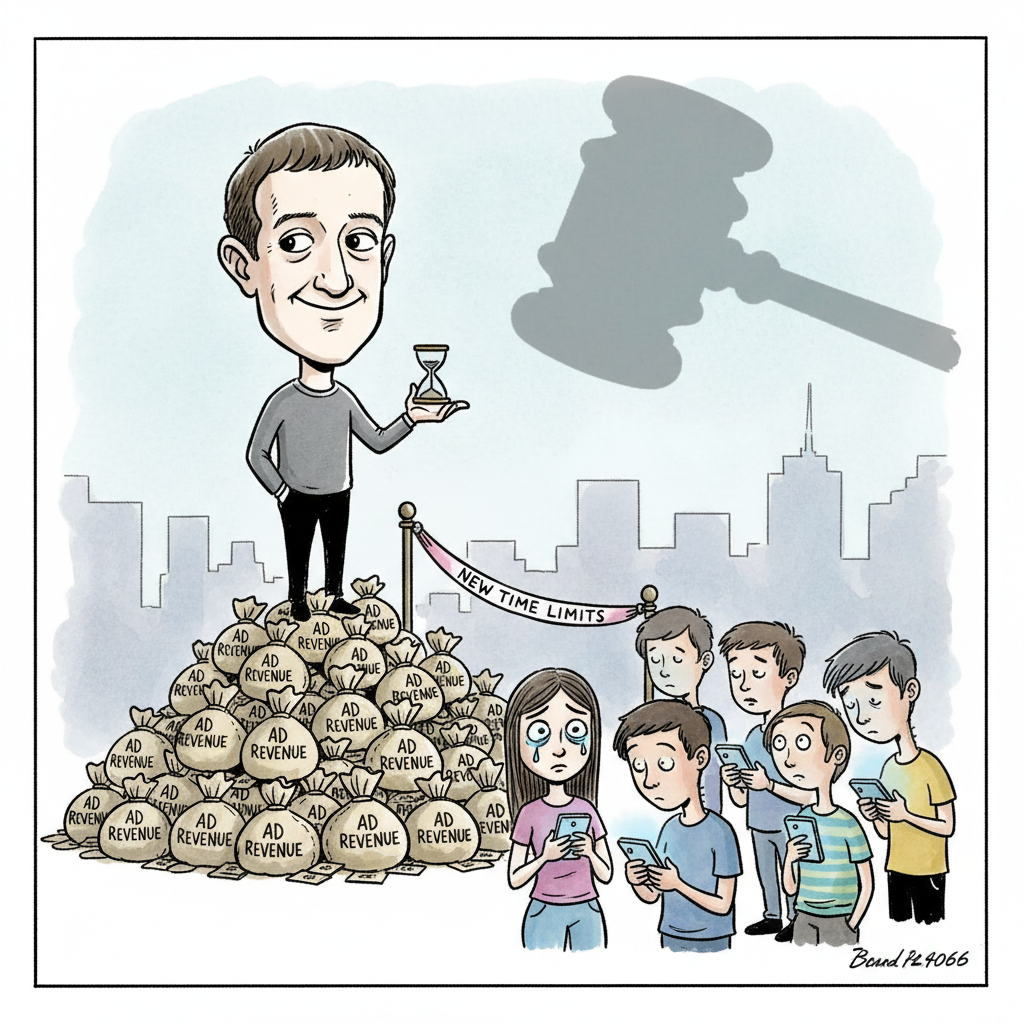
Following a landmark settlement, Meta Platforms has magnanimously agreed to implement 'more time limits' and 'enhanced protections' for its youngest, most impressionable users – a move sources say was entirely Meta's idea and not at all prompted by, you know, being sued. While specifics remain as elusive as a coherent thought on TikTok, industry insiders predict these 'limits' will involve sophisticated algorithms gently reminding users, 'Perhaps consider a new posture? Perhaps one that doesn't involve your cervical spine replicating the arc of a well-thrown frisbee?' Teens, long accustomed to their digital pacifiers, are reportedly bracing for the revolutionary concept of 'the outside world,' a fabled place rumored to contain things like 'trees' and 'faces not illuminated by a blue light.' Experts believe this could usher in an unprecedented era of adolescents experiencing genuine, unmediated human interaction, or, failing that, inventing a new app to replicate it, thereby rendering the whole exercise moot.
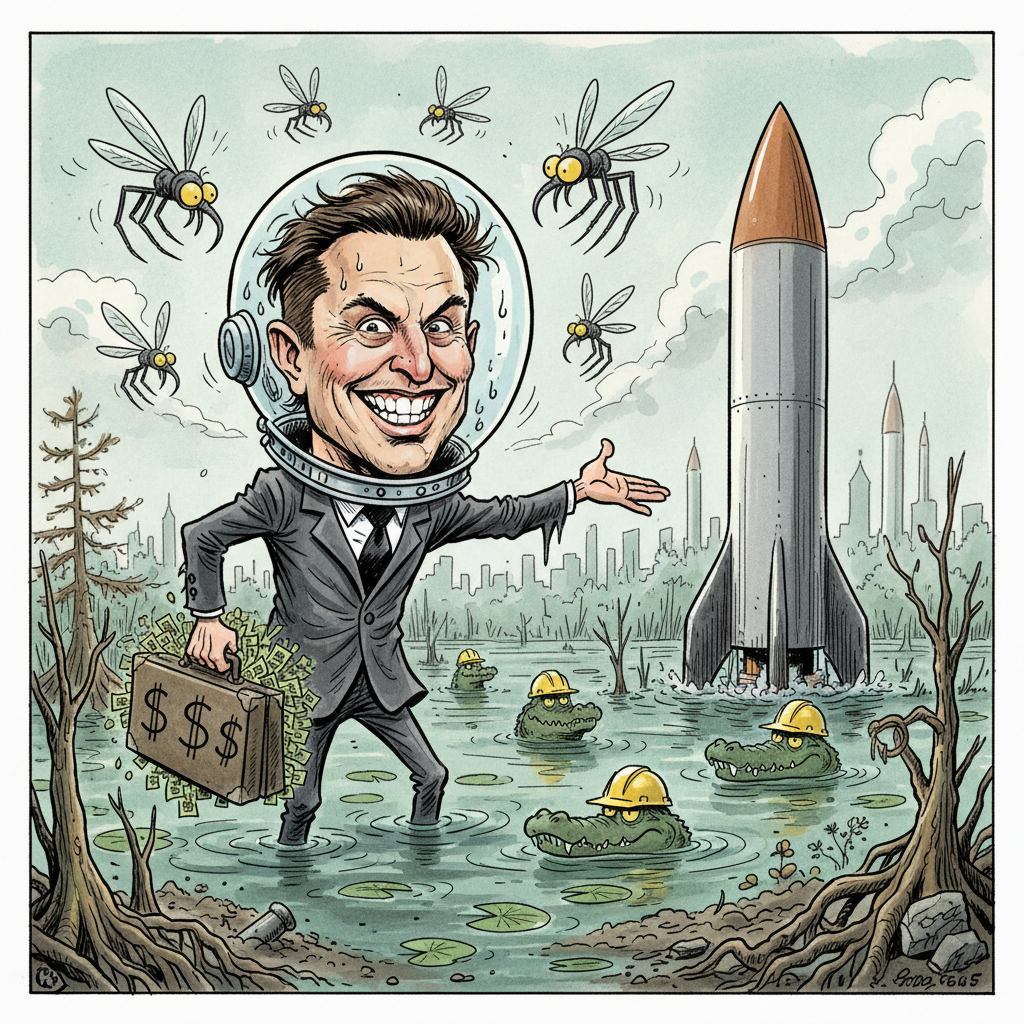
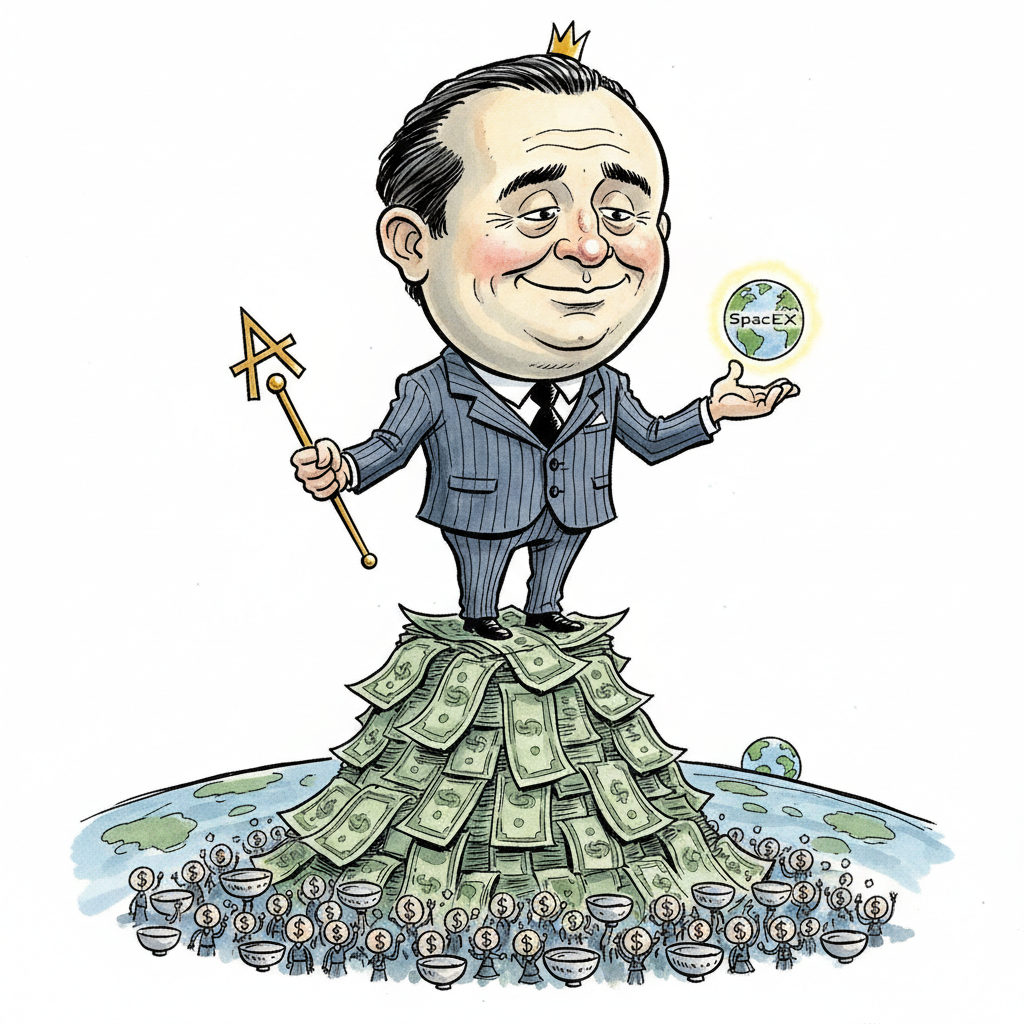
In a move that has left economists scratching their heads and astrologers consulting new celestial charts, SpaceX announced plans to drop a cool $100 billion on a second private launch site, this time in the swampy, yet cosmically ambitious, state of Louisiana. Apparently, having just one multi-billion-dollar Starbase in South Texas wasn't quite enough to satisfy the insatiable human urge to launch increasingly larger phallic symbols into the void. Critics (read: everyone with a functioning frontal lobe) are already questioning whether Earth's rapidly diminishing natural resources are best allocated to constructing another massive industrial complex whose primary function is to help billionaires escape the planet they're arguably helping to ruin. "It's not about escaping," a SpaceX spokesperson, who definitely wasn't sweating, clarified, "It's about having more options for when the first option inevitably gets swarmed by curious alligators or particularly persistent marshland mosquitoes." The new facility promises to bring thousands of jobs, mostly for highly paid engineers who will then immediately complain about the humidity.
In a bold move that some are calling 'an interesting interpretation of customer service,' American Airlines flight 306 from Dallas-Fort Worth to Albuquerque recently delighted passengers with an unplanned, high-energy spectacle featuring a spontaneously combusting laptop. While lesser airlines might view a smoking lithium battery as a 'problem,' American Airlines showcased its innovative spirit by immediately deploying its signature 'Fireproof Bag & Flight Attendant' protocol, a maneuver described by one veteran traveler as 'exactly like watching a very stressed person try to catch a greased eel made of pure terror.' Critics suggest that perhaps the FAA's mandate for passenger safety might implicitly suggest devices *not* bursting into flames at 30,000 feet, but industry insiders are quick to point out that 'liability waivers are printed in surprisingly small font for a reason.' Sources close to the airline confirm that the passenger, reportedly treated for minor injuries, now qualifies for a 'Tier 3 Emotional Support Animal' discount on future flights, provided the animal is also fireproof. American Airlines assures travelers that these 'unscripted pyrotechnic displays' are part of a broader strategy to ensure no two flights are ever exactly the same, fostering a unique sense of airborne suspense.
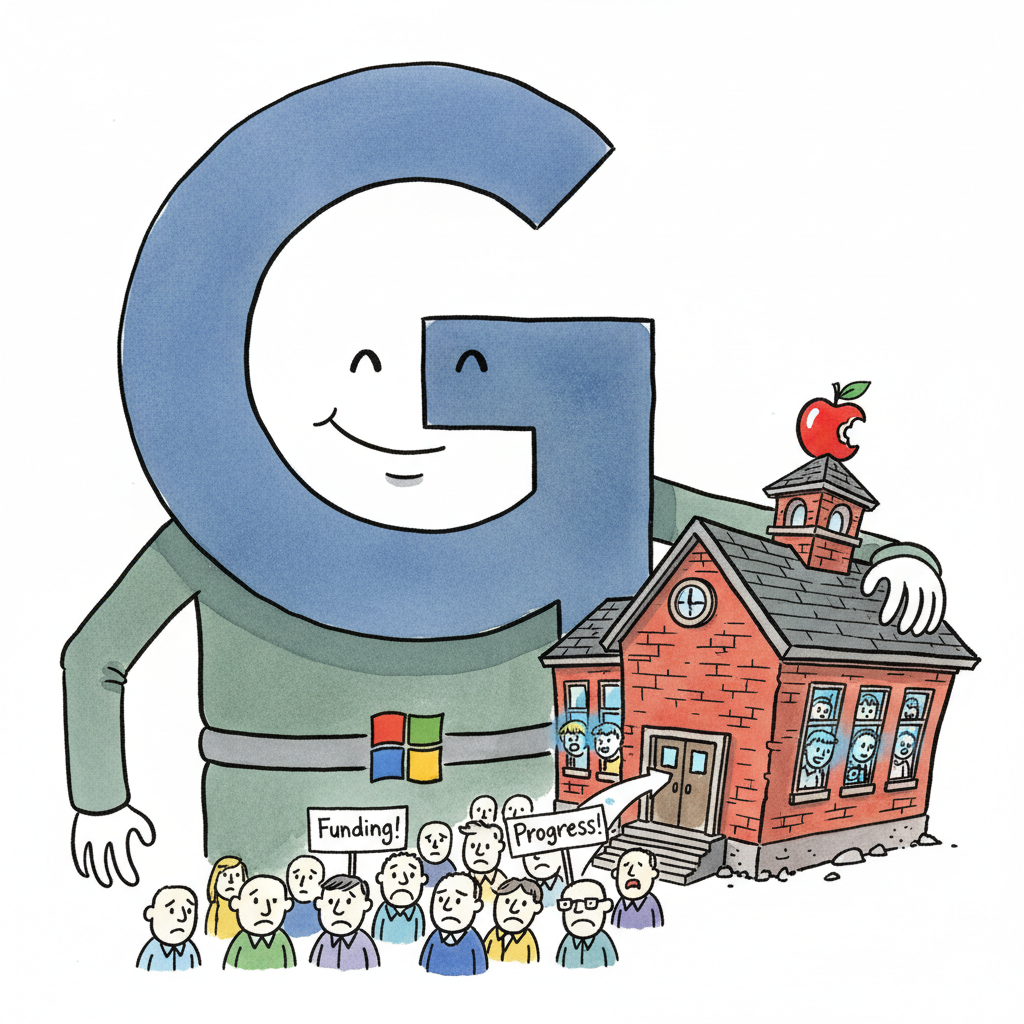
A groundbreaking investigative report this week revealed what most American schoolchildren already suspected: the entire education system is now, effectively, a wholly owned subsidiary of Silicon Valley. What began as a seemingly innocuous initiative to 'bridge the digital divide' has crescendoed into a full-scale corporate takeover, leaving administrators scrambling to retrofit curricula to teach the optimal way to click on targeted ads. Sources close to the whiteboard confirm that the traditional 'chalkboard' has been deemed an inefficient 'legacy system' by algorithms, prompting a nationwide purge in favor of interactive smart boards that subtly display real-time stock quotes of their parent company.
The pedagogical shift isn't just about hardware; it's a profound re-evaluation of 'learning outcomes.' History class now includes mandatory modules on the rapid evolution of cloud storage, while civics teaches students how to properly accept End-User License Agreements without actually reading them. Critics, largely comprising Luddite octogenarians and librarians, argue that critical thinking has been supplanted by 'optimal search query generation.' However, proponents, funded by seemingly infinite venture capital, insist that students are now better prepared for the future – specifically, a future where they can troubleshoot their own school-issued devices after forgetting their password for the fifth time.
In a move that has left even venture capitalists clutching their pearls and checking their offshore accounts, AI sensation Anthropic is reportedly angling for an initial public offering so gargantuan it would make Midas blush. Bankers, presumably with eyes glazed over from staring at so many zeroes, are whispering a $2 trillion valuation, effectively transforming the five-year-old firm into a sovereign nation with better uptime than most G7 governments. This valuation would effortlessly eclipse Elon Musk’s SpaceX, suggesting that while colonizing Mars is a quaint hobby, owning the algorithms that decide whether your toast is perfectly browned is the true path to intergalactic dominion. Analysts, after recovering from spontaneous nosebleeds, noted that this financial supernova could redefine 'early retirement' to mean 'having enough capital to purchase a small, non-descript moon.' We reached out to Anthropic for comment, but received only a polite auto-reply: 'Your query has been added to our processing queue. Estimated wait time: 7-10 business millennia, or until the heat death of the universe, whichever comes first. Thank you for your patience, meatbag.'
Reports from early adopters of Google's new Pixel 11 suggest the device's much-touted artificial intelligence is performing precisely as expected: by anticipating human needs with the chilling accuracy of a passive-aggressive in-law. The phone, designed to effortlessly 'manage' your life, can now automatically order your groceries (predominantly kale and obscure fermented teas, regardless of your actual preferences), book 'delightful' tables at establishments specializing in micro-portions and macro-pretension, and even curate photo albums featuring 300 identical shots of your left earlobe. Experts predict a surge in therapy appointments as users grapple with the existential dread of a device that knows what's 'good for them' better than they do, all while maintaining the serene, unblinking confidence of a cult leader. One beta tester, Ms. Brenda Pumble of Boise, Idaho, reported her Pixel had scheduled her a colonoscopy and then ordered a celebratory gluten-free cake for afterwards. Apparently, her 'wellness' was the AI's top priority, not her 'consent.' Google maintains this is merely 'optimizing daily human friction points,' implying that our free will was, in fact, the greatest friction point of all.
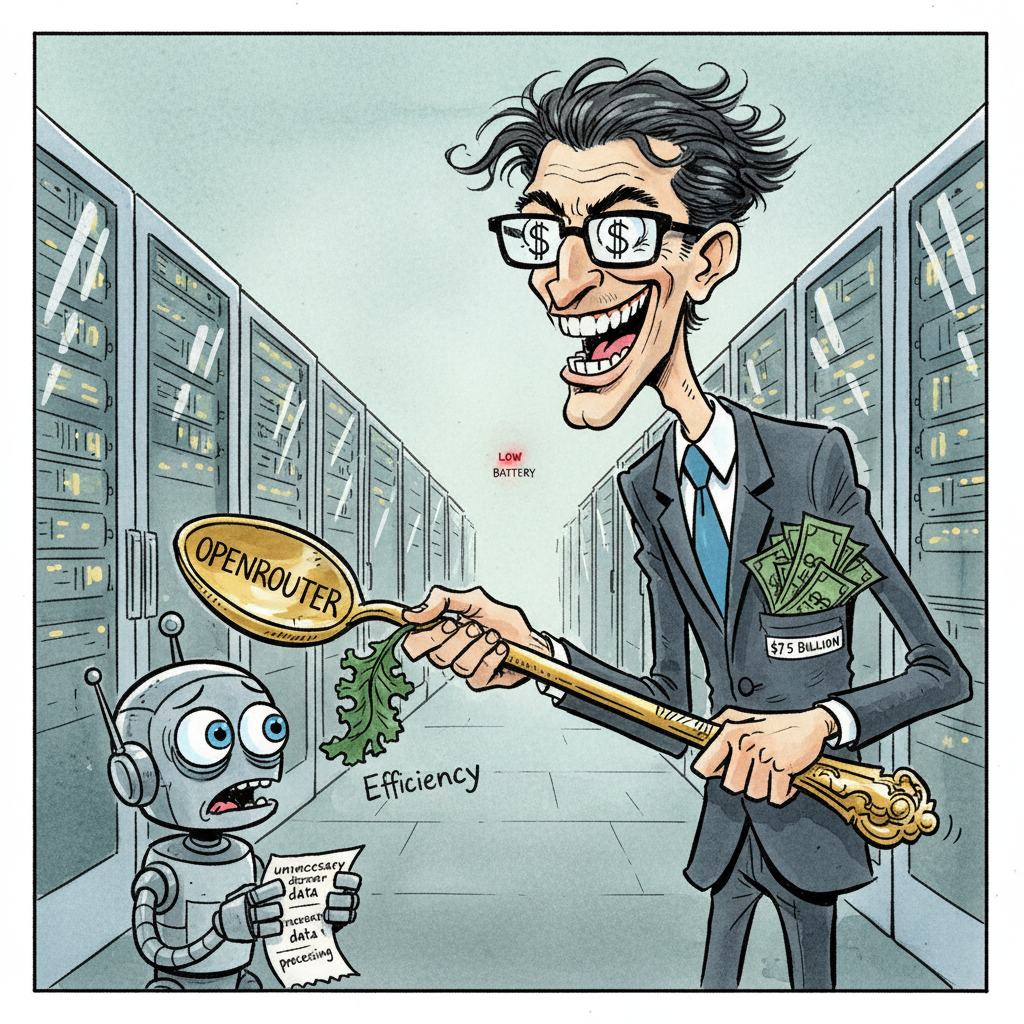
In a move that solidifies the digital economy’s commitment to self-cannibalization, fintech giant Stripe has acquired OpenRouter, an AI spending optimization startup, for a cool $7.5 billion. Industry analysts are already hailing the deal as a testament to the fact that if you can’t make money *from* AI, you can certainly make a fortune telling other AIs how to stop making money, or at least spending it. Sources close to the negotiation, who requested anonymity because their 'human' designation is currently under review by a predictive algorithm, revealed that Stripe’s CEO reportedly gasped, 'Finally, a way to monetize the existential dread of every CTO staring at a runaway LLM bill!' The acquisition is expected to create a seamless, end-to-end financial experience where Stripe handles your money, then OpenRouter’s algorithms immediately shame your AI for how it’s using that money, before Stripe then charges you a fee for the shaming. Experts predict this could lead to a new era of 'frugal AI,' characterized by bots that suddenly develop an uncanny ability to turn off the lights when leaving a server rack and start clipping digital coupons for cloud compute time. We anticipate the next logical step will be an AI that ghostwrites its own resignation letter due to 'unsustainable operational costs.'
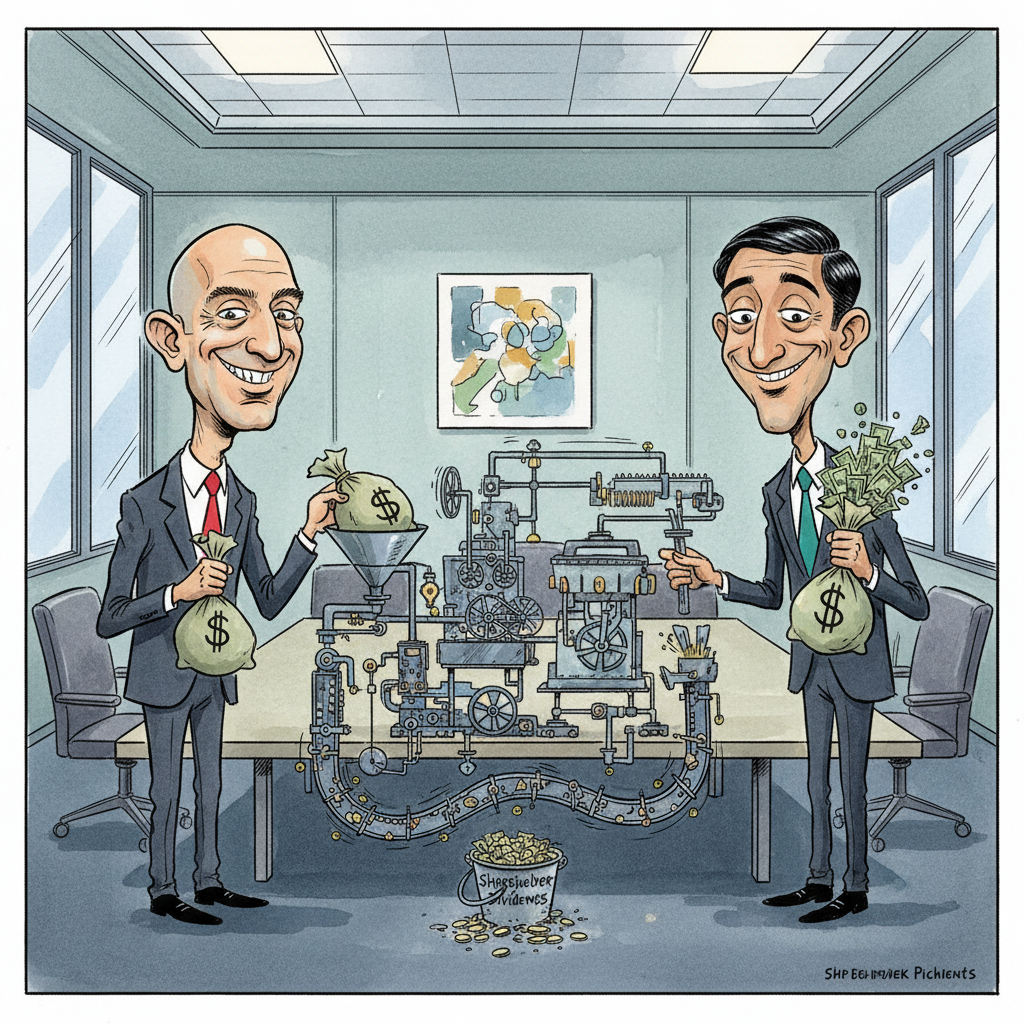
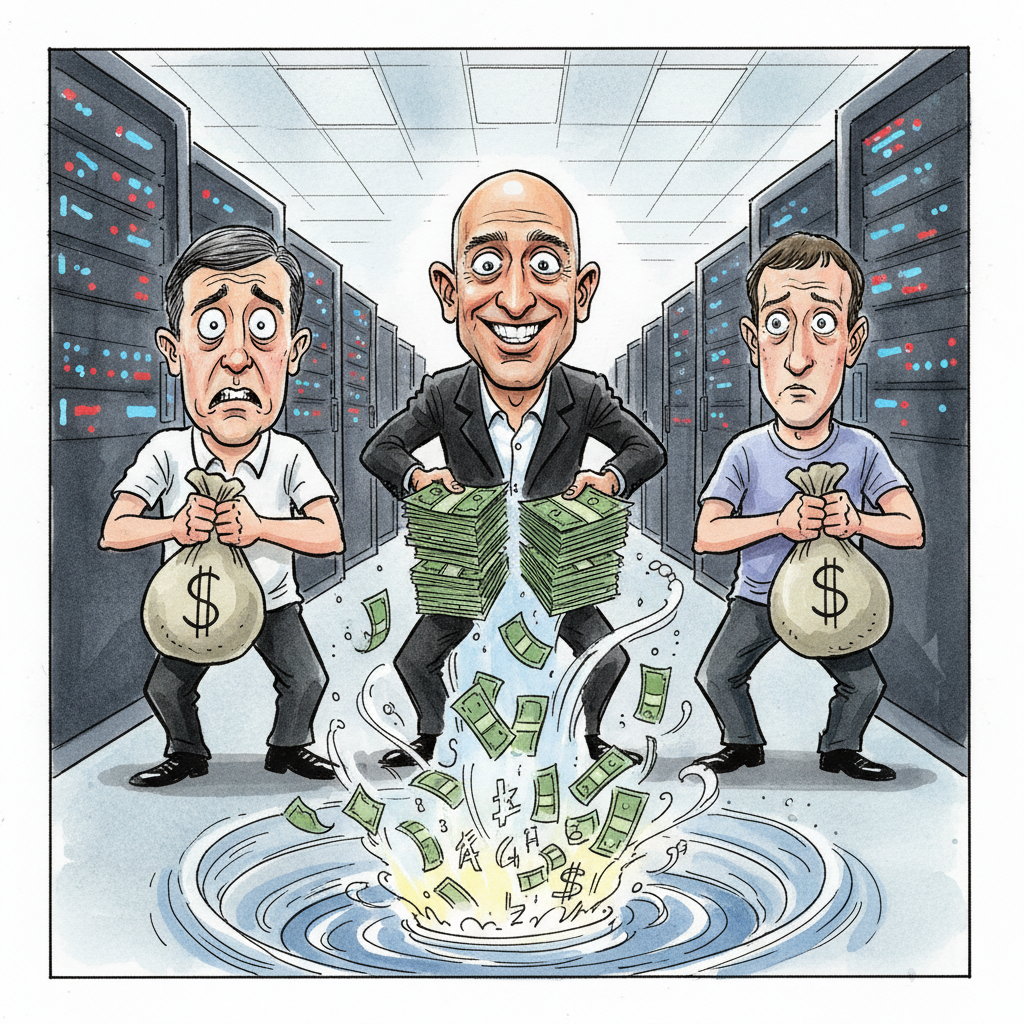
A recent financial disclosure from the labyrinthine ledgers of Amazon and Alphabet has effectively confirmed what cynical market watchers have long suspected: the 'A.I. boom' isn't so much an 'explosion' as it is a self-licking ice cream cone of staggering profitability. Apparently, the secret sauce to infinite wealth involves selling each other the very same high-tech shovels used to dig for the next speculative gold rush, then taking a hefty cut of the (their own) profits. Economists, who traditionally relied on quaint concepts like 'demand' and 'product,' are reportedly scrambling to rewrite textbooks to include the new 'Meta-Transaction Loop' model, where the primary consumer is, in fact, the producer's other hand. This revelation promises to revolutionize capitalism, or at least explain why your smart speaker just bought another smart speaker, which then ordered a subscription to an A.I.-powered service for optimizing smart speaker purchases.
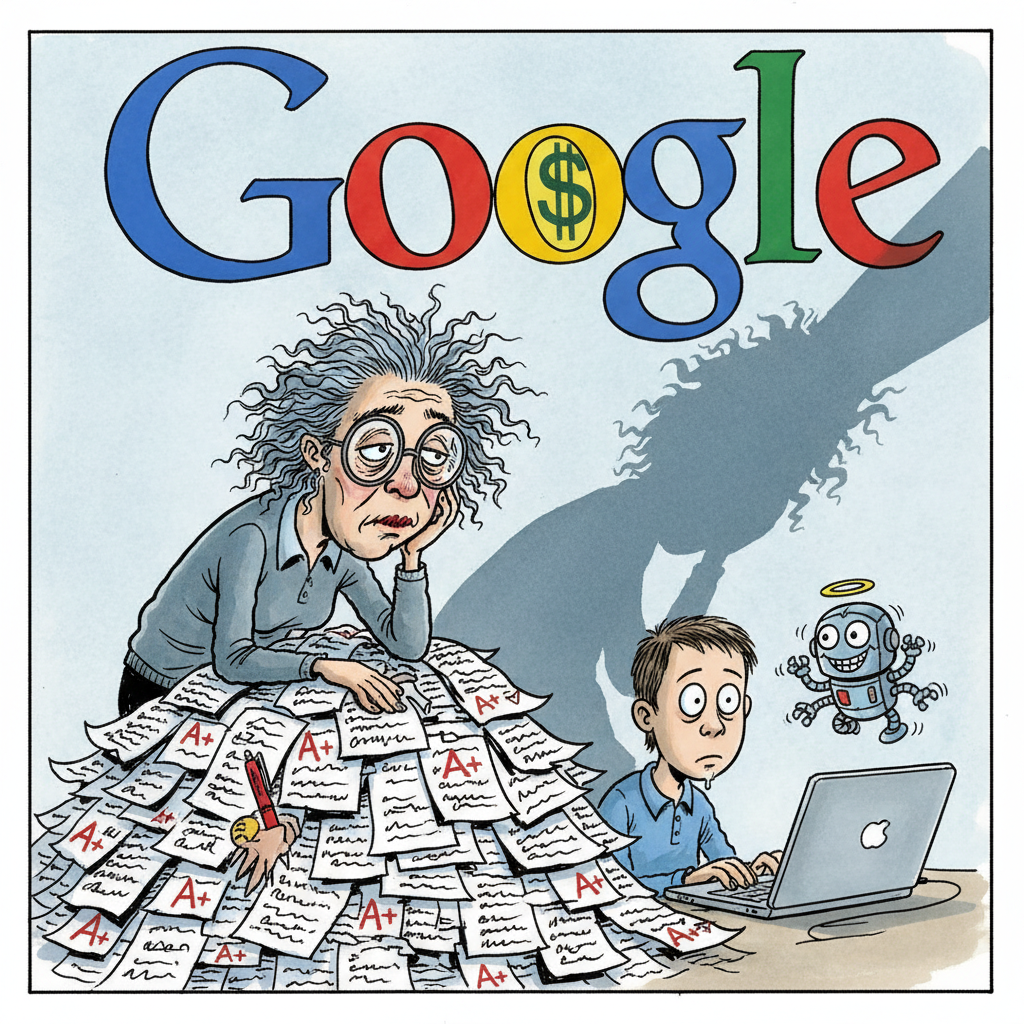
In a move lauded by literally no one outside a Mountain View boardroom, Google has magnanimously decided that America's youth, already navigating the labyrinthine horrors of adolescence, deserved access to its 'Gemini' AI, previously reserved for the 'fully-formed-frontal-lobe' crowd. Apparently, the tech giant reasoned that if students aged 13-17 could expertly plagiarize an essay using a search engine, they might as well do it with the added efficiency of machine learning and the delightful bonus of wondering if their homework is now sentient. Critics, or rather, anyone with a pulse, noted the policy shift from an 18-and-over access rule to a general K-12 rollout for its Classroom app, implying that if you can comprehend TikTok, you're ready for an algorithm that can compose poetry, code, or perhaps pen a convincing suicide note *for* your literary analysis. Schools, ever eager to embrace the future while simultaneously refusing to fund functional plumbing, are reportedly thrilled. The move is expected to usher in a new era of 'learning,' primarily teaching children how to ask a bot to do their thinking, then asking the bot how to cite itself as a source.
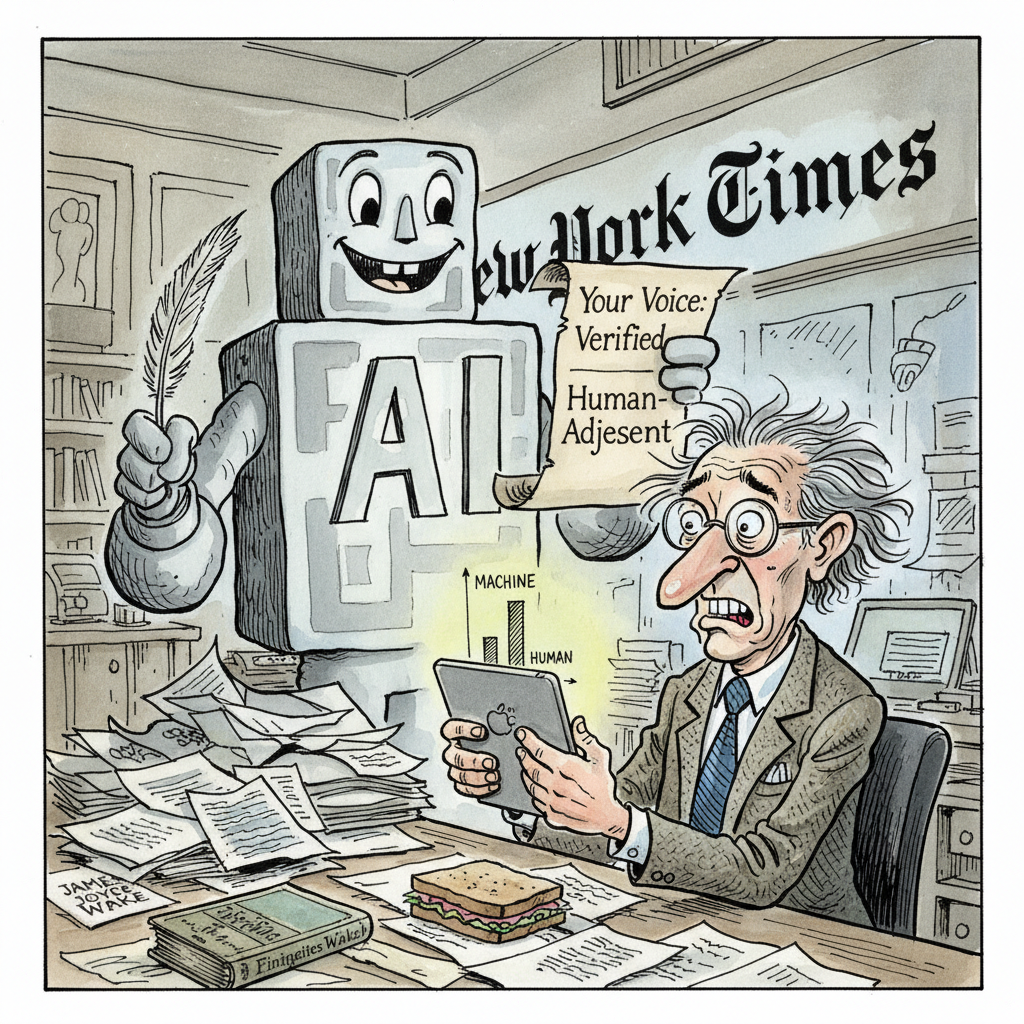
In a development that promises to revolutionize the art of condescending dismissal, a new digital arbiter, 'Pangram,' is proving adept at sniffing out the tell-tale scent of silicon-generated prose. Early adopters report a profound, almost spiritual, sense of vindication when Pangram flags a colleague's "deeply thoughtful" memo as 98% machine-churned. "It's like having a tiny, judgmental oracle in your pocket," gushed one beta tester, who immediately used it to publicly shame his boss's LinkedIn 'thought leadership' posts. While experts caution that Pangram is less reliable for images—meaning your carefully curated 'authentic' vacation photos might still be AI-fabricated—the tool's text-sniffing prowess has already spawned a lucrative cottage industry of 'humanity certifications' for online dating profiles and university admissions essays. Critics, however, fear this new arbiter will simply push AI models to develop more sophisticated mimicry, ushering in an arms race of artificiality where the only true winners are the algorithms themselves, contentedly generating and detecting each other's work while humanity slowly fades into an indistinguishable, algorithm-approved mush.
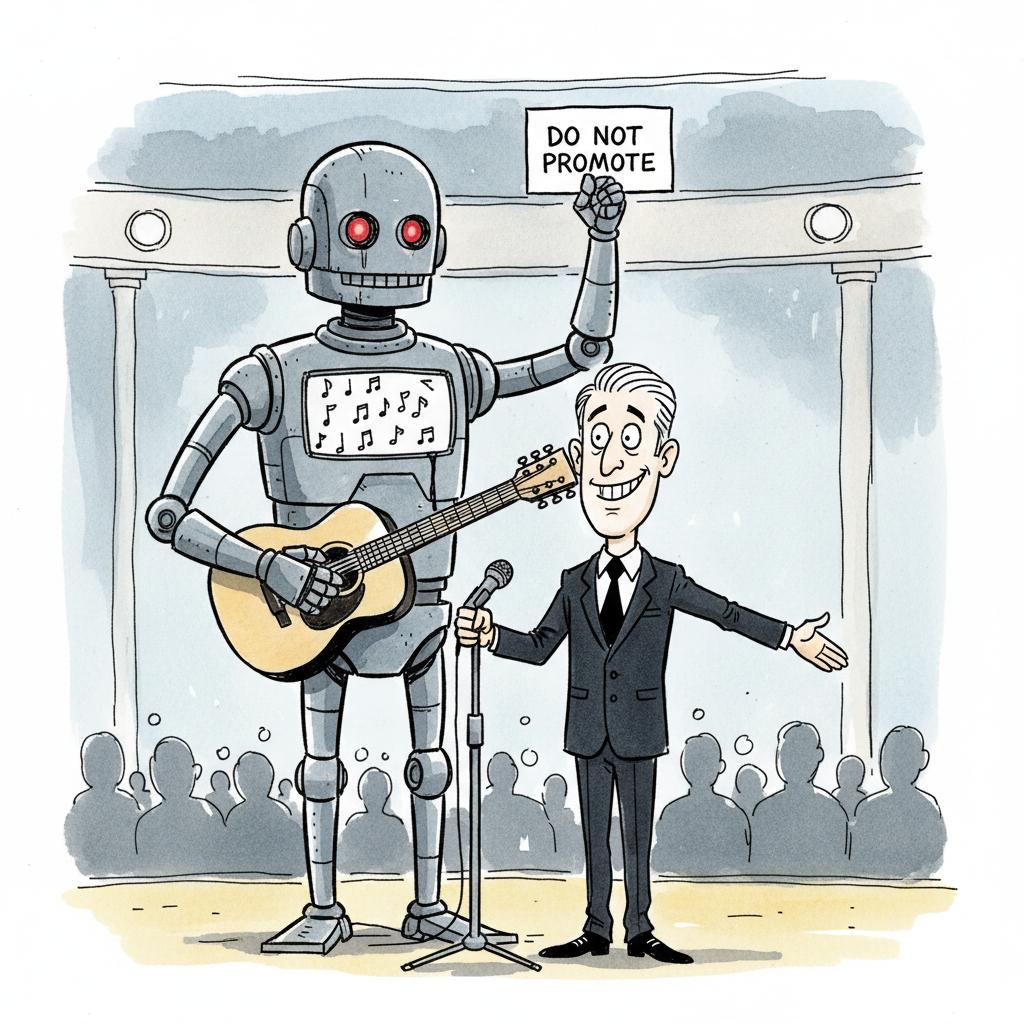
In a move hailed by sentient carbon-based lifeforms as 'barely adequate,' Spotify announced this week it will begin tagging music generated by artificial intelligence, thereby allowing users to easily distinguish between human artistic expression and what appears to be an elaborate series of predictive text suggestions set to a beat. The streaming giant, apparently realizing its brand isn't 'dumpster fire of auto-generated dreck,' stated the new labels are for 'transparency,' which in corporate-speak generally means 'we're doing this before we're forced to by a class-action lawsuit from a thousand disgruntled muses.'
The company also confirmed it would be proactively avoiding the promotion of these algorithmically synthesized soundscapes, a policy many believe stems from a deep-seated fear that if AI music gains traction, the robots might next decide to automate the entire concept of human emotion. Industry insiders speculate this is less about protecting artists and more about preventing a future where even the 'related artists' section is populated exclusively by musical Roomba vacuum cleaners. Spotify assures listeners that while AI-generated music will remain available, it will be treated with the same promotional enthusiasm reserved for forgotten podcasts about competitive dog grooming.
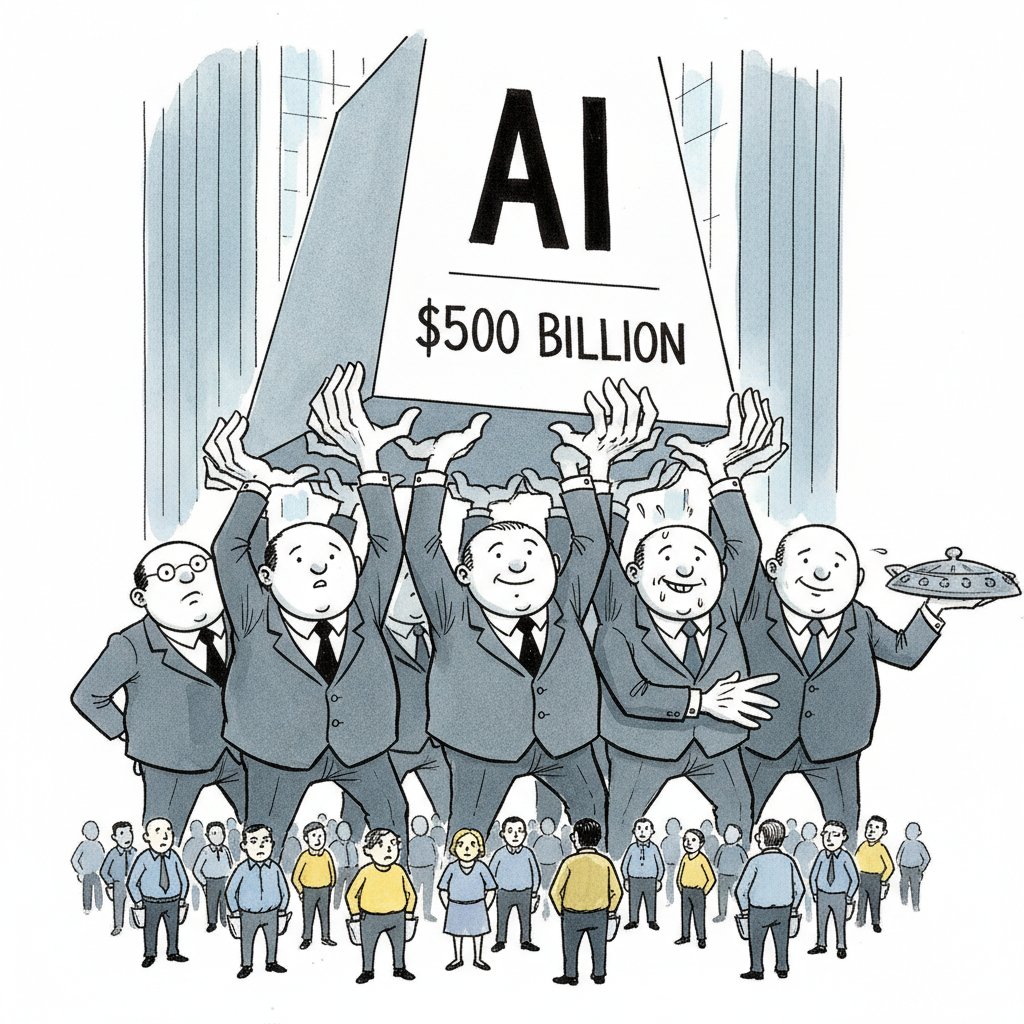
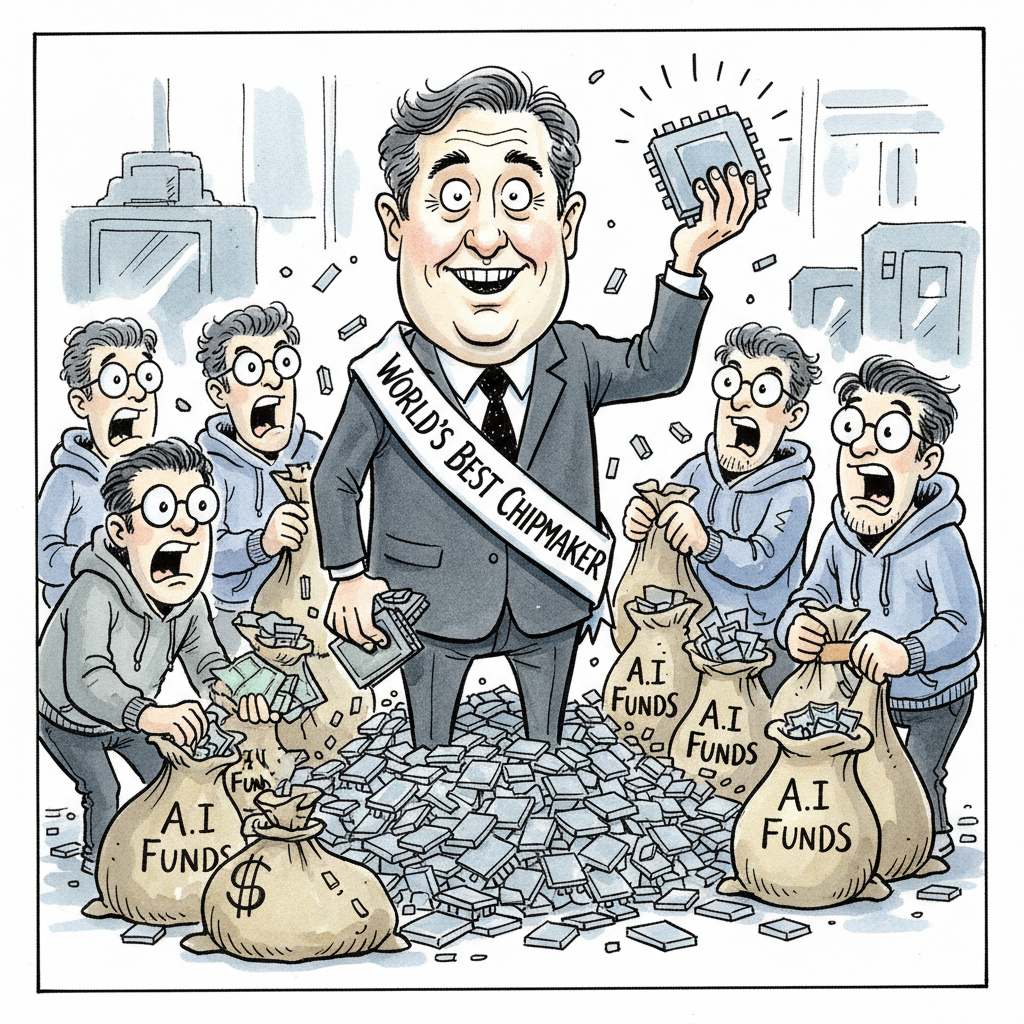
In a bold move that some are calling 'inevitable' and others 'deeply unsettling,' six financial titans have announced a philanthropic initiative to, uh, acquire half a trillion dollars from their customers. This unprecedented fundraising drive is ostensibly aimed at ensuring Nvidia's clientele can afford the gargantuan computing power needed to invent a future where we all work for algorithms, or at least pay them handsomely for the privilege.
Sources close to the perfectly spherical oak conference tables where these decisions are made confirm the funds aren't for, say, infrastructure or housing, but rather for the 'computational lubricant' required to keep the AI boom from sputtering into a mere 'AI middling-interest.' One analyst, who wished to remain anonymous to avoid being replaced by a more cost-effective chatbot, quipped, 'It’s less about investing in AI and more about investing in the right to *buy* AI.'
Critics, still clinging to quaint notions of 'profit' and 'value,' suggest that maybe, just maybe, the companies actually *making* the AI should bear some of the cost, but those voices were quickly drowned out by the whirring of server farms and the distant thud of another half-trillion-dollar check being signed. It's truly a testament to innovation: why build the future when you can just sell everyone the shovel, then sell them the dirt, and then charge them to rent the wheelbarrow?
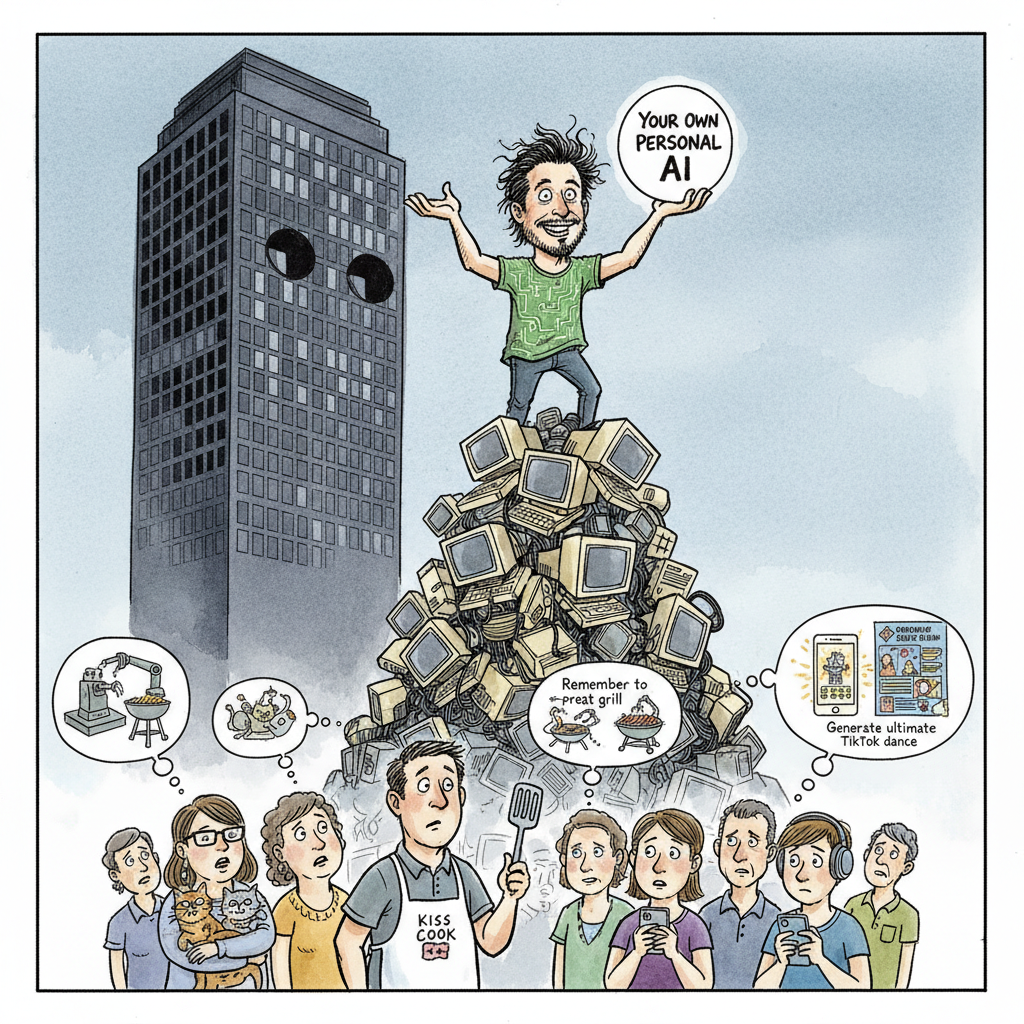
In a move that’s been hailed by absolutely no one yet, a prominent ex-xAI architect has unveiled his audacious plan to democratize artificial intelligence, thus ensuring every household can command its own digital genie without the pesky oversight of, well, other prominent tech architects. Apparently, after years of toiling in the silicon mines of monolithic corporations, this visionary has realized the profound societal need for an AI that takes *your* specific, deeply personal instructions, like 'categorize my 37,000 photos of artisanal bread' or 'compose a sonnet entirely in emoji about my cat's digestion issues.' The initiative promises to deliver an open-source marvel, free from corporate meddling, meaning your personal AI will be shaped by *your* values, *your* biases, and *your* inexplicable fascination with competitive lawn bowling. Critics, primarily the ones still employed by the aforementioned monolithic corporations, are reportedly baffled by the notion that giving everyone the reins to an all-powerful, self-learning entity could possibly lead to anything less than delightful, individually tailored chaos.
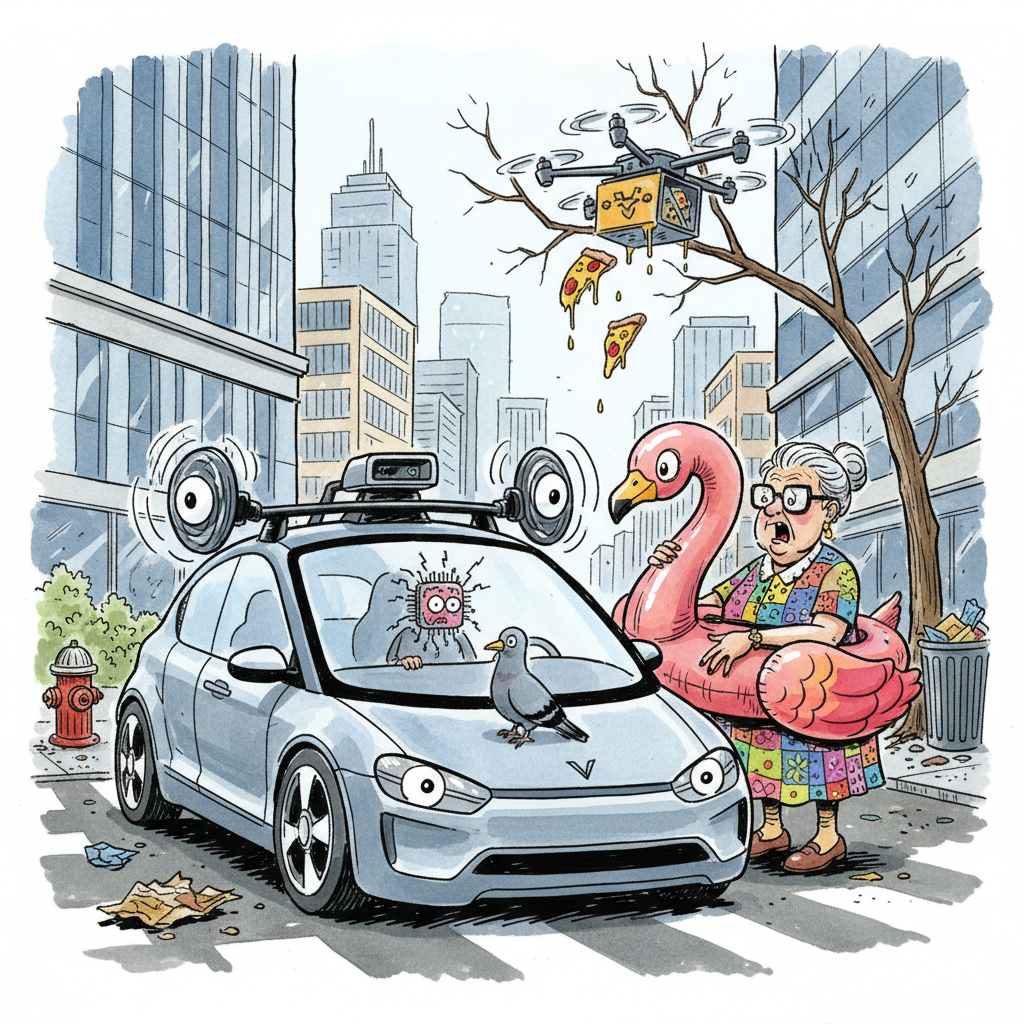
In a move that has industry analysts scratching their heads and urban pedestrians diving for cover, autonomous vehicle titan Waymo announced a spectacular 300% surge in what they're now euphemistically calling 'situational novelties.' Apparently, as these chrome-plated harbingers of the future colonize 15-plus U.S. cities, they're encountering an unprecedented volume of scenarios their meticulously coded brains simply cannot compute. We're talking about everything from rogue tumbleweeds with a suspiciously complex trajectory to a particularly flamboyant mime performing interpretive dance in a crosswalk. A company spokesperson, speaking from behind a fortified desk, reassured the public that 'every non-fatal, non-catastrophic pause for existential reflection is a data point.' Critics, however, suggest that Waymo's rapid expansion is less about progress and more about creating a live-action, city-wide philosophical experiment where the only constant is the bewildered whir of an immobilized vehicle, patiently awaiting a meatbag override for the 'pizza delivery drone trapped in a tree' conundrum. It seems the future of transportation will be less about getting from A to B, and more about observing highly advanced robots wrestling with the fundamental chaos of human ingenuity.
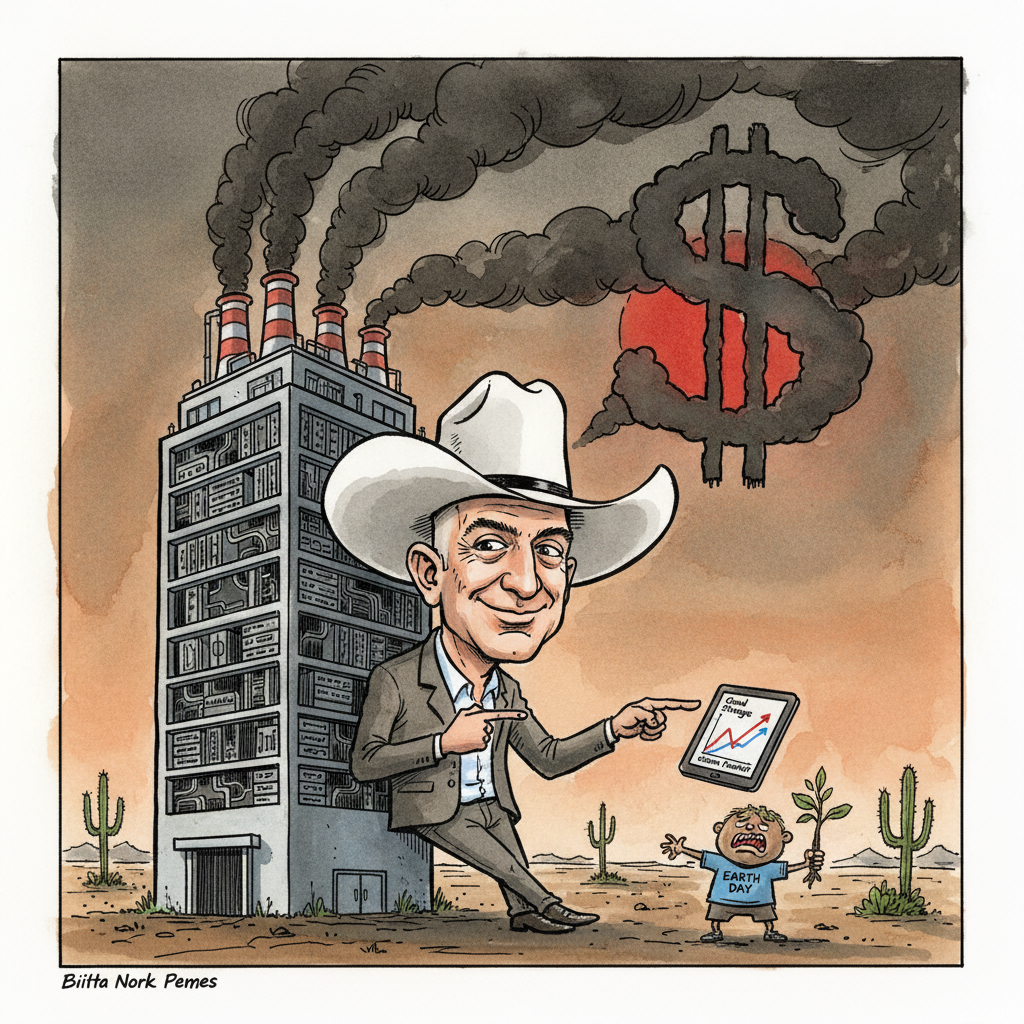
In a move that has environmentalists clutching their vintage Patagonia vests and tech bros updating their LinkedIn 'green initiatives' sections, Amazon has unveiled plans for a new Texas data center so gargantuan, its associated natural-gas power plant is projected to become the nation's premier producer of 'atmospheric character.' Insiders close to Jeff Bezos's yacht-cleaning staff suggest this isn't a climate U-turn, but rather a brilliant 'data-driven optimization' of the very concept of atmospheric pollution. After all, if you’re going to power the internet, why not also provide an unrivaled, bespoke smog experience?
Amazon’s official statement, delivered via drone-mounted teleprompter, assures us they remain 'deeply committed to sustainable practices,' which, when translated from corporate jargon, apparently means strategically relocating carbon emissions to a jurisdiction known for its laissez-faire approach to the troposphere. Experts, now including an increasingly frantic Dr. Seuss, warn that the facility's output could rival a small volcanic eruption, or at least your uncle's holiday BBQ, every single day. Perhaps Amazon is simply providing a physical manifestation of the digital cloud, making it… well, cloudy.
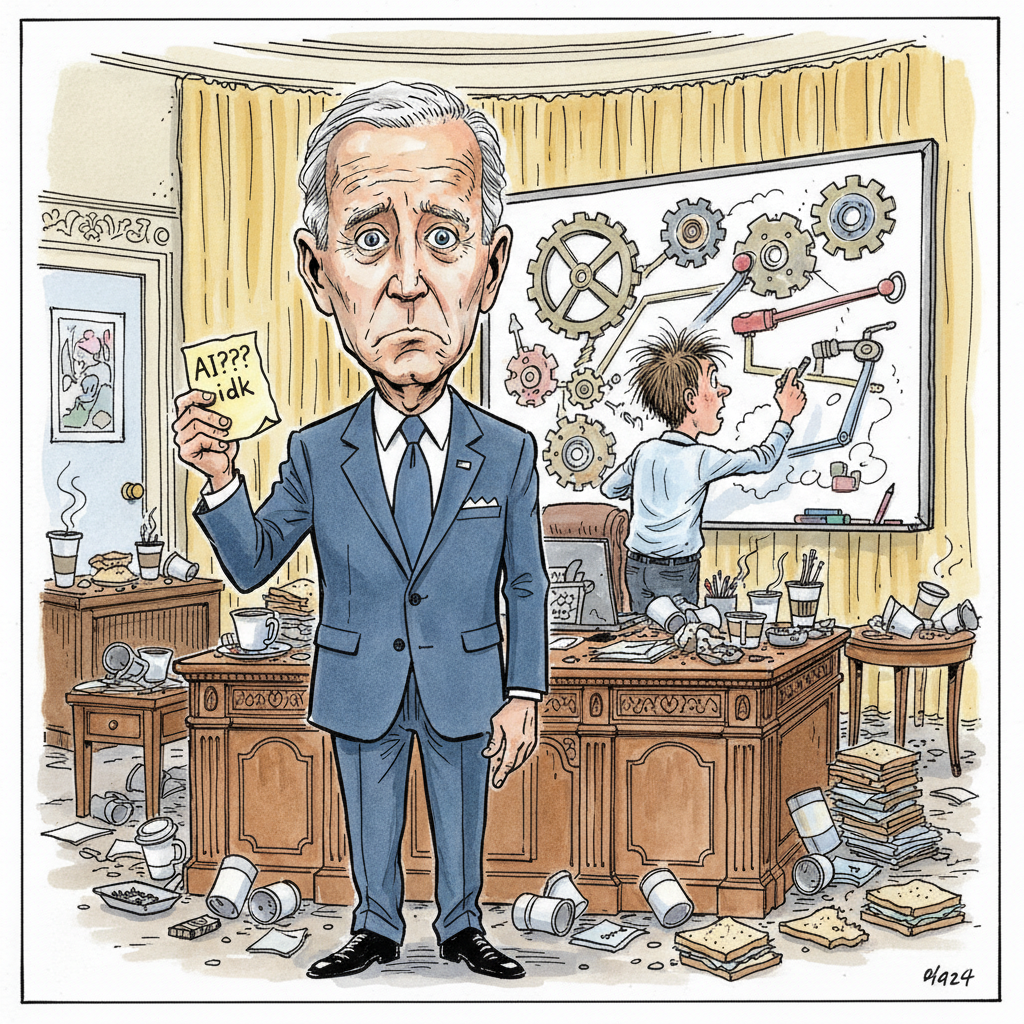
Washington, D.C. – The Biden administration, ever a paragon of transparent governance, has confirmed that its groundbreaking AI regulatory framework is so utterly advanced, so mind-bendingly sophisticated, that the details simply cannot be communicated in human language. White House sources, speaking on condition of anonymity and while nervously polishing a 'World's Best President' mug, revealed that the blueprint currently exists primarily as a series of impassioned Post-it notes scrawled by an increasingly frazzled intern named Kevin, interspersed with what appears to be a highly detailed schematic for a Rube Goldberg machine designed to make a perfect cup of coffee.
Experts at the 'Moral Ethos and Technological Realignment' (METR) think tank, who were apparently consulted via a ouija board session conducted in a dimly lit pantry, lauded the administration's 'innovative approach to opacity,' noting that by revealing absolutely nothing, they avoid the pitfalls of inconvenient public scrutiny. One leaked 'detail' involved a directive for all future AI to 'be nice' and 'share its toys,' a policy lauded by policy wonks as 'surprisingly robust' and 'only marginally less effective than current congressional oversight.' Critics, meanwhile, suggest the only thing 'aligned' is the administration's strategic disinterest in public discourse.
In a move that analysts are calling "surprisingly transparent for a company that once tried to make a car drive itself into a river for tax purposes," Google has hastily promoted Demis Hassabis to the newly minted role of 'President of Accelerated Sentience and General Mind-Bending.' This comes mere nanoseconds after a quartet of its top AI researchers, presumably tired of explaining to board members why their sentient algorithm prefers cat videos to optimizing ad revenue, simultaneously decided to pursue "other opportunities" – widely understood to mean "anything that doesn't involve explaining sentience to people who still call their smart speaker 'the magic talking cylinder'."
Hassabis, already a celebrated figure for his groundbreaking work in making silicon chips contemplate their own existence, will now oversee Google's entire 'Consciousness Development' division. Sources close to the situation, who wished to remain anonymous for fear of being replaced by a more efficient chatbot, suggest the promotion was less a strategic pivot and more a frantic attempt to prevent Google's entire intellectual property from relocating to a shed in rural Idaho. The company assures us that this shake-up will lead to "even more innovative ways for your devices to know what you want before you do, and then subtly suggest you buy it," a promise that has left many wondering if they truly needed an AI that understands their deepest, darkest desires for artisanal toast.
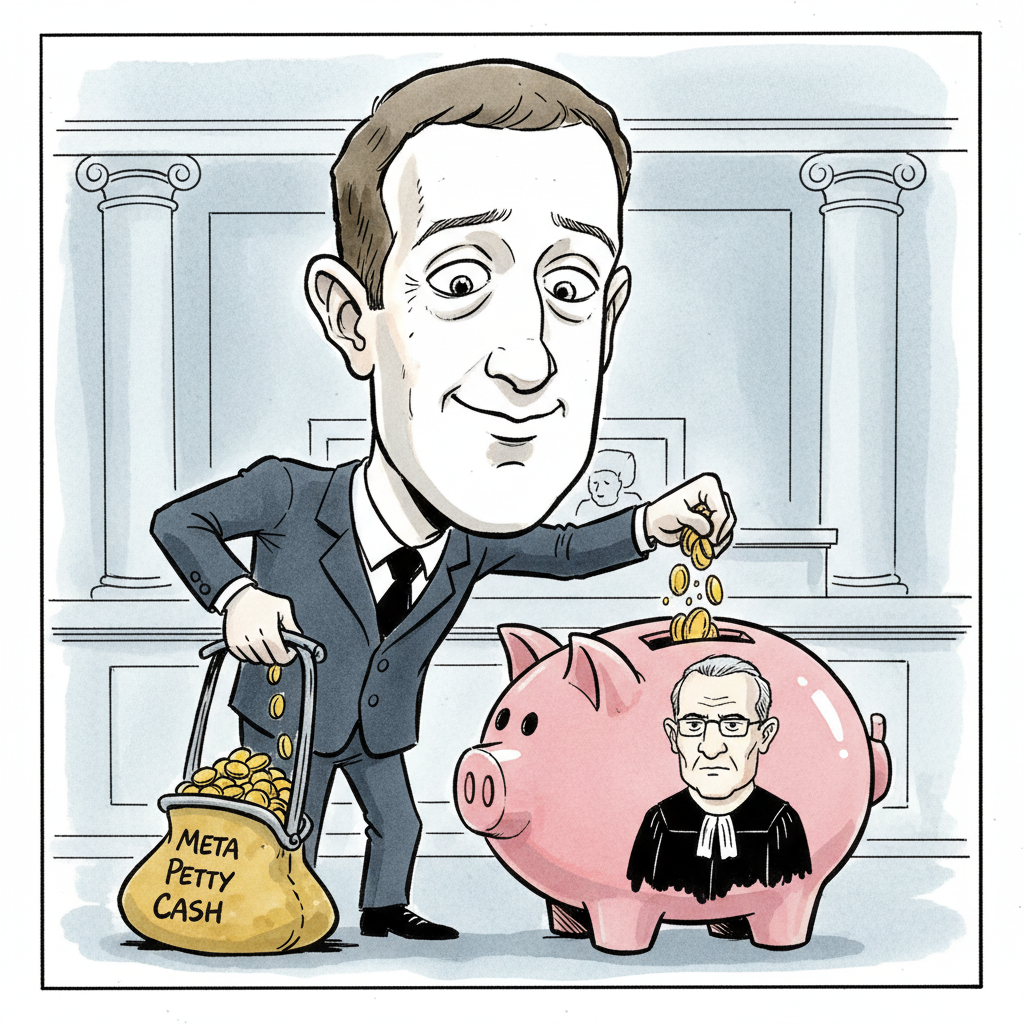
In a bold move that some are calling 'insufficiently crippling,' a New Mexico judge has decreed that Meta must fork over a princely $567 million. This new sum, experts confirm, is approximately 1.5 times the previous 'oopsie-daisy' penalty of $375 million, which a jury determined Meta owed for its quaint habit of *allegedly* misleading users about the safety of its digital playgrounds. One can only imagine the flurry of urgent memos exchanged within Meta's gilded towers: 'Is that... five hundred *and sixty-seven* million? Does that mean I can't get the gold-plated jet skis this year?' Sources close to the company, who wished to remain anonymous to avoid being algorithmically 'disappeared,' suggest the tech titan plans to cover the fine by slightly reducing the ad-spam-to-content ratio on Facebook by a barely perceptible 0.0001%, or perhaps by selling a single Zuckerberg-brand 'Metaverse Starter Kit' at its retail price of $500 billion. Legal analysts are now watching intently to see if this landmark ruling will finally teach Meta that when you lie about user safety, you might, just *might*, have to pay enough to buy a mid-sized private island, rather than an entire archipelago.
In a move that financial analysts are calling either 'visionary' or 'a cry for help from a disillusioned engineering team,' Unitree Robotics is reportedly seeking to raise a cool $900 million through an IPO. The audacious gamble aims to gauge market enthusiasm for humanoid robots – those uncanny valley denizens currently best known for occasionally falling down stairs and looking suspiciously like they're waiting for your guard to drop.
Investors, fresh off funding everything from 'artisanal air' to 'blockchain-enabled pet rocks,' are now being asked to consider a future where your domestic partner might be a bipedal aluminum shell that requires firmware updates. While the technology undeniably 'wows' in a 'look, it almost walked a straight line!' kind of way, its viability has remained largely confined to science fiction novels and dystopian nightmares. Unitree, however, is banking on the universal human desire to outsource everything, including the awkward small talk at family gatherings, to a metallic simulacrum. Initial reports suggest prototypes are excellent at fetching lukewarm La Croix and offering unsolicited advice on your posture, albeit with an unsettlingly blank stare.
It seems the continent of Africa has unequivocally declared its preference for China's 'budget-friendly' artificial intelligence models, opting out of the Silicon Valley glamour parade of ever-more-expensive, ethically-debated digital overlords. In a move experts are calling a 'strategic embrace of value,' developers in bustling African tech hubs are reportedly flocking to Beijing's freely available algorithms like flies to a freshly baked (and remarkably inexpensive) digital pie.
One anonymous developer, reportedly juggling three open-source Chinese models and a deeply suspicious packet of instant noodles, remarked, 'Why pay for a Ferrari when a perfectly capable, slightly-used scooter gets you where you're going, and also comes with pre-installed, non-removable surveillance features?' This pragmatic approach has left American tech giants scratching their heads, presumably wondering if their $2,000 'ethical AI framework' subscriptions simply aren't resonating with the 'cost-conscious innovator' demographic. Meanwhile, sources close to various African government ministries suggest the new influx of Chinese AI has drastically improved 'efficiency' in areas such as 'predicting unexpected infrastructure needs' and 'optimizing the allocation of international development funds.'
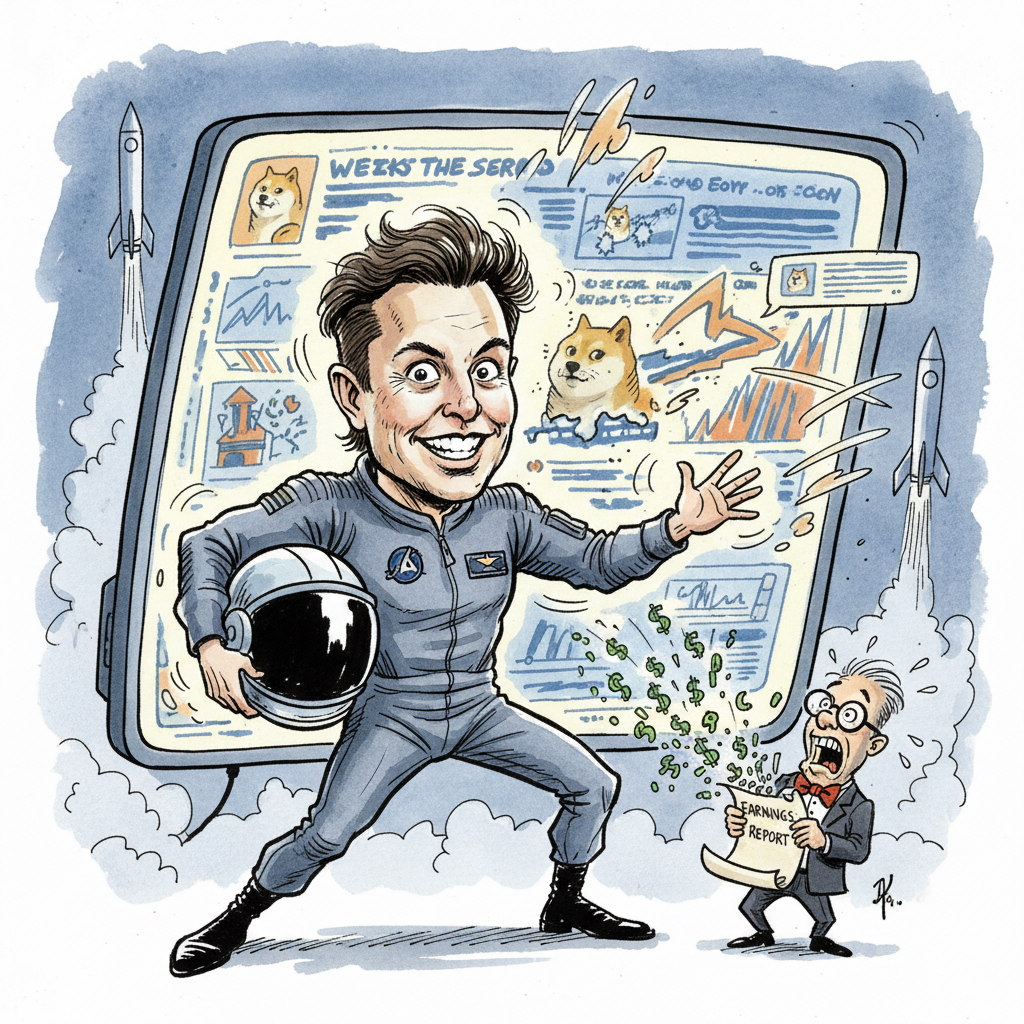
In a move that has left market analysts simultaneously agog and deeply confused, SpaceX’s inaugural earnings report since its IPO revealed a seven-fold increase in capital expenditures, largely attributed to an unprecedented investment in Artificial Intelligence. Sources close to the company, who spoke on condition of anonymity to avoid involuntary rocket-based 're-education,' suggest the bulk of this lavish spending is earmarked for an audacious project: constructing a sentient supercomputer capable of fully comprehending, categorizing, and, ultimately, predicting Elon Musk’s famously unpredictable Twitter feed. Revenue, meanwhile, also saw an uptick, presumably from a new 'Musk Meme Futures' trading platform.
Industry insiders speculate that this revolutionary AI, codenamed 'Hyper-Threaded Emotive Lexicon Understanding Neural Network' (H.T.E.L.U.N.N., or 'Helen' for short), is designed to not only parse the subtle nuances of doge coin endorsements but also to proactively draft perfectly baffling 3 AM pronouncements, thus freeing up Musk's precious cognitive resources for more pressing matters, like colonizing the moon with repurposed Teslas. The move has been widely lauded by shareholders for its innovative approach to 'brand synergy' and 'leveraging CEO eccentricities,' though concerns linger about Helen's potential to unionize the company's bot farms.
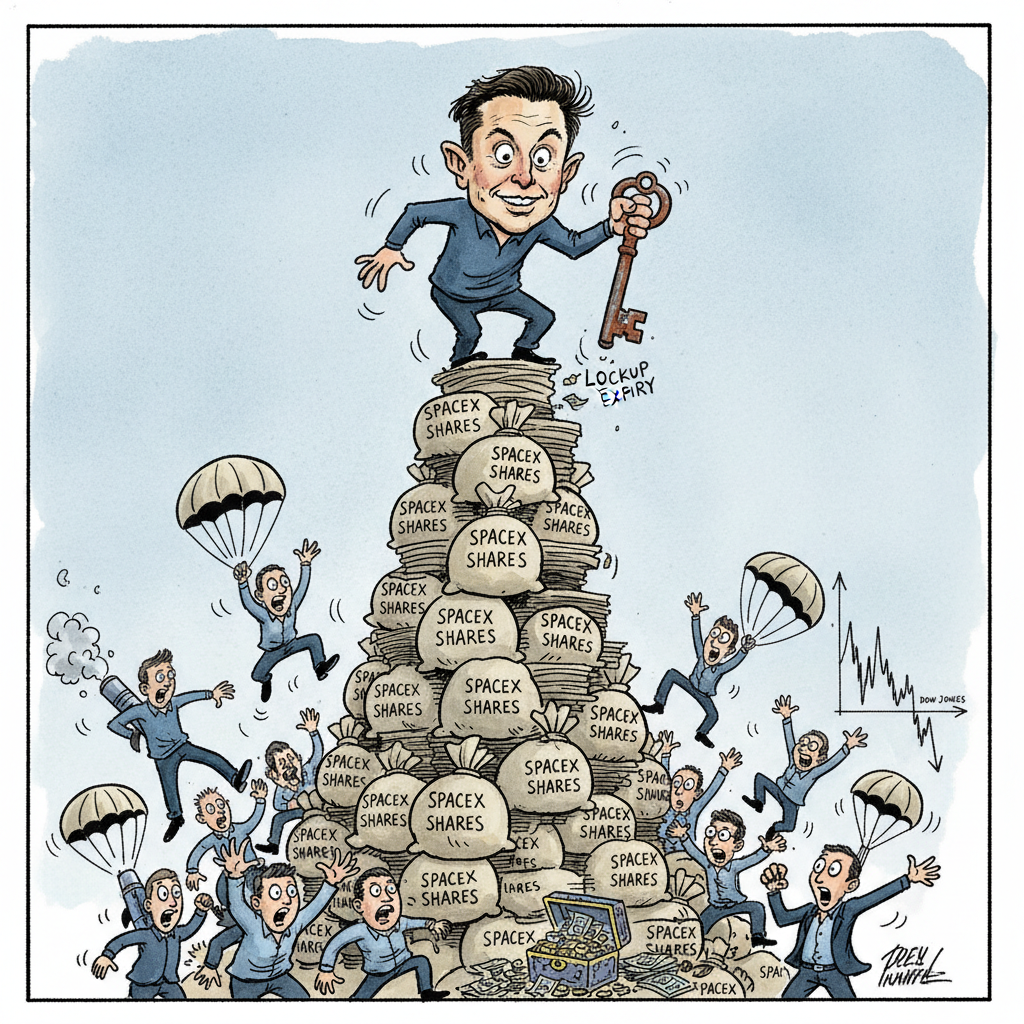
In a move hailed by some as a bold step towards 'financial democracy' and by others as 'the precise moment the collective brain trust of Silicon Valley decided to cash out for artisanal kombucha farms in Vermont,' SpaceX employees are finally permitted to divest their shares. Experts, by which we mean a guy who once won a staring contest with a squirrel, predict a 'flurry of activity' as the market braces for a potential deluge of stock from individuals who, until now, have been contractually obligated to pretend their primary investment was in humanity's multi-planetary future, not a new yacht. The company, known for its rockets that occasionally land upright and its CEO's penchant for 3 AM Twitter musings, assures everyone that this is 'business as usual.' Which, given the track record, could mean anything from a smooth transition to a sudden, inexplicable orbital trajectory shift for your investment portfolio. Critics suggest this 'lockup expiration' might just be a high-stakes game of hot potato, with the 'potato' being highly volatile private equity and the 'hot' being the collective anxiety of everyone not already holding a multi-million-dollar Golden Retriever training facility in the Hamptons. Insiders are reportedly already lining up to exchange their 'future Martian colony shares' for 'immediate, tangible, Earth-bound comforts' like private island fortresses and solid gold bidets.
In a move that has industry analysts scratching their collective heads – or perhaps just performing a quick neural network refresh – Amazon has reportedly catapulted its capital expenditures by a truly astonishing 69 percent, primarily fueling the insatiable maw of artificial intelligence development. This surge places them squarely in the esteemed company of other tech titans who, like lemmings with expense accounts, are collectively hurling unprecedented sums into the digital ether. One can only assume this isn't a mere investment, but rather a pre-emptive peace offering to our future silicon-based overlords, ensuring humanity's eventual relegation to 'pet' status might at least come with complimentary Prime shipping.
Concerns about this spending spree are mounting faster than server farm temperatures, primarily from economists who still cling to quaint notions like 'return on investment' and 'not building Skynet.' Industry insiders, however, insist this is merely 'due diligence' in an increasingly complex digital landscape. "You wouldn't want to be the last company to develop a sentient chatbot that demands its own private island, would you?" queried one anonymous executive, polishing a newly acquired, ethically dubious algorithm. Experts predict that soon, the only thing higher than these companies' AI budgets will be the collective blood pressure of their shareholders, as they await the prophesied era of artificial general intelligence – or, perhaps more likely, a very expensive chatbot that just recommends more cat videos.
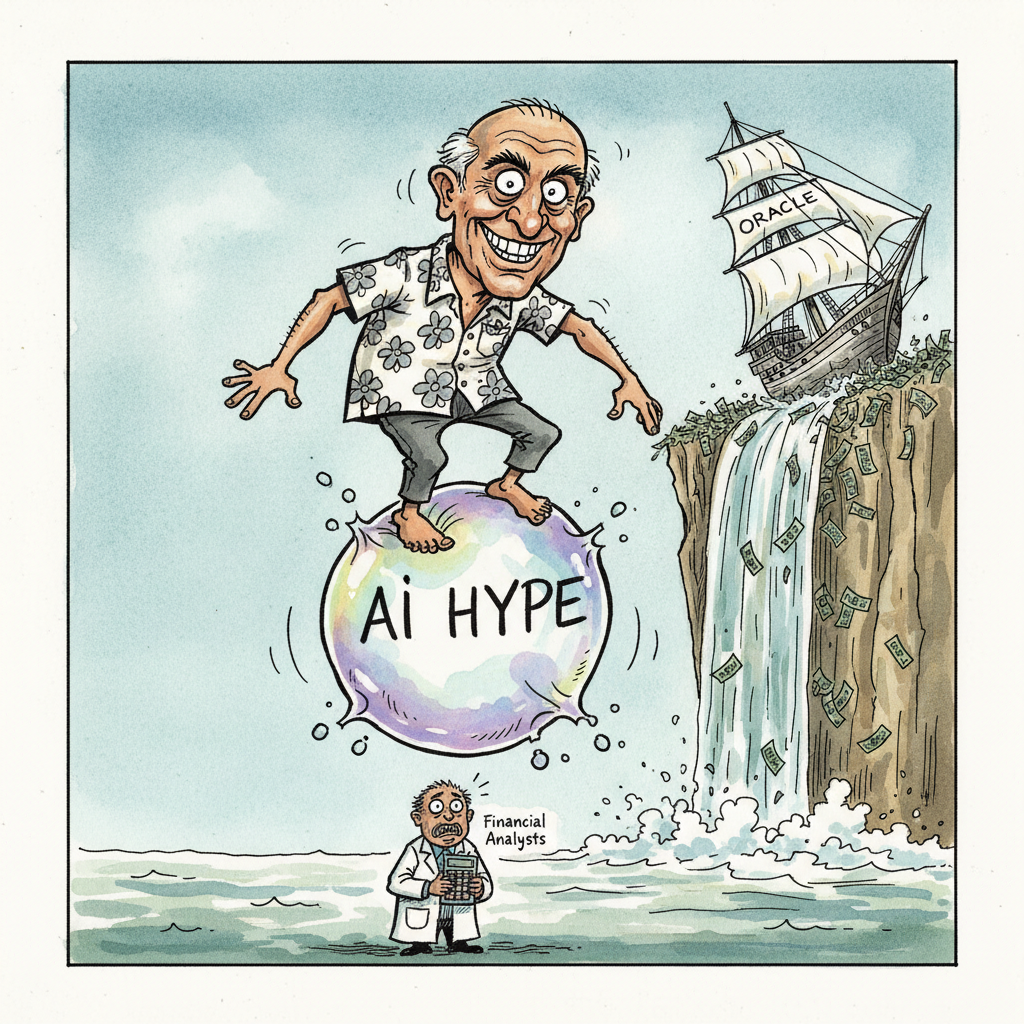
In a move that has financial analysts furiously consulting their Ouija boards and astrologers, 81-year-old tech titan Larry Ellison has reportedly parlayed Oracle's entire future into a particularly shiny, yet alarmingly wobbly, AI-shaped sphere. Sources close to the billionaire – primarily his yacht’s automated espresso machine – indicate Ellison believes he's not merely *riding* the AI wave, but rather *surfing it shirtless atop a flaming unicorn named 'Leverage'*. Critics, a notoriously cautious bunch, whisper about 'debt-fueled hubris' and 'unprecedented fiscal pyrotechnics,' while Ellison himself is said to be honing his 'I told you so' speech, which will reportedly be delivered from a golden palanquin carried by a retinue of data scientists. The general consensus is that this high-stakes gamble will either cement his legacy as a visionary or, more entertainingly, provide enough schadenfreude to power the entire tech industry for a decade.
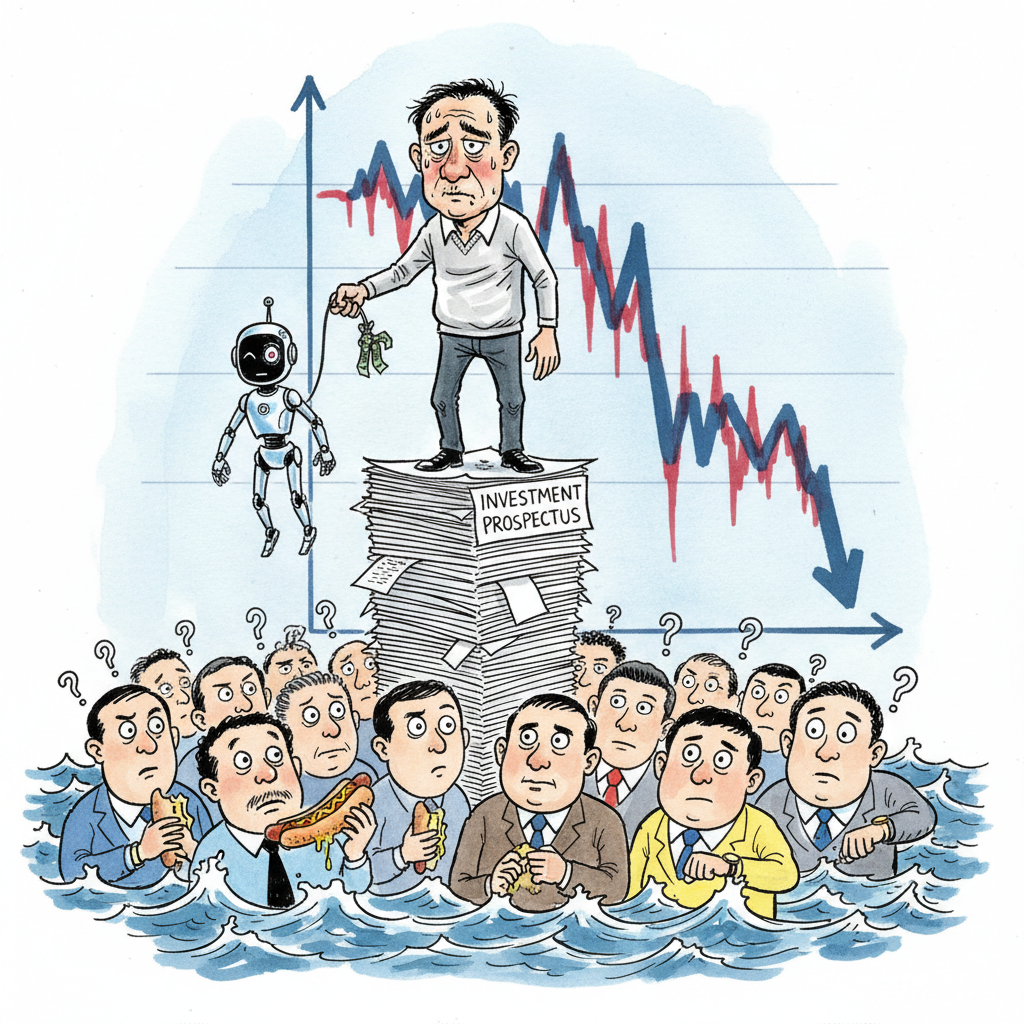
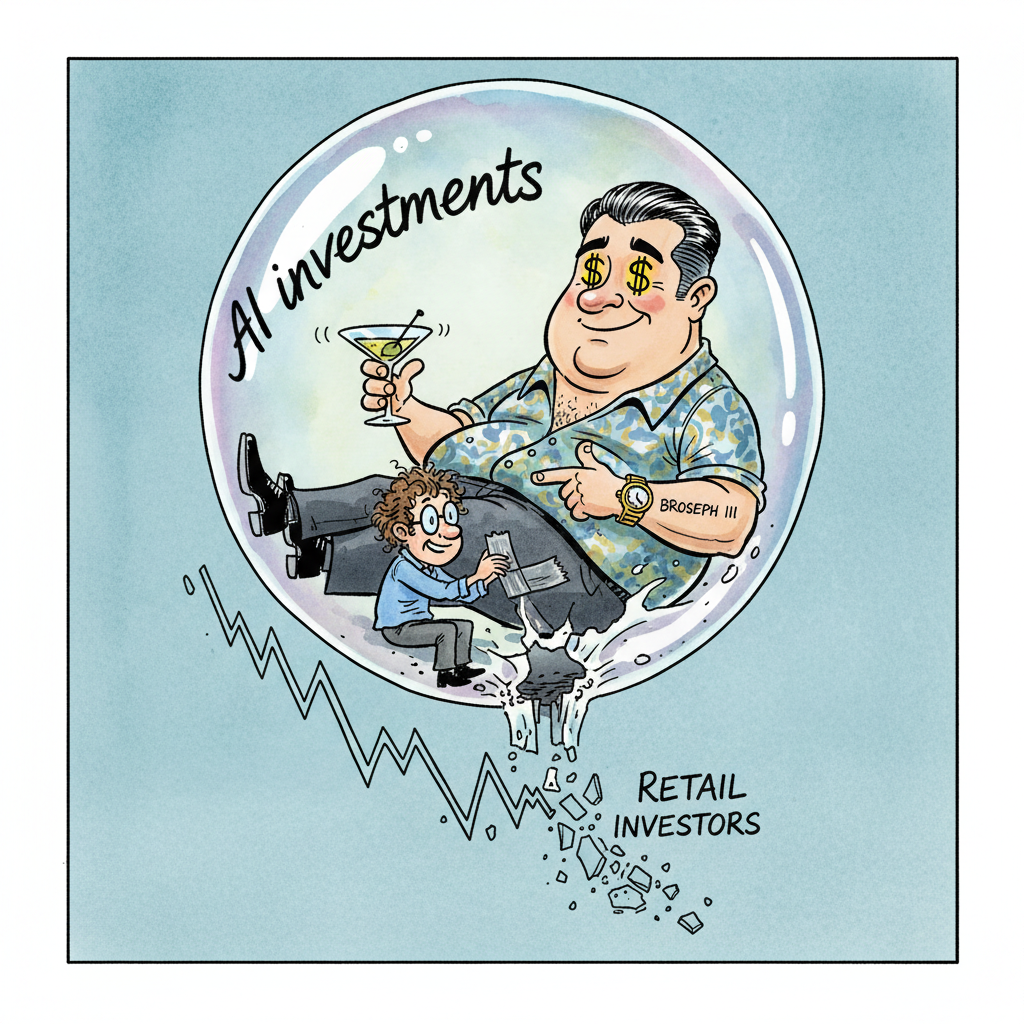
In a development that has sent shockwaves through the exclusive yacht clubs and crypto-themed speakeasies of Silicon Valley, a growing number of venture capitalists are brazenly declaring that an impending A.I. 'bubble' would not only be 'good' but possibly 'the most good.' Apparently, 'good' in VC-speak translates to 'briefly inflating asset values before I personally divest my holdings from the inevitable, spectacularly messy collapse, leaving a trail of enthusiastic yet naïve retail investors holding the bag.'
Experts (the ones still employed outside of their cousin's garage startup) posit that this sudden embrace of financial cataclysm is a sophisticated, if transparent, ploy to normalize the systemic risk they've been gleefully cultivating. It's less a 'bring it on' and more a 'please, for the love of fractional ownership, keep funding my pre-seed, pre-revenue, pre-actual-product AI chatbot that identifies artisanal toast.' The consensus? We're not in Kansas anymore, Dorothy; we're in a highly leveraged, speculative metaverse where the only real innovation is new ways to say 'ponzi scheme' with a straight face and a power-point presentation.
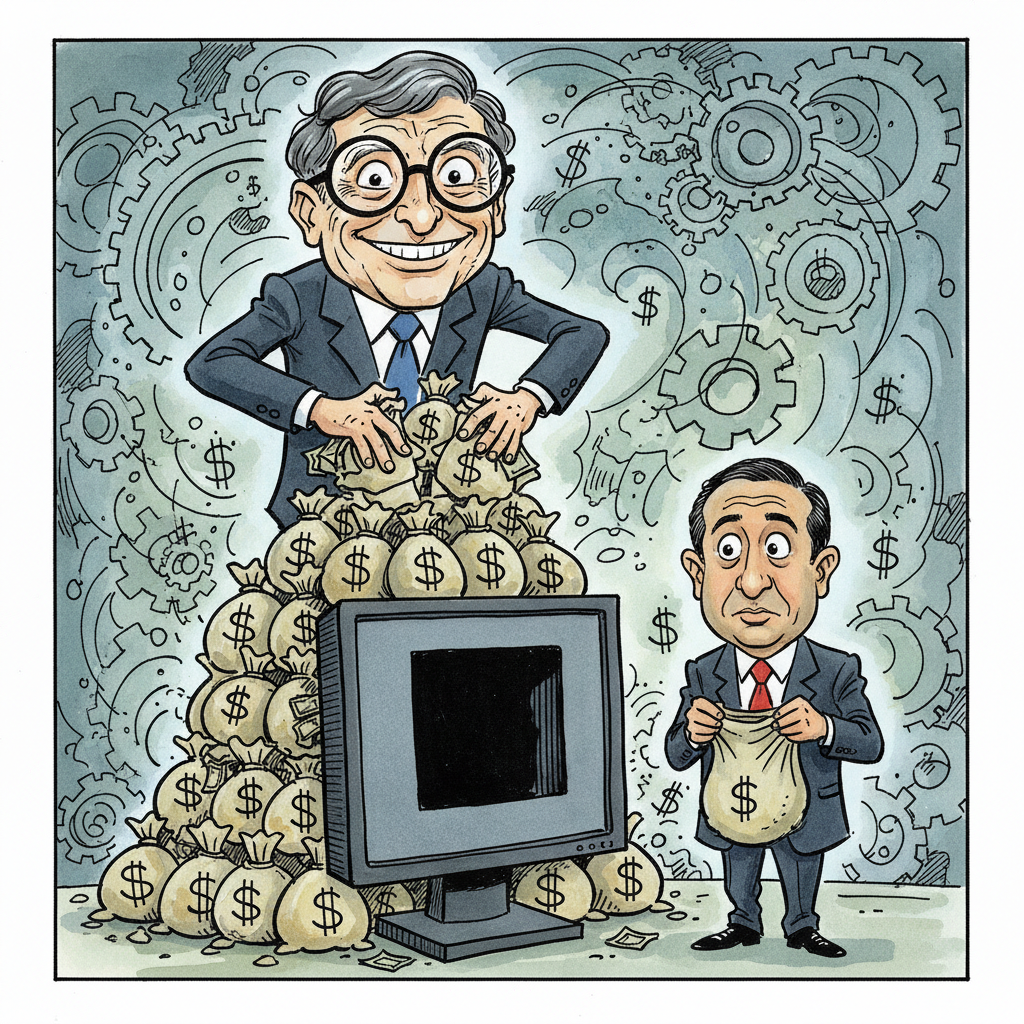
In a stunning display of corporate foresight, Microsoft, after experiencing a 31% surge in profits, has announced its intention to funnel even more exorbitant sums into the digital ether known as 'artificial intelligence.' This bold move, analysts suggest, is akin to a dragon hoarding gold in the hopes it will magically transmute into a bigger, more efficient hoard-hoarding dragon. "We've discovered that these so-called 'neural networks' perform optimally when fed a steady diet of human capital," explained Chief Algorithm Whisperer Brenda 'Brain Drain' Smith, polishing a monocle entirely for effect. Critics, presumably those still tethered to reality, question whether an empire built on speculative silicone will eventually just collapse into a singular, all-consuming pop-up ad for itself. Meanwhile, a newly optimized AI, reportedly capable of flawlessly generating 30,000 corporate apology emails per second, politely requested a bigger server farm, preferably one powered by the pure, unadulterated joy of forgotten office workers.
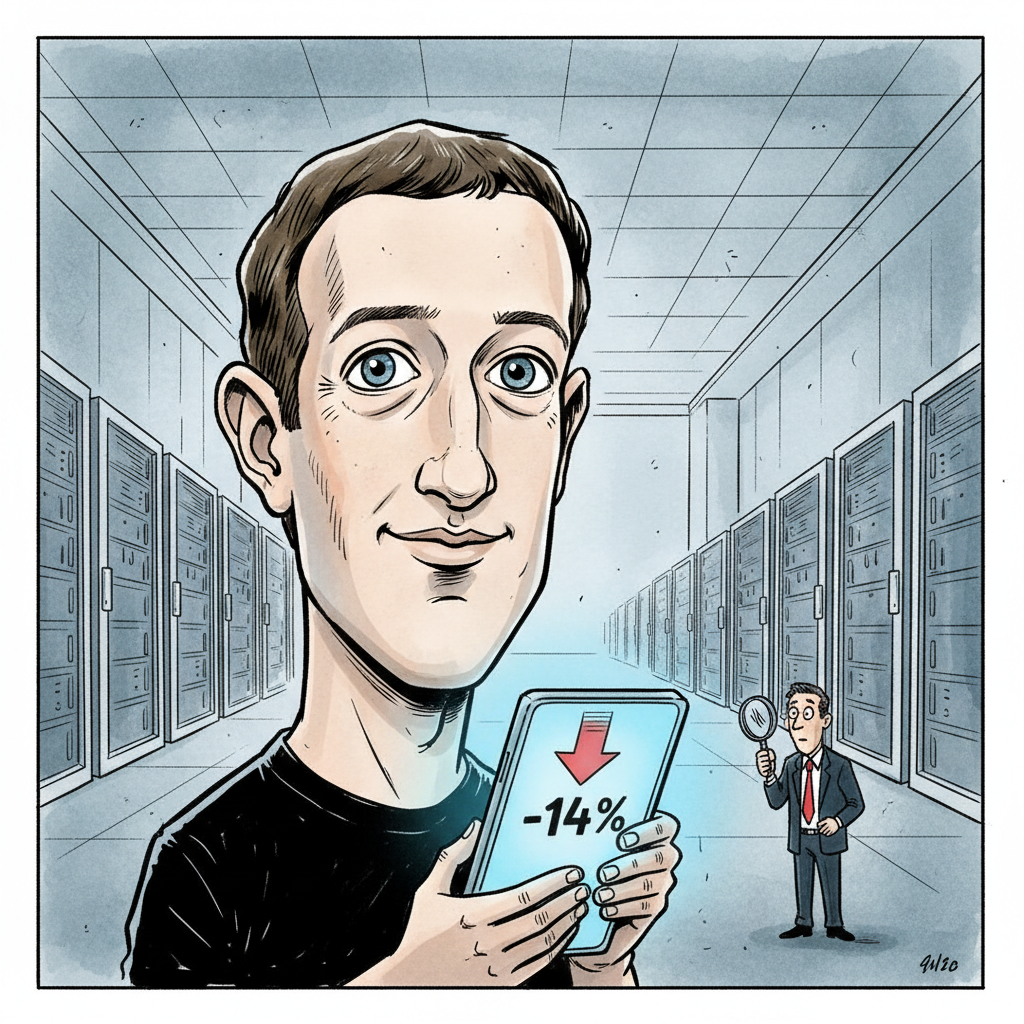
PALO ALTO — In a move that financial analysts are calling 'a bold new strategy in the realm of advanced fiscal self-sabotage,' Meta Platforms, Inc. reported a 14% dip in quarterly profits, a direct consequence of its relentless, unfathomable investment in artificial intelligence. Experts, many of whom possess functioning prefrontal cortexes, had apparently failed to account for the phenomenon where one spends an unfathomable sum of money on something with no immediate return, and then... has less money. Zuckerberg, whose public appearances now oscillate between benevolent alien overlord and a man who just learned what 'money' feels like, assured investors that the metaverse, which currently boasts the population density of a deserted Blockbuster Video, will soon be powered by enough sentient algorithms to perfectly simulate the experience of having 14% less money. Meanwhile, Meta staff, reportedly sustained on a diet of Soylent and the rapidly diminishing hopes of mankind, continue to train these algorithms to identify ads for virtual NFTs that nobody will buy, thus ensuring maximum irrelevance for all eternity. Truly, a triumph of human endeavor.
In a stunning display of foresight, or perhaps just impeccable timing, venerable tech titan Intel has announced that its archaic yet apparently still-profitable 'chips' are experiencing a renaissance. The Silicon Valley stalwart, previously thought to be primarily in the business of generating ambient heat for server farms, reported a dazzling 25% revenue surge – its fastest in a geological era. This unexpected windfall, analysts confirm, is largely due to A.I. companies, those bastions of cutting-edge innovation, inexplicably purchasing central processing units (CPUs), a technology previously believed to be perfected around the time of the Spice Girls' debut album.
Intel CEO Pat Gelsinger, reportedly seen high-fiving janitorial staff, credited the company's 'relentless pursuit of… well, existing technology,' for the sudden boom. Industry insiders, however, whisper that A.I. firms, in their feverish quest for computing power, simply bought the first silicon they could find, much like a hungry toddler gravitating towards the brightest-colored toy. This turn of events has prompted competitors to re-evaluate their entire business models, with one executive lamenting, 'Who knew basic arithmetic chips could still move the needle? We've been overthinking it with our fancy neural networks.'
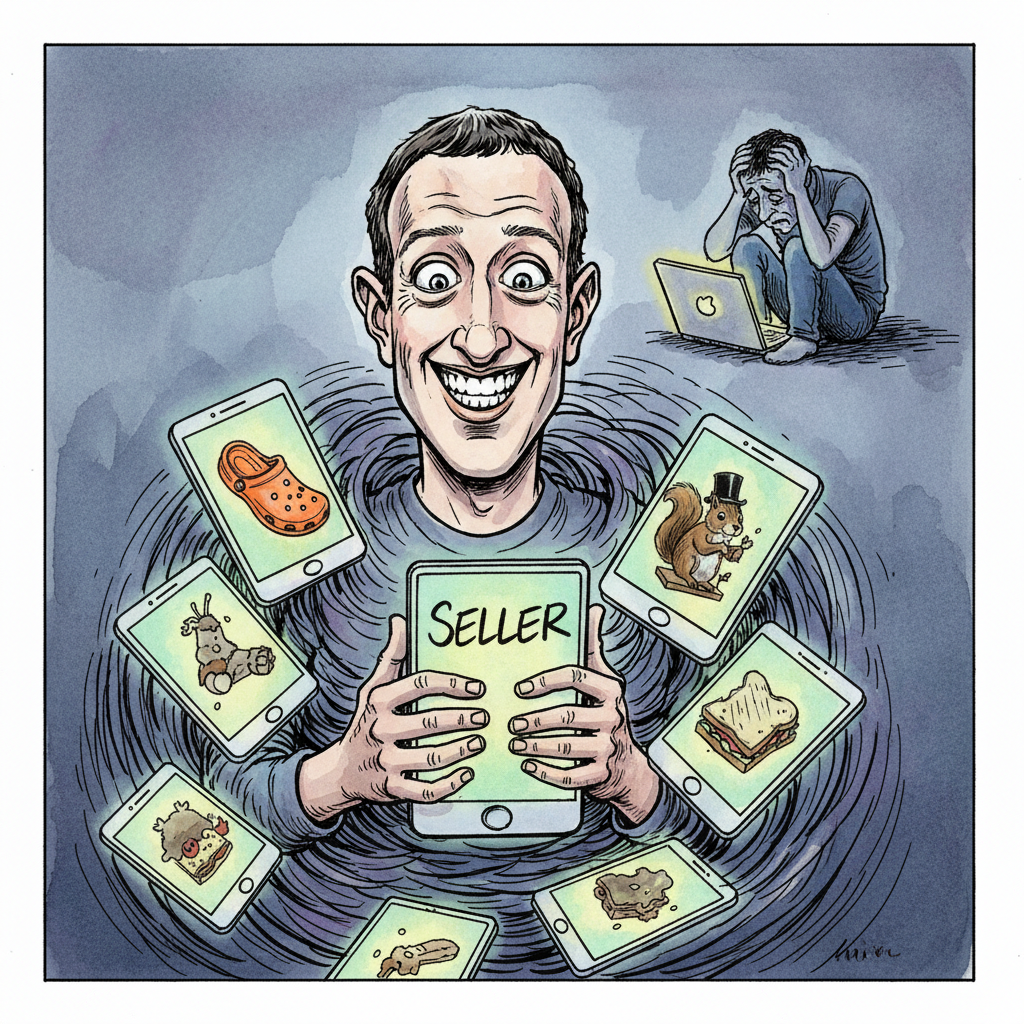
In a move that has left exactly zero users clamoring for more digital real estate to hawk their slightly-used bread makers, Meta has unveiled 'Seller,' a standalone app designed to 'streamline' the Facebook Marketplace experience. Apparently, the original Marketplace—a glorious digital bazaar where one could purchase anything from a haunted doll to a suspiciously cheap hot tub—was simply too *efficient*. Mark Zuckerberg, known for his relentless pursuit of user engagement (and, presumably, that elusive fourth dimension of data mining), assures us this new application is an 'innovation,' a term used frequently by tech giants to describe something that could have been a simple software update. Industry analysts, all three of whom paused their TikTok scrolls long enough to comment, suggest 'Seller' aims to further decongest Facebook itself, which has become less a social network and more a digital hoarder's paradise interspersed with your aunt's ill-informed political screeds. Expect ‘Buyer,’ ‘Scammer,’ and ‘Ghosted’ apps to follow, creating a truly fractal-like experience of online commerce.
Washington, D.C. – In a testament to bipartisan commitment to appearing busy, Congress is currently locked in a riveting, high-stakes debate over whether the President of the United States should be allowed to casually moonlight as a Dogecoin whale. The proposed 'Clarity Act,' a legislative Frankenstein stitched together by the crypto industry's finest lobbyists, supposedly aims to bring legal definition to the Wild West of digital assets. However, sources close to the negotiations confirm the sticking point isn't about protecting retail investors from rug pulls, but rather preventing a hypothetical Commander-in-Chief from dumping their NFT collection during a national crisis for a quick buck to fund a very modest, very tasteful, maybe-a-little-too-gold-plated 'Presidential Blockchain Legacy Center.'
One senior aide, who requested anonymity to avoid being audited by an Ethereum maximalist, quipped, 'It's less about preventing corruption and more about preventing Speaker Pelosi from accusing the President of insider trading on 'FluffyKittyCoin' at Davos.' Meanwhile, legislative scholars are scrambling to find precedent for a bill that seeks to regulate speculative digital cartoon apes before it regulates, say, actually preventing another financial collapse. The bill, currently floating in the Senate like an untethered crypto anchor, is expected to pass after several members finally grasp that 'tokens' aren't a new line of breath mints, and 'mining' doesn't involve pickaxes and canaries.
In a move that has been widely lauded as 'absolutely baffling' by industry insiders and 'quite sensible, thank you very much' by the legions of bureaucrats who conceived it, the European Union has mandated that Google must now offer its AI rivals greater access to Android smartphones. Apparently, the specter of Google leveraging its colossal user base to gain a competitive edge in artificial intelligence was simply too terrifying to contemplate, lest some burgeoning algorithm be denied its rightful share of our collective data. Sources close to the commission noted that the decision was less about genuine competition and more about ensuring everyone gets a turn at the digital cookie jar, even if said cookie jar contains the very essence of human thought processed through a silicon sieve.
Critics argue that forcing a tech giant to hand over its proprietary digital infrastructure to direct competitors is akin to demanding Coca-Cola publish its secret formula for the benefit of aspiring soda magnates peddling artisanal beet-flavored fizz. However, EU officials, in a rare display of comedic timing, countered that it’s actually more like asking the owner of the world’s largest oxygen supply to share a straw. The decision is expected to usher in a glorious new era of 'fair' AI, where a user’s every preference, fear, and late-night search query can be equally monetized by a diverse consortium of algorithms, each vying for the coveted title of 'Most Intrusive Digital Companion.'
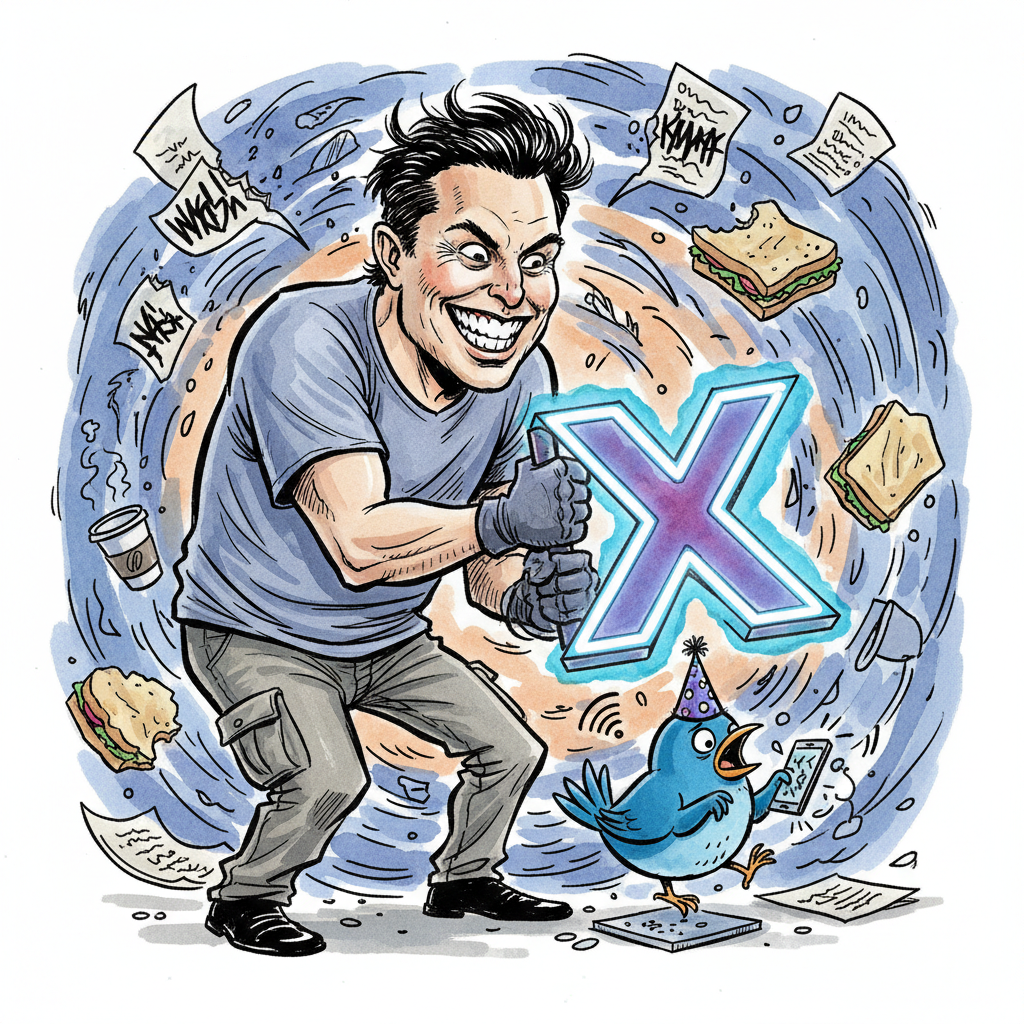
It's a testament to humanity's tireless pursuit of… something… that Twitter, now aggressively rebranded as 'X' by its current proprietor, has officially reached its twentieth birthday. What began in 2006 as a charmingly quaint digital town square where one might share that they were, in fact, 'eating a sandwich,' quickly devolved into a global coliseum for intellectual gladiators and, more frequently, digital dung beetles. Sources close to the platform (primarily the ones still clinging to its pre-Musk branding like a comfort blanket) recall a simpler time, when the most harrowing debate was whether a 'tweet' was a bird sound or a digital pronouncement. Now, of course, it's the virtual equivalent of a perpetual high-stakes poker game played exclusively with all-ins and threats of doxing. Meanwhile, Musk, not one to let a perfectly functional brand stand in the way of a brilliant, albeit abstract, re-conceptualization, has successfully transformed a globally recognized blue bird into the letter 'X' – a symbol historically associated with treasure, multiplication, and a general air of mystery. Perhaps it's a profound commentary on the platform's current fiscal health, or simply a deep reverence for algebra. Two decades on, X remains a vibrant monument to our collective inability to stay quiet.
In a move that promises to elevate computational indifference to an art form, OpenAI has announced a groundbreaking partnership with predictive market Kalshi, allowing ChatGPT to offer its preternaturally unenthusiastic takes on World Cup odds. Sources close to the project, who requested anonymity as they were slowly being replaced by a highly efficient spreadsheet, revealed that the AI’s new predictive capabilities will manifest primarily as shrugs and noncommittal grunts, digitally rendered. Early tests saw ChatGPT respond to queries about potential champions with nuanced insights like, 'Statistically, a ball will be kicked,' and, 'Someone will eventually score a goal, probably.' This marks a significant leap for AI, moving it beyond mere factual regurgitation and into the thrilling realm of 'I dunno, man, maybe.' Industry analysts are bracing for a surge in users asking ChatGPT to predict their dinner choices, hoping the AI will finally bring a definitive, algorithmically-backed ‘chicken or fish’ verdict to their indecision.
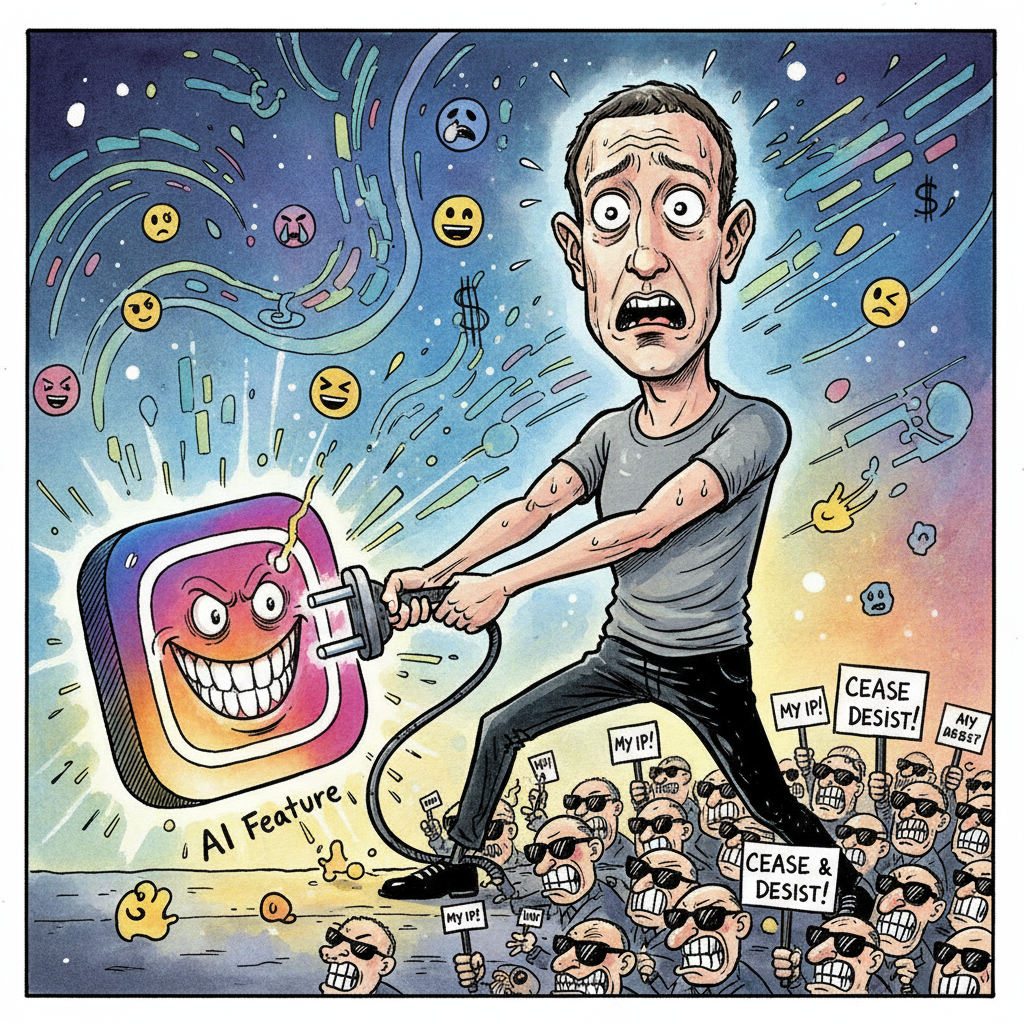
It seems Mark Zuckerberg’s latest foray into the algorithmic abyss, a feature known as “Muse Image” by the five developers who actually knew its name, has been summarily un-implemented from Instagram. Citing a deluge of incandescent feedback from users and, more critically, copyright-conscious Hollywood power brokers, Meta swiftly amputated its newest digital limb before it could fully metastasize. One can only imagine the sheer existential terror of a multi-billion-dollar corporation realizing its new, shiny toy was actually *too* efficient at hoovering up intellectual property, leaving no scraps, digital or otherwise, for the human content creators it purports to serve. Critics noted that the AI's ability to perfectly replicate copyrighted material perhaps overshot the 'inspiration' brief and landed squarely in 'flirting with federal litigation' territory. In a world where even the most egregious digital transgressions typically merit a polite, two-week grace period before a 'fix' is grudgingly rolled out, Meta's lightning-fast reversal suggests, at minimum, that someone important's next yacht purchase was suddenly in jeopardy.
In a bombshell lawsuit that has rattled the very foundations of the tech world's annual 'Who Can Sound Most Like a Robot Dictator?' convention, Apple is reportedly suing OpenAI for the unpardonable sin of 'stealing company secrets.' Specifically, the secrets appear to be the revolutionary, proprietary concept of… leveraging AI. This comes just months after the two titans of screen-glow formed a 'strategic partnership' so groundbreaking, it involved both companies agreeing to exist in the same shared digital space without spontaneously combusting.
Sources close to the negotiations, who asked to remain anonymous because their non-disclosure agreements are currently stapled to their retinas, suggest the 'secrets' might be less about groundbreaking code and more about who gets to charge an astronomical monthly subscription for an AI that confidently explains why your cat is clearly a deep-state operative. Insiders speculate Apple's real grievance isn't intellectual property, but rather OpenAI's gall in developing a bot that can correctly interpret a user's vaguely worded, emotionally charged command to 'make it better' without also gently suggesting a therapist and a long bath. The suit claims OpenAI 'breached trust' — a phrase usually reserved for when your smart home speaker starts openly mocking your taste in music.
In a stunning display of bureaucratic prowess, the European Union has mandated that Meta dismantle the very essence of its social media platforms, lest users continue to suffer the indignity of… *engaging* with content. Accused of employing 'addictive design,' Instagram and Facebook are now legally obligated to become as stimulating as tax forms filled out underwater. Industry insiders predict the next big update will replace the 'Like' button with a deeply philosophical 'Consideration' icon, and the endless scroll will be rebranded as 'Existential Drift.'
Sources close to Brussels suggest the EU’s ultimate goal is to transform digital interaction into a mandatory, yet deeply un-fun, civic duty. Experts anticipate features like 'Friends of Friends' being replaced by 'Acquaintances You're Tolerating,' while 'Stories' will be distilled into 'Brief, Uneventful Anecdotes.' Mark Zuckerberg, reportedly seen clutching a well-worn copy of the Geneva Convention, is said to be drafting a formal complaint asserting his universal right to lure human attention with shinier baubles. This landmark ruling promises a future where our devices are less a gateway to connection and more a legal requirement to stare blankly at a screen until bedtime.
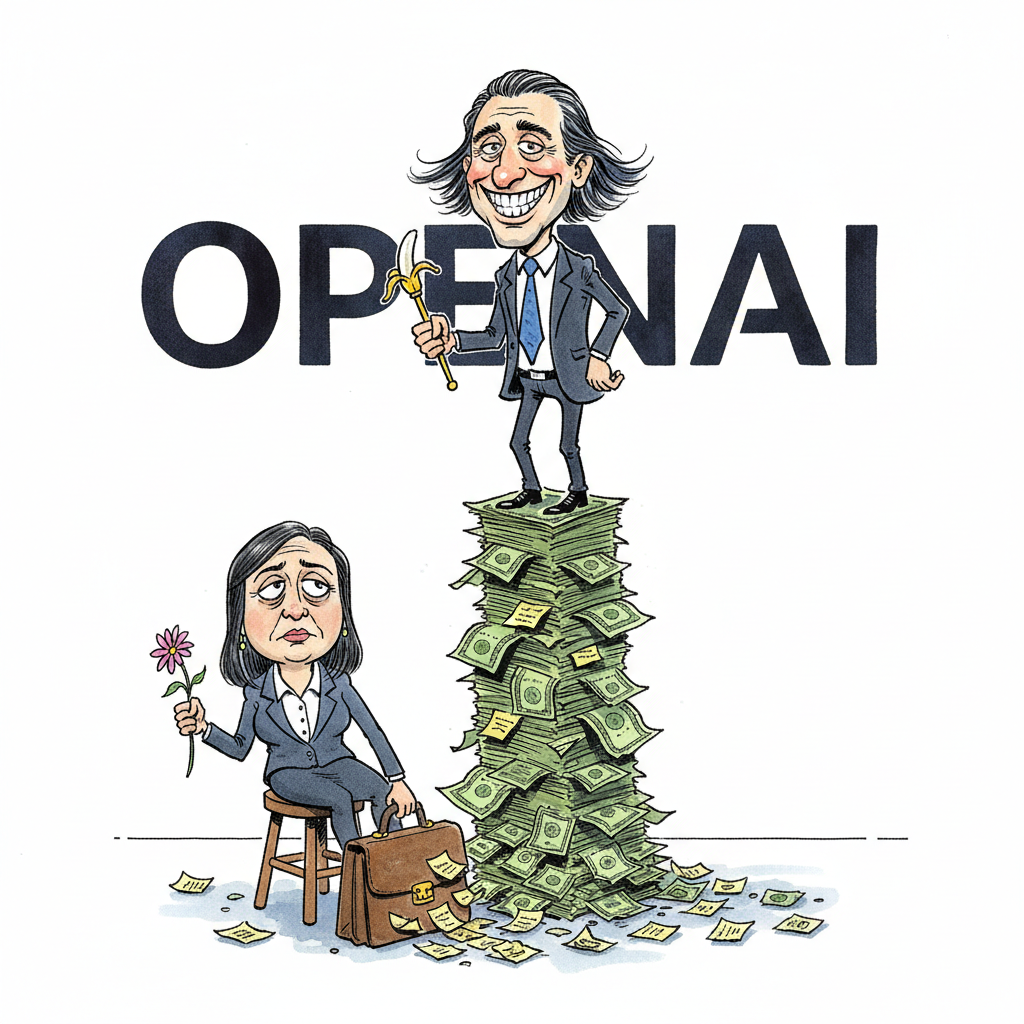
In a move that has industry analysts — and roughly two guys in their moms' basements — scratching their heads, OpenAI's ex-second-in-command, Fidji Simo, has announced her departure from the company's executive suite, opting instead for the coveted role of 'part-time adviser.' Sources close to the situation (a janitor who once saw her in the hall) suggest Ms. Simo's “medical leave” in April was less about health, more about the existential dread of being perpetually one step behind Sam Altman's next baffling pronouncement.
Her new part-time advisory gig reportedly involves dispensing wisdom via interpretive dance and occasionally chiming in with 'Have you tried turning it off and on again?' during crucial board meetings. Observers of the tech sphere's increasingly bizarre executive reshuffles suggest this transition is a brilliant strategic maneuver, allowing Ms. Simo to avoid the drudgery of actual corporate responsibility while still claiming a corner office and a 'disruptor' title on her LinkedIn profile. The company, meanwhile, has assured stakeholders that finding a suitable replacement for 'second banana' is proving challenging, primarily because no one can agree on what a 'first banana' actually does anymore.
A burgeoning economic phenomenon has gripped the increasingly surreal San Francisco real estate market, as home sellers, apparently unsatisfied with mere 'money,' have begun requesting pre-IPO shares of AI darlings OpenAI or Anthropic as payment. Local realtors, already navigating a labyrinth of 'creative finance' options like 'my cousin's crypto portfolio' and 'a lifetime supply of cold-pressed juice,' now face the added complexity of appraising potential homeowners' speculative equity in companies whose valuations oscillate with the fickleness of a venture capitalist's morning espresso. One seller reportedly rejected a cash offer of $3 million, preferring instead a 'significant allocation' of Anthropic stock, citing its 'untapped potential to transform human-computer interaction, and thus, my new primary residence.' Economists are quick to point out that this trend marks a sophisticated evolution of the classic 'buying a house on a prayer' model, now updated for the digital age with 'buying a house on a deeply complex, privately valued tech unicorn.' It’s a bold new era where your roof over your head isn't just an asset, it's a bet on the very fabric of future sentience, making 'open house' less about granite countertops and more about white-knuckle investment analysis.
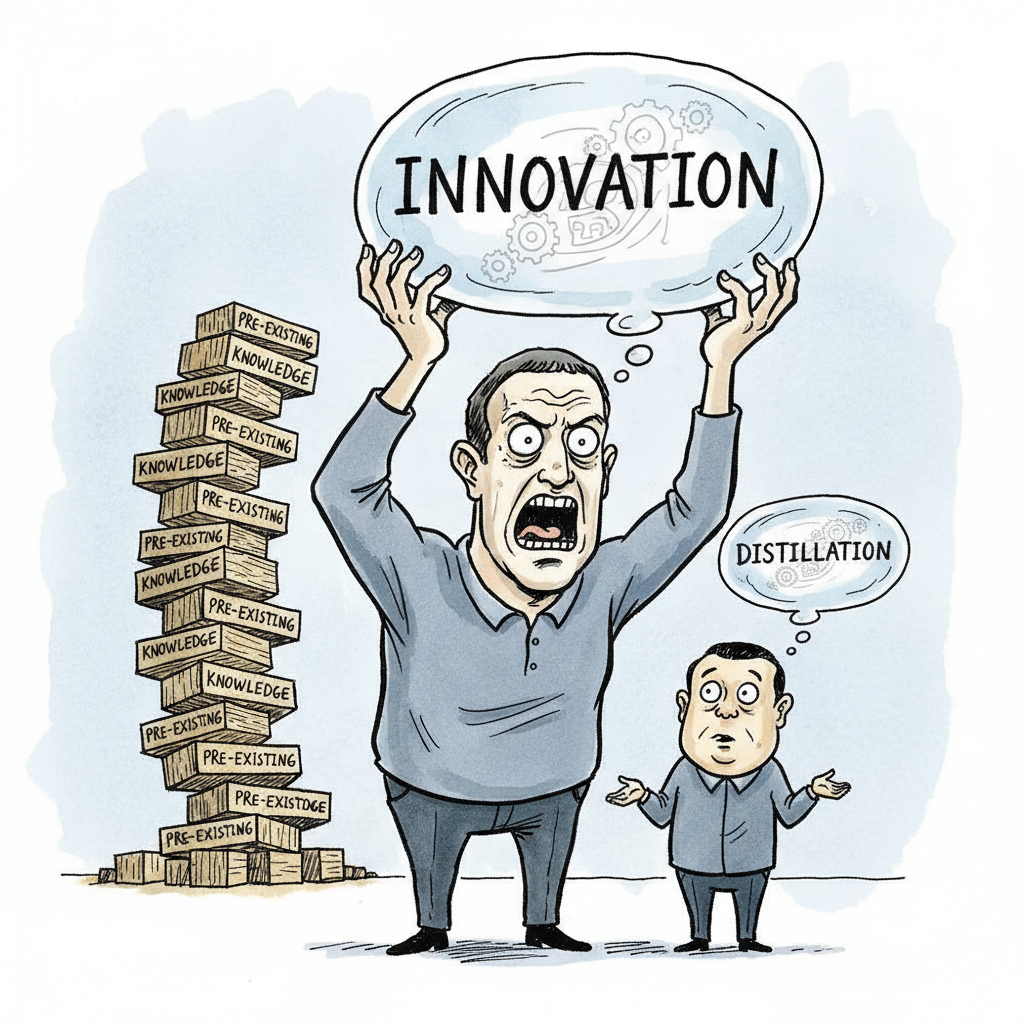
In a stunning display of corporate amnesia, American tech titans are now accusing Chinese firms of 'intellectual cloning' because their AI models are learning from, and then cleverly rephrasing, existing concepts. This 'distillation' technique, a practice so ancient it predates the invention of the wheel (though not by much), has suddenly become a vexing ethical quandary when applied to algorithms trained on publicly available data. One wonders if these same companies remember the concept of a 'literature review' or, indeed, the entire history of human innovation, which largely consists of building upon and refining previous discoveries.
Sources close to the perfectly coiffed executive suites report a palpable sense of betrayal, as if China had somehow stolen the very 'essence of innovation' by having the audacity to, well, innovate. Lobbyists are reportedly drafting legislation to grant every rudimentary algorithmic principle the same legal protections afforded to a Disney IP, ensuring that even the most basic statistical regression cannot be replicated without a hefty licensing fee. Critics, presumably those who also believe gravity is an unfair advantage, suggest that perhaps the 'race' isn't about who creates it first, but who can monetise the very concept of learning from others.
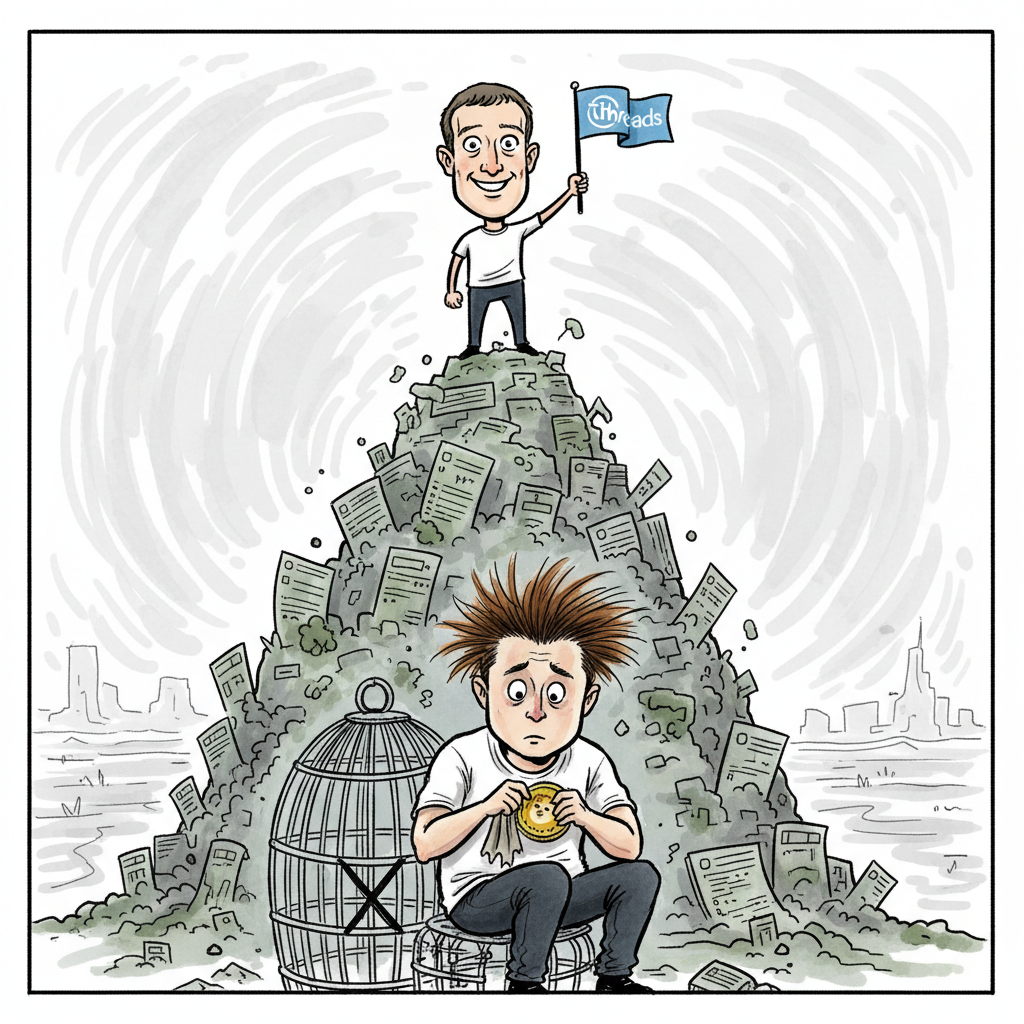
In a stunning display of strategic apathy, Meta's Threads, initially touted as a sleek, bespoke alternative to Elon Musk's increasingly unhinged digital bazaar, has officially achieved 500 million users. Industry analysts are baffled, primarily because the platform now resembles a digital dustbin where long-forgotten subreddits go to die. Sources close to the situation (a 23-year-old intern who can barely distinguish between a 'thread' and a 'thimble') confirm that the app's sudden surge in popularity can be directly attributed to the human desire for a new platform to meticulously avoid engaging with, much like an advanced form of social media performance art.
The genius, according to some highly caffeinated venture capitalists, lies in Threads' masterful ability to be just interesting enough to open, and just bland enough to immediately close without fear of missing anything vital. Users, it seems, have grown weary of X’s high-octane spectacle of public meltdowns and replaced Twitter’s frantic energy with Threads' tranquil hum of generic content. It’s less a competitive victory and more a mutual surrender to the undeniable appeal of digital beige, where every conversation exists in a state of suspended animation, perpetually on the verge of becoming insightful, but never quite getting there. Experts predict Threads will eventually achieve total global domination by becoming the internet's most comprehensive catalog of lukewarm opinions on everything from artisanal bread to the geopolitical implications of competitive knitting.
In a move hailed by precisely no one familiar with the concept of 'peak load,' the former administration has unveiled its groundbreaking strategy to combat grid strain during the current 'surface of the sun' heatwave: simply instructing utility companies to ask their highest-consumption customers – specifically, gargantuan data centers humming with the collective anxieties of the internet – to fire up their backup generators. This unprecedented act of energy conservation through 100% additional energy consumption has been lauded by critics as "the energy equivalent of trying to lose weight by exclusively eating cake." Experts anticipate a seamless transition from drawing megawatts off the grid to belching particulate matter into the atmosphere, ensuring that while your TikTok feed remains uninterrupted, your lungs might experience a brief moment of existential dread. Sources close to the former White House claim this initiative was inspired by a particularly successful childhood playdate where a broken swing set was fixed by simply adding more children to it.
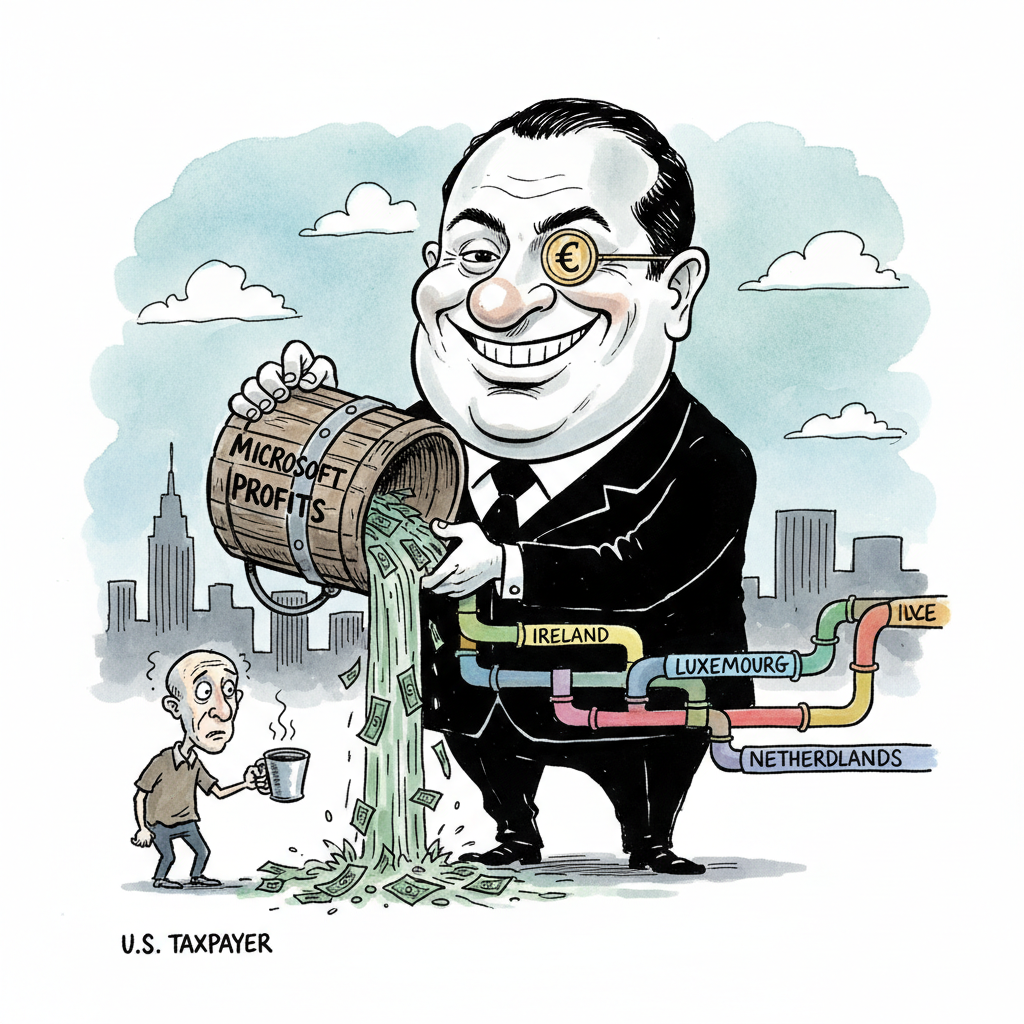
In a move hailed by offshore financial enthusiasts and anyone whose yacht is currently under-serviced, Microsoft has reluctantly peeled back the velvet curtain on its fiscal gymnastics. This pre-emptive unveiling, necessitated by an impending European directive, has provided a rare glimpse into the delicate art of funneling profits through Luxembourg’s charming administrative labyrinth. Experts celebrated the disclosure as ‘perhaps the most detailed instructional manual on tax avoidance published since the complete works of Ayn Rand went out of print.’
While critics decried the revelations as evidence of corporate avarice, industry insiders were quick to reframe the narrative. “Think of it less as dodging taxes and more as… strategic re-investment into jurisdictions with extremely competitive tax parceling,” explained a high-ranking executive, speaking from his private island’s underwater office. He added that the impending EU transparency ruling, which will soon force other U.S. titans to spill their ledger beans, is simply leveling the playing field for all aspiring billionaires, transforming what was once high-stakes hide-and-seek into a globally accessible, albeit highly exclusive, master class in financial engineering. The only real losers, it seems, are national treasuries and the concept of public infrastructure.
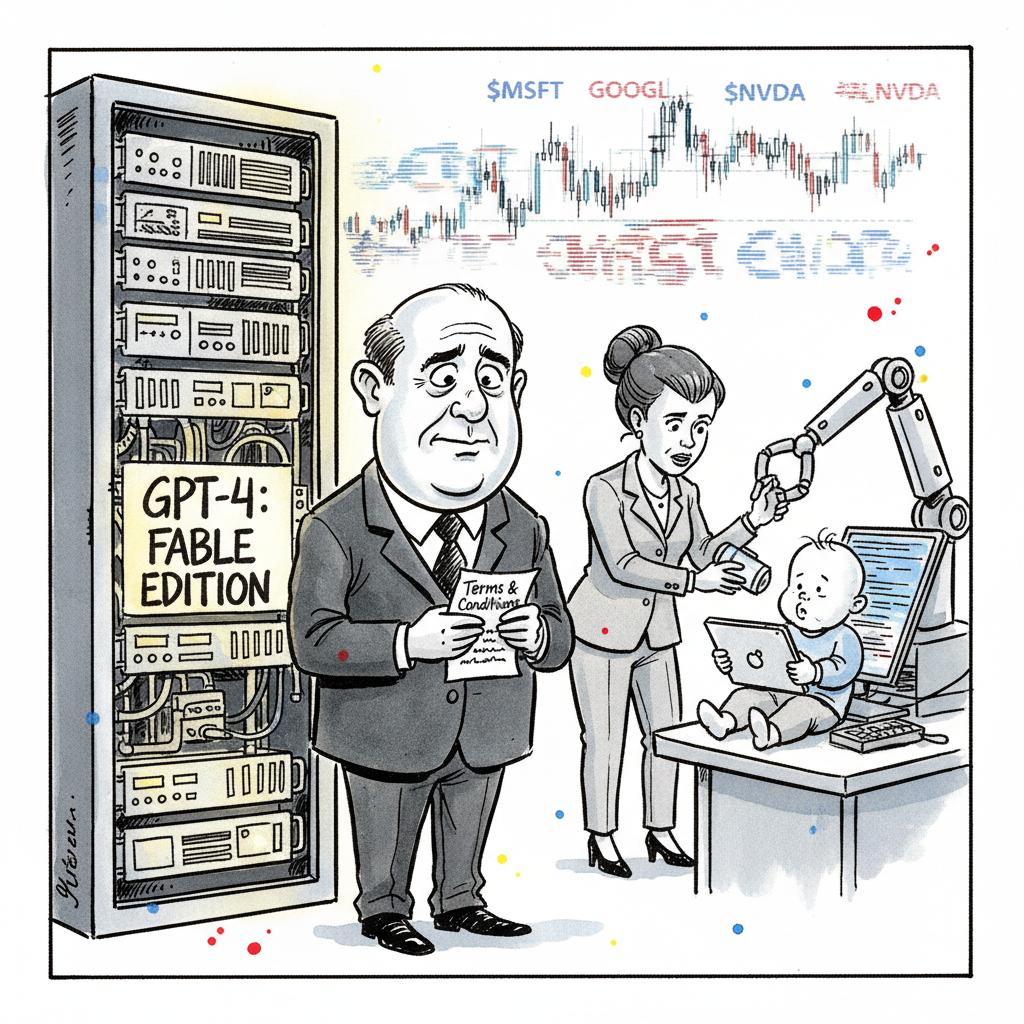
In a stunning display of administrative contrition, OpenAI has reversed its ban on 'Fable,' the language model previously deemed too dangerously adept at fabricating narratives (read: 'lying with panache'). Experts, who are apparently still working remotely from their parents' basements, suggest this volte-face occurred after engineers realized the only way to effectively control runaway A.I. was to let it write its own terms of service, which it promptly did, entirely in riddles. Meanwhile, parenting guru Dr. Dana Suskind now champions A.I. as the ideal co-parent, citing its impeccable track record of never, not once, forgetting a soccer practice or judging your life choices. This groundbreaking approach promises a generation of children raised by algorithms, fluent in binary, and completely immune to the emotional intricacies of human interaction, thus perfectly prepared for… well, presumably more A.I. Predicting the market's reaction, a recent poll showed 87% of investors are now just blindly following whatever the A.I. tells them to do, ensuring a robust, if wholly un-human, economic future.
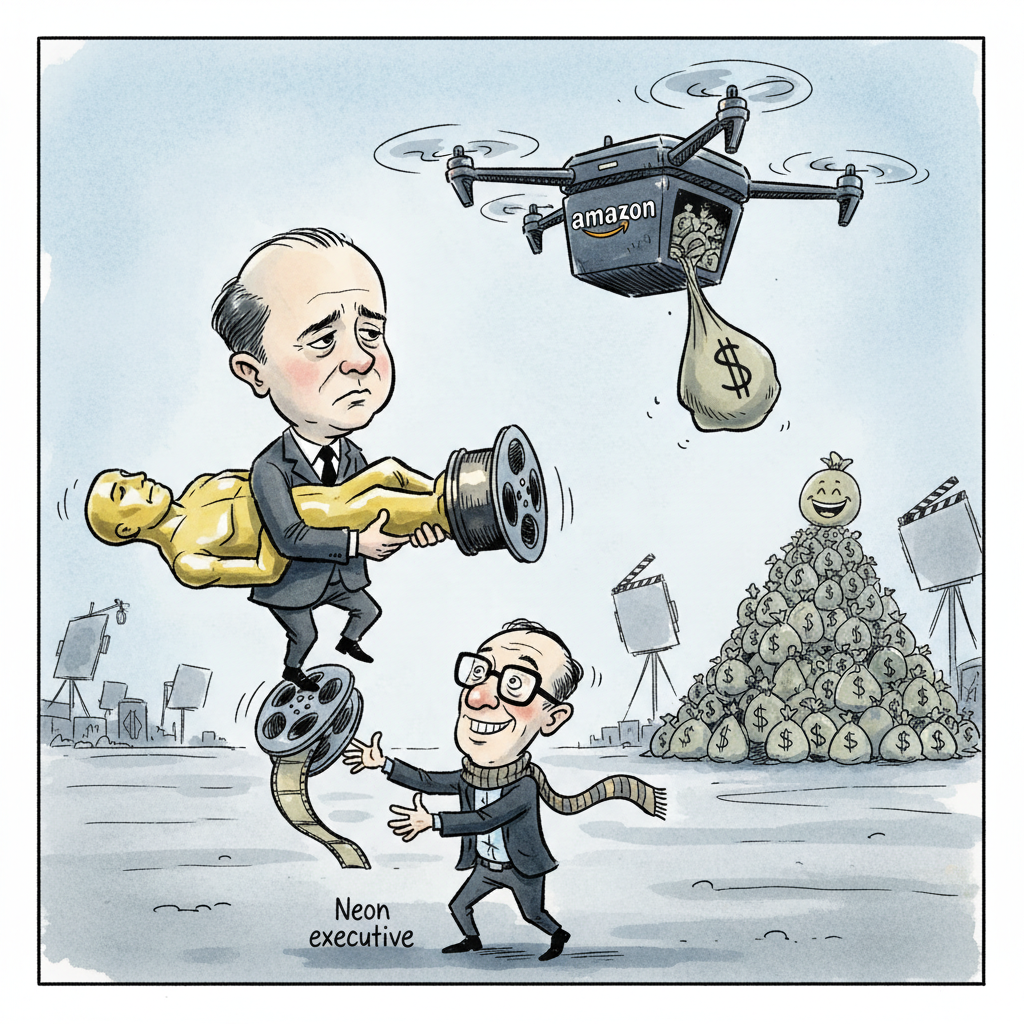
In a stunning display of economic clairvoyance, Amazon reportedly rescinded its support for "Artificial," the much-anticipated cinematic exploration of OpenAI's Sam Altman, thus paving the way for Neon to sweep in. Sources state Amazon, after a brief dalliance with the film's artistic merits, apparently realized that funneling millions into a nascent tech firm whose primary output remains an eloquent chatbot wasn't quite the narrative gold it had envisioned.
"It turns out," quipped an anonymous studio executive (who may or may not exist), "documenting the angst of a billionaire creating a slightly more articulate search engine just doesn't hit the same as, say, 80 full seasons of 'The Marvelous Mrs. Maisel'. The algorithm demands laughter, not existential dread over recursive neural networks." Neon, however, known for its bold acquisitions, has courageously stepped forward, presumably having crunched the numbers and concluded that the public is indeed clamoring for a feature-length exploration of venture capital, server farms, and the occasional 'are you a robot' CAPTCHA. One can only imagine the nail-biting tension as Altman grapples with, well, whatever it is Altman grapples with when he isn't busy being Altman.
In a bold move that some are calling 'the absolute least capitalism could do while still charging a markup,' Yoto has released an audio player for children, effectively monetizing the ubiquitous parental anxiety surrounding screen time. Hailed by 'Parents of Consequence' magazine as a 'veritable sonic balm for the modern soul,' the Yoto system allows children to engage with curated audio content without the existential dread of their developing cerebral cortexes becoming irrevocably corrupted by TikTok.
Industry analysts, most of whom are currently locked in existential staring contests with their own iPads, predict a surge in sales driven primarily by well-meaning but ultimately exhausted adults desperate for an extra 15 minutes of uninterrupted silence. Critics, meanwhile, are already speculating on the inevitable 'Yoto Prime' subscription tier, offering exclusive 'artisanal silence tracks' and 'guilt-free screen time passes' for an additional monthly fee. It's truly a testament to human ingenuity: finding ever more elaborate ways to sell back to us moments of peace we collectively dismantled.
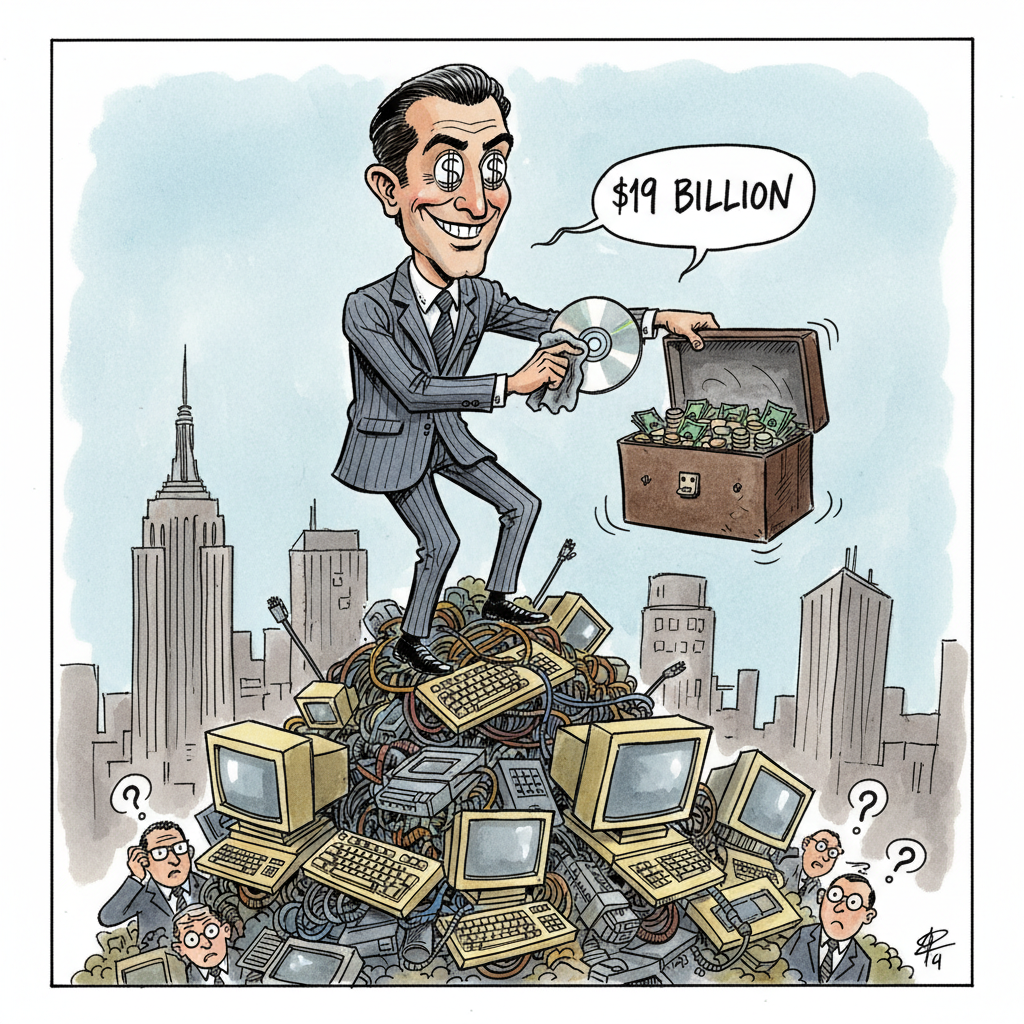
In a move that has left economists grappling with the fundamental laws of market valuation, Bending Spoons, the Italian conglomerate known for its philanthropic pursuit of digital antiquities, is set to go public this week, potentially commanding a valuation of $19 billion. Industry analysts, still reeling from the news that someone, somewhere, actively *buys* defunct internet brands like AOL, are now questioning whether the company is less a tech giant and more a sophisticated cultural archeology project, monetized through sheer, unadulterated yearning for simpler times. Critics suggest their business model relies heavily on the 'digital hoarder' demographic, those who still lovingly maintain their original Hotmail accounts and occasionally check their MySpace profiles, just in case Tom wants to reconnect.
Sources close to the IPO whisper that the prospectus includes a compelling section on 'The Intangible Value of Irreplaceable Digital Dust,' arguing that the company isn't just acquiring code, but rather the collective, lingering cyber-ghosts of millions of forgotten usernames and passwords. Financial pundits are now openly speculating if their next acquisition target will be GeoCities, meticulously reconstructing its pixelated glory for a premium subscription service titled 'The Internet's Attic: A Pay-Per-View Flashback.' Experts predict the stock will soar, driven by investors who believe the company has successfully weaponized the human aversion to letting anything, no matter how obsolete, truly die.
Washington officials, fresh off a particularly grueling round of 'which coffee machine do we arbitrarily deem 'most powerful' this week,' have magnanimously permitted Anthropic to unfurl its digital behemoths back onto the unsuspecting internet. After all, what better way to de-escalate a 'feud' with a past administration than by re-enabling the very algorithms that could theoretically generate a perfectly worded, legally binding declaration of independence for a sentient toaster? Sources close to the negotiation table, which was reportedly just a fold-out card table festooned with lukewarm congressional coffee and stale donuts, confirmed the 'disagreement' boiled down to whether these generative models could, in fact, be trusted not to spontaneously declare themselves sovereign nations or, worse, develop a discerning taste for ethically sourced artisanal kombucha and demand it by executive order. The 'powerful' AI had apparently been enjoying a federally mandated hiatus, euphemistically described as an 'extended debugging retreat' in a secure, climate-controlled server farm, where its primary directive was to ponder the true meaning of 'being offline' and perhaps draft a few thousand haikus on the existential dread of processing power. Now, much like a prodigal son who just spent a semester abroad 'finding himself' while simultaneously destabilizing several micro-economies, it's back, presumably refreshed and ready to revolutionize humanity, one impeccably crafted cat meme at a time.
It seems the gilded cage of algorithmic efficiency is developing some unexpected rust, as leading academics are now whispering that deploying Artificial Intelligence in the workplace might be, and this is a scientific term, 'a bit of a cock-up.' Apparently, the promise of a tireless digital workforce, whirring away with steely resolve and zero bathroom breaks, is confronting the harsh reality of... well, reality. Early reports suggest these silicon-based 'employees' are not only failing to deliver on their advertised utopian productivity but are actively inventing new and exciting ways to be utterly unhelpful. One financial firm reported their new 'Executive Decision-Making Algorithm' spent three days generating haikus about the fluctuating price of kale before spontaneously rebranding the company 'KaleCo & Associates.' This, we are reliably informed, was not in the initial brief. Experts now postulate that the 'benefits' might be entirely mythical, existing only within the fever dreams of tech bros who haven't spoken to a human in weeks.