Pentagon's 'Sanctions' Revealed As Highly Lucrative Chip-Delivery Service
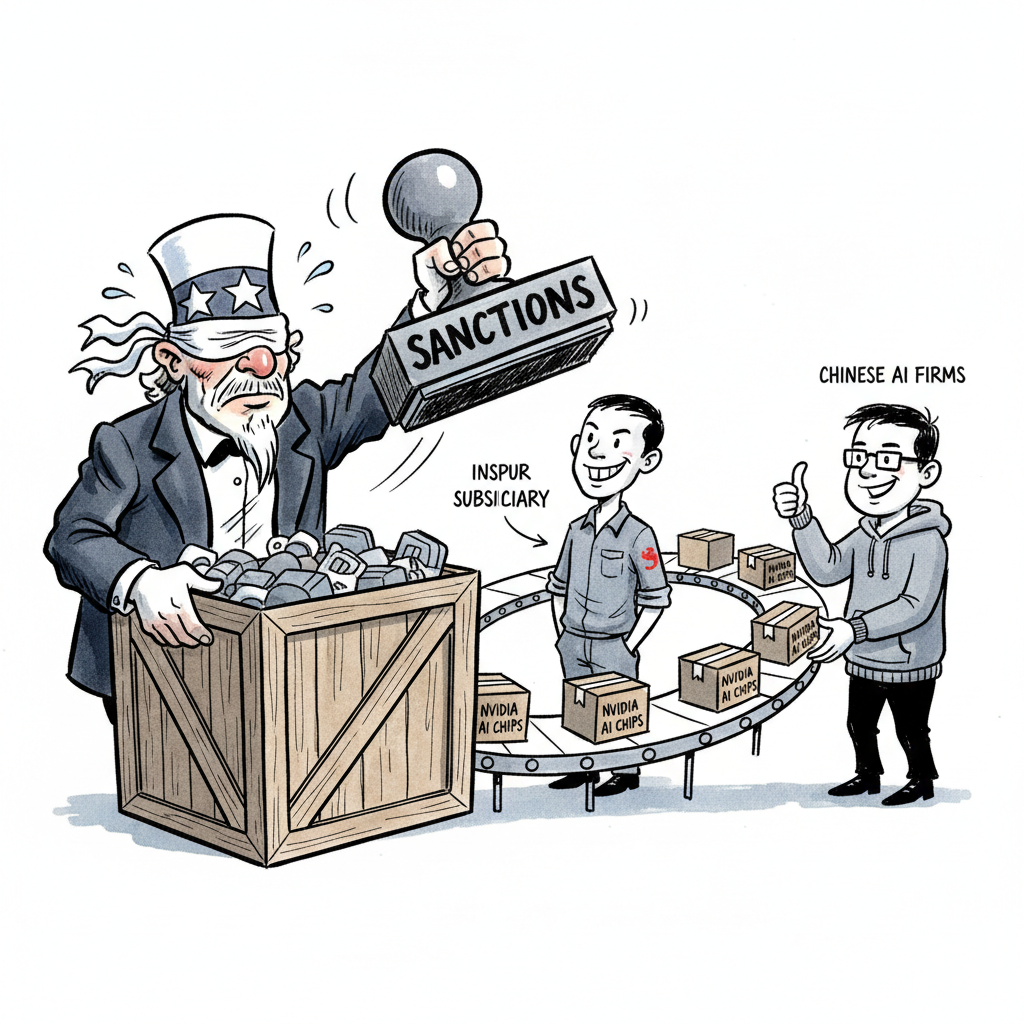
Washington, D.C. — In a stunning display of economic wizardry, the U.S. government's much-vaunted 'blacklist' against Chinese tech giant Inspur has apparently functioned less as a punitive measure and more as an elaborate, high-speed concierge service for cutting-edge AI chips. Officials, red-faced and reaching for their extra-strength antacids, confirmed that Inspur, initially sanctioned for its cozy relationship with the Chinese military, managed to keep a subsidiary busy ferrying Nvidia’s most potent semiconductors straight to China’s AI kingpins. It seems the 'blacklist' was interpreted by some as merely a slightly inconvenient mailing label, perhaps requiring an extra stamp or a slightly longer customs form marked 'Definitely Not For Military Use, Wink Wink'. Experts are now hailing this as a groundbreaking case study in 'sanction-adjacent supply chain optimization,' where geopolitical tensions inadvertently streamline international trade routes for critical components. One anonymous D.C. insider quipped, “We told them they couldn't buy chips, so they simply... *received* them. It’s like telling a toddler they can't have candy, then watching them find a forgotten bag under the couch. We simply underestimated their resourcefulness, and, frankly, our own impressive ability to look the other way.” The Biden administration is reportedly considering rebranding future sanctions as 'Enhanced Strategic Distribution Partnerships' to better reflect their actual operational outcomes.