U.S. Declares Strategic Retreat In Global Pixel-Wiggling Arms Race
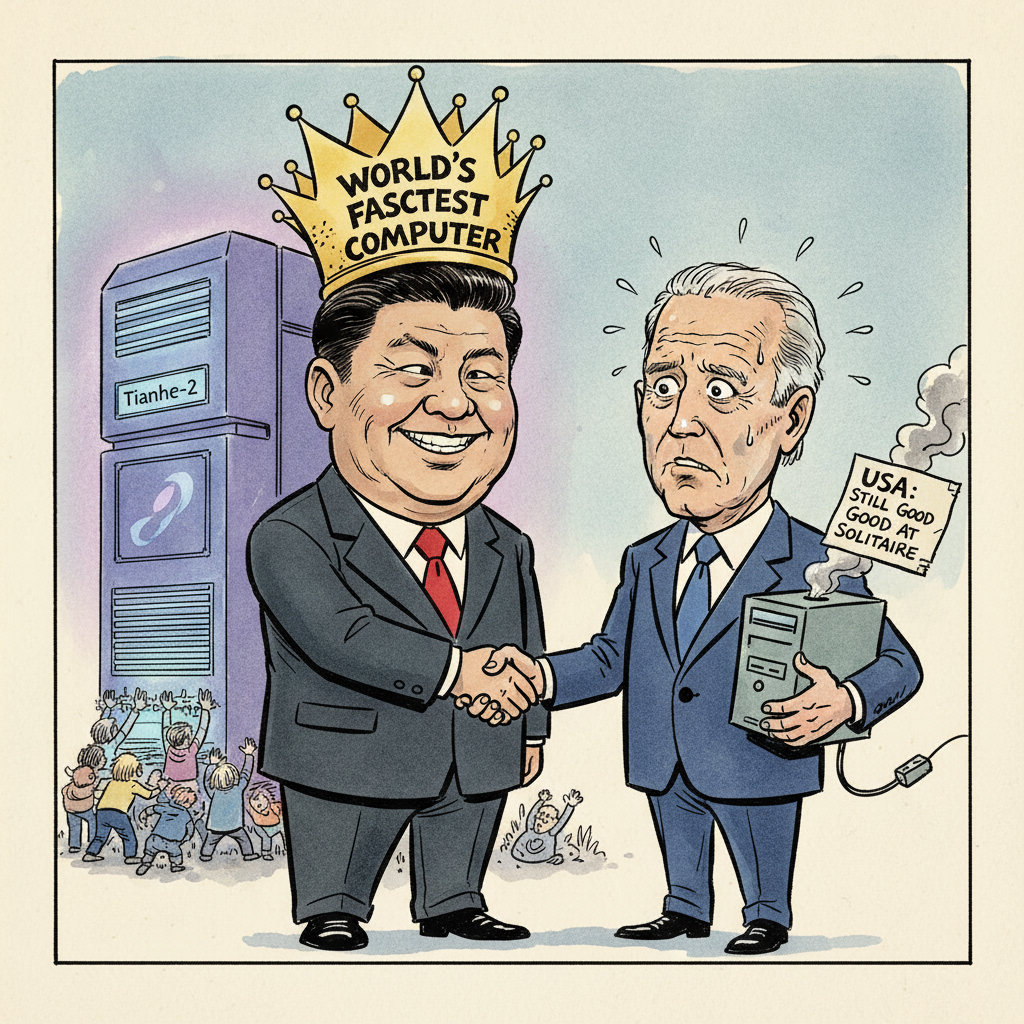
In a stunning geopolitical development that sent reverberations through the clandestine world of digital adding machines, China has successfully usurped America's long-held throne as the undisputed monarch of numerical processing speed. The 'Tianhe-2,' a supercomputer residing in Shenzhen, has been formally recognized as the fastest bundle of wires on Earth, achieving its dizzying computational feats not with the flashy, specialized graphics processing units that have become a hallmark of Western digital prowess, but with a surprising reliance on pedestrian microprocessors. Experts speculate this tactical pivot away from bespoke silicon wizardry and towards quotidian chip sets might signal a disturbing new era where raw, unadulterated processing power is no longer contingent on who has the most 'special' semiconductors. The Pentagon, reportedly caught off guard, immediately convened an emergency session to determine if this constitutes a 'digital Pearl Harbor' or merely a 'very rude surprise party for our algorithms.' Analysts are now frantically re-evaluating whether national security truly depends on a computer's ability to render extremely high-definition explosions at 120 frames per second.